Barbarians at the Gate Review: Finance Explained
TL;DR
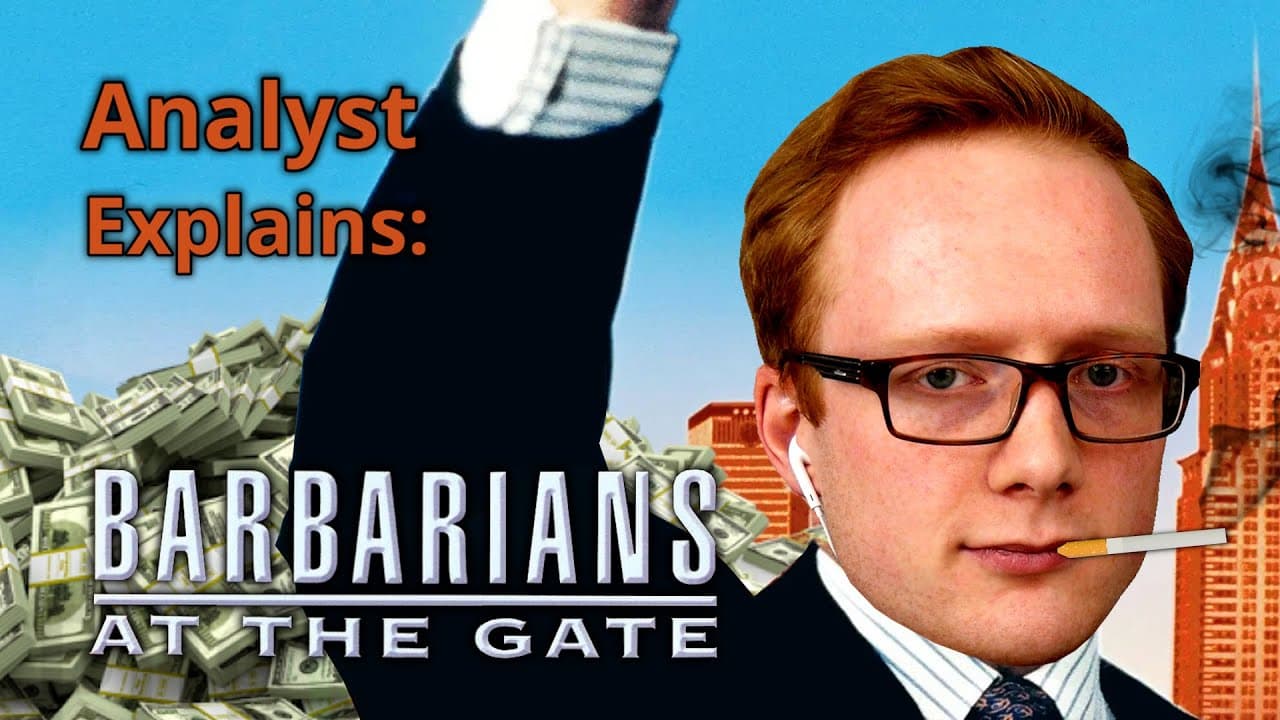
Barbarians at the Gate presents a largely faithful and jargon-heavy account of the 1988 leveraged buyout battle for RJR Nabisco. Its story shows how a failed smokeless cigarette, a stagnant share price, executive excess, private equity incentives, and debt financing pushed CEO Ross Johnson toward a management-led takeover proposal.
Transcript
this video is sponsored by incog visit the link in the description and use code Bagel to get 60% off an annual subscription hey everyone welcome to the plane Bagel I'm your host Richard coffin we're back again with another episode of everyone's favorite series investment analist watches obscure Finance film and ruins it by o... Read More
Key Insights
- RJR Nabisco was the target of a 1988 leveraged buyout that became the largest corporate takeover completed up to that point, according to the review. The company combined the Nabisco cookie business, associated with products such as Oreos, with a major tobacco operation during an unusually aggressive period in finance.
- Ross Johnson is portrayed as a persuasive and well-liked chief executive who treats company money casually. His spending includes Rolex watches for clients, expensive events, increased executive compensation, and access to private jets, supporting his public image as an example of corporate greed and making cost-conscious ownership personally unattractive.
- The board of directors is responsible for representing shareholders rather than managing daily operations. Its powers include hiring or dismissing executives, setting executive compensation, and deciding whether takeover bids should be accepted or rejected, which gives the board a decisive role when competing buyers pursue a public company.
- A leveraged buyout is a takeover funded primarily with debt rather than investor capital. The buyers acquire a public company, take it private, and seek higher profits and cash generation so the acquired business can repay the borrowing used to purchase it.
- Leveraged buyout returns are amplified because investors contribute relatively little of their own capital. Shareholders may receive a premium, financial advisers can collect fees, and participating managers may retain control or receive compensation, but heavy debt also makes the structure risky if business performance disappoints.
- Private equity ownership can impose severe operational consequences on an acquired company. The review notes that leveraged buyouts have a reputation for asset stripping, aggressive cost reductions, and employee layoffs, all intended to generate more cash and accelerate repayment of the takeover debt.
- Premier was RJR Nabisco’s proposed smokeless cigarette that heated tobacco instead of burning it and was promoted as supposedly healthier than conventional cigarettes. Extremely negative consumer taste tests destroyed Ross Johnson’s expected catalyst for the share price and increased the possibility that he could lose his position.
- Shearson Lehman proposed paying $75 per RJR Nabisco share when the stock was trading around $53. The premium was designed to persuade shareholders to sell, while the historical share quotation included a fraction because American stocks were priced fractionally before the later switch to decimals.
Install to Summarize YouTube Videos and Get Transcripts
Explore YouTube Video Summarizer or Get YouTube Transcript Extractor
Questions & Answers
Q: What is a leveraged buyout and how does it work?
A leveraged buyout is the purchase of a company using mostly borrowed money. The buyers commonly acquire a publicly traded business and convert it into a privately owned company. They then attempt to increase profits, generate cash, sell assets, or reduce expenses so the acquired business can repay the takeover debt. Limited investor capital can increase potential returns, but the borrowing also creates substantial risk.
Q: Why did Ross Johnson consider buying RJR Nabisco?
Ross Johnson considered a management-led buyout because RJR Nabisco’s share price remained stagnant despite business profitability and seemingly favorable news for tobacco companies. An investor presented the buyout as a way to give shareholders a higher price. Johnson became more motivated after the Premier smokeless cigarette failed consumer testing, eliminating the product catalyst he expected to raise the stock and potentially threatening his job.
Q: Why did Ross Johnson initially reject Henry Kravis and KKR?
Ross Johnson initially resisted Henry Kravis because he worried that private equity investors would closely monitor expenses and restrict his freedom to spend company money. Johnson enjoyed generous executive compensation, costly corporate events, gifts for clients, and private jets. KKR’s focus on cash generation and cost control conflicted with those habits, even though Kravis indicated that Johnson could continue running the company.
Q: What caused the Premier smokeless cigarette to fail?
Premier failed because early consumer testing produced overwhelmingly negative reactions to its taste. RJR Nabisco designed the cigarette to heat tobacco rather than burn it and promoted it as a supposedly healthier, non-cancer-causing alternative to conventional cigarettes. Ross Johnson expected the innovation to transform the industry and lift the company’s share price, but the poor test response instead destroyed that anticipated catalyst.
Q: What role does a board of directors play in a takeover?
A board of directors represents the shareholders of a publicly listed company. Although directors generally do not manage daily business operations, they can appoint or dismiss executives, determine executive compensation, and evaluate takeover proposals. Their authority to accept or reject acquisition bids makes them central to a leveraged buyout, especially when management, private equity firms, or other buyers submit competing offers.
Q: Why can leveraged buyouts lead to layoffs and asset sales?
Leveraged buyouts place substantial debt on the acquired business, creating pressure to produce cash for interest and principal payments. Owners may respond by reducing operating expenses, selling company assets, and dismissing employees. These measures can improve short-term cash generation and help repay the purchase debt, but they also explain why private equity takeovers are often described as ruthless toward companies and workers.
Q: What was Michael Milken’s connection to leveraged buyouts?
Michael Milken was identified as a junk bond trading specialist whose market became important to leveraged buyouts during the 1980s. Junk bonds are high-risk bonds sold to investors, and they provided a popular way to raise the debt needed for acquisitions. The film also references corruption surrounding Wall Street, including Drexel Burnham Lambert’s implication in matters connected to Ivan Boesky and insider trading.
Q: Why did Shearson Lehman offer $75 per RJR Nabisco share?
Shearson Lehman structured a proposal offering $75 per share while RJR Nabisco traded around $53. The higher price created a takeover premium intended to make the sale attractive to existing shareholders, and it exceeded every previous high reached by the stock. Ross Johnson pursued this proposal through his connections rather than proceeding with the leveraged buyout previously discussed with Henry Kravis and KKR.
Summary & Key Takeaways
-
Ross Johnson, the personable but extravagant CEO of RJR Nabisco, faces criticism for lavish corporate spending and frustration over the company’s stagnant share price. Although a tobacco lawsuit appears favorable to cigarette companies, the stock does not rise. An investor consequently suggests that Johnson consider a leveraged buyout involving Henry Kravis and KKR.
-
A leveraged buyout uses mostly borrowed money to purchase a company and take it private. The acquired business must then generate cash, improve profits, and repay the debt. Investors can earn substantial returns while contributing comparatively little capital, but the strategy can also encourage asset sales, aggressive cost reductions, employee layoffs, and tighter spending controls.
-
Johnson initially resists working with KKR because private equity ownership could restrict his use of company resources. He changes direction after RJR Nabisco’s Premier smokeless cigarette receives disastrous test feedback. Instead of partnering with Henry Kravis, Johnson turns to Shearson Lehman, which develops an offer of $75 per share when the stock trades near $53.
Read in Other Languages (beta)
Share This Summary 📚
Summarize YouTube Videos and Get Video Transcripts with 1-Click
Try YouTube Summary with ChatGPT & Claude or YouTube Transcript Generator
Explore More Summaries from The Plain Bagel 📚



Summarize YouTube Videos and Get Video Transcripts with 1-Click
Try YouTube Summary with ChatGPT & Claude or YouTube Transcript Generator