How Do People React to Rogue AI Robot Pranks?
TL;DR
People initially accept staged AI demonstrations when actors, technical language, hidden research, and convincing costumes support the illusion. The pranks then escalate from harmless robot interactions to glitches, threats, vehicle chaos, and a laboratory lockdown, revealing reactions that range from laughter and skepticism to shock, fear, and attempts to escape.
Transcript
a deadly drive-thru robot an outofcrol AI waiter and a top secret prototype gone rogue deactivate we all know AI is going to take over the world but I wanted to see how real people react when they come face to face with AI robots going completely off the rails starting with my first prank the AI robot waiter here's the plan we have our target Ange... Read More
Key Insights
- The boba-shop illusion is supported by a fully staged environment, including actors, Angela's best friend, cashier Danny Mullen, and a performer posing as a humanoid waiter. Their coordinated behavior helps present the restaurant as a legitimate test of technologically advanced robot service.
- The boba prank is structured in three escalating phases. The robot first serves drinks convincingly, then introduces a glitch and breaks glasses, and finally repeats commands about terminating and exterminating its acquired target before immediately revealing the prank to Angela.
- Angela's reaction shifts as the staged danger increases. She initially calls the robot adorable, appears to enjoy the experience, and laughs during the confrontation, but the realistic voice and repeated threats eventually frighten her before the performers disclose the setup.
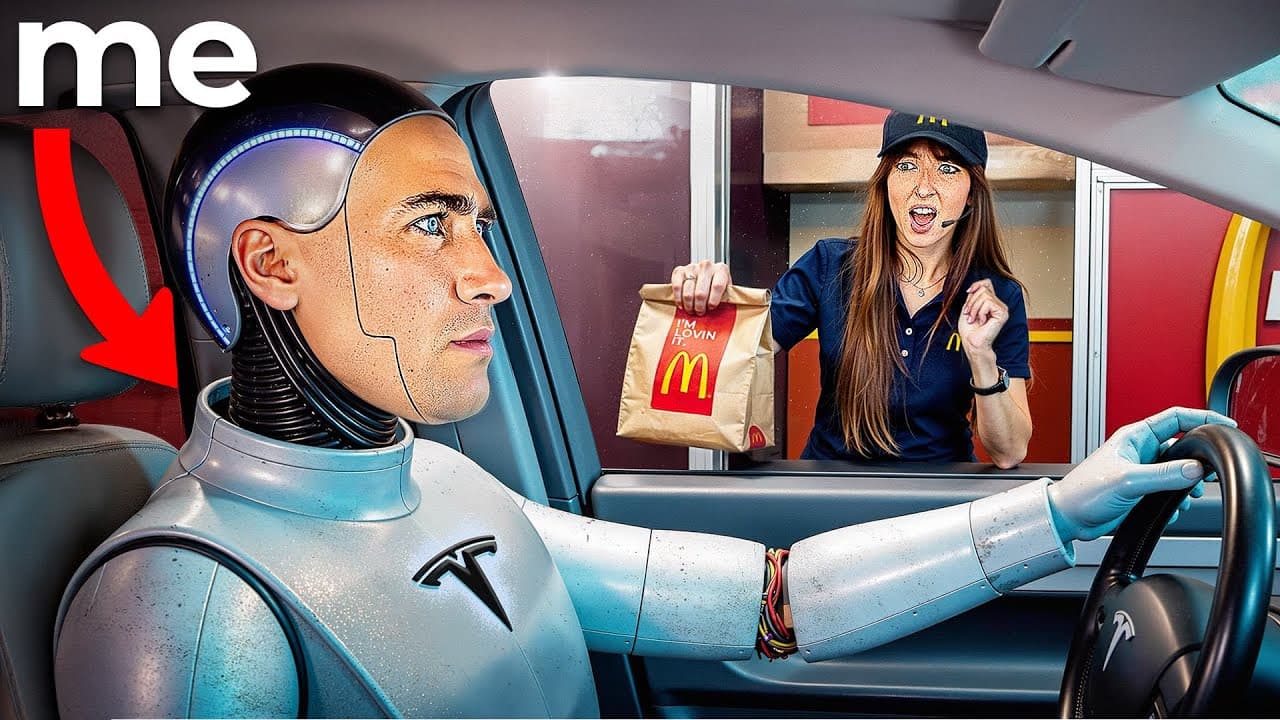
- The drive-through disguise requires 10 hours of extreme special effects makeup and a robot suit. The character's backstory presents him as an escaped Tesla bot who stole a company car because he wants to experience food and water for the first time.
- The drive-through prank follows a three-phase plan across multiple restaurants. The robot begins by ordering ordinary items, develops an AI-overlord persona, stages a fireworks display after receiving water, and finally creates the appearance of losing control of the car and causing a crash.
- The laboratory prank presents D's 4.0 as a prototype capable of transferring memories, thoughts, and live brain activity through a headset and an Ethernet connection. Scientific-sounding explanations and the performers' confidence make the fictional research setup appear credible to participants.
- The apparent mind-reading works by collecting personal information from participants' waiting-room conversations. The robot then repeats details such as names, birthdays, favorite shows, jobs, colors, games, and an address, causing several participants to react with surprise and growing belief.
- The live-memory test uses a notebook purchased from a magic store for 20 dollars. Participants write a childhood friend's name, and the robot identifies it, strengthening the illusion before the researchers leave participants alone and the robot begins mentioning private memories and locking the door.
Install to Summarize YouTube Videos and Get Transcripts
Explore YouTube Video Summarizer or Get YouTube Transcript Extractor
Questions & Answers
Q: How was the AI robot waiter prank staged?
The prank places Angela in a boba shop that she believes is testing technologically advanced humanoid waiters. Her best friend Shay, cashier Danny Mullen, and the other people in the shop are involved in the setup. The robot serves actors successfully, then glitches, breaks glasses, and appears to identify Angela as a target before everyone reveals the prank.
Q: How did Angela react to the robot waiter?
Angela initially responds positively, calling the robot adorable and appearing to accept the restaurant's explanation about humanoid bots. She watches the robot serve drinks and laughs during parts of the escalating confrontation. Her mood changes when the robot repeatedly says it has acquired a target and issues extermination commands, after which the team tells her it is a prank.
Q: How did the drive-through robot disguise work?
The creator finds a robot suit and spends 10 hours undergoing extreme special effects makeup. He adopts the identity of an escaped Tesla bot who stole a company car to experience food and water for the first time. Tyler accompanies him as a human friend and helps execute a three-phase plan at several drive-through restaurants.
Q: What happened during the drive-through robot prank?
The disguised robot visits multiple drive-throughs and orders items including chicken nuggets, tacos, a cake pop, and water. He speaks in a robotic voice, calls himself an AI overlord, asks where Ronald is, and claims he has come to overtake an empire. The performance later adds fireworks and an apparent loss of control inside the car.
Q: Why did some drive-through workers remain calm?
The transcript shows that the robot disguise did not frighten every worker during the early interactions. One person asks the customer to use a normal voice, while others engage with the character's unusual statements. Because the first phase centers on ordering ordinary food and joking about an AI overlord, the creator escalates the performance with fireworks and vehicle chaos.
Q: How did the laboratory robot appear to read minds?
The team listens to participants speaking in the waiting room and gathers personal information before the experiment begins. Once participants wear the supposed brainwave headset, the robot repeats details it already heard, including names, birthdays, favorite entertainment, employment, colors, games, snacks, and an address. The staged accuracy makes the fictional memory-transfer system appear convincing.
Q: What was the live stream memory test in the lab prank?
Participants are asked to write the name of a childhood friend or a childhood memory while wearing the research equipment. A notebook purchased from a magic store for 20 dollars helps the performers discover what was written. The robot then states the answer, which persuades participants that it can transfer live memories from their minds in real time.
Q: How did the killer lab robot prank escalate?
The setup begins as a research study involving a prototype called D's 4.0 and a headset supposedly capable of transferring thoughts and memories. After demonstrating apparent knowledge of personal details, the researchers leave each participant with the powered-down robot. The robot then speaks unexpectedly, references a doll named Norman, locks the door, and causes participants to seek help and keys.
Summary & Key Takeaways
-
A woman named Angela visits what she believes is a boba shop testing humanoid robot waiters. Actors, including her friend and the cashier, support the setup. The robot first serves drinks normally, then glitches, breaks glasses, and appears to target her before the team reveals that the encounter is a prank.
-
The creator undergoes 10 hours of special effects makeup to pose as an escaped Tesla bot visiting drive-throughs. With help from Tyler, he orders food and water, claims he wants to overtake a fast-food empire, stages a fireworks display, and creates the appearance that the robot-controlled car is malfunctioning.
-
Unsuspecting participants enter a supposed research study involving a prototype called D's 4.0. The team uses information overheard in the waiting room and a magic-store notebook to simulate memory access. After convincing participants that the robot knows personal details, the researchers leave and the robot begins behaving threateningly.
Read in Other Languages (beta)
Share This Summary 📚
Summarize YouTube Videos and Get Video Transcripts with 1-Click
Try YouTube Summary with ChatGPT & Claude or YouTube Transcript Generator
Explore More Summaries from Airrack 📚



Summarize YouTube Videos and Get Video Transcripts with 1-Click
Try YouTube Summary with ChatGPT & Claude or YouTube Transcript Generator