Area of a Triangle, Given 3 Sides, Heron's Formula
TL;DR
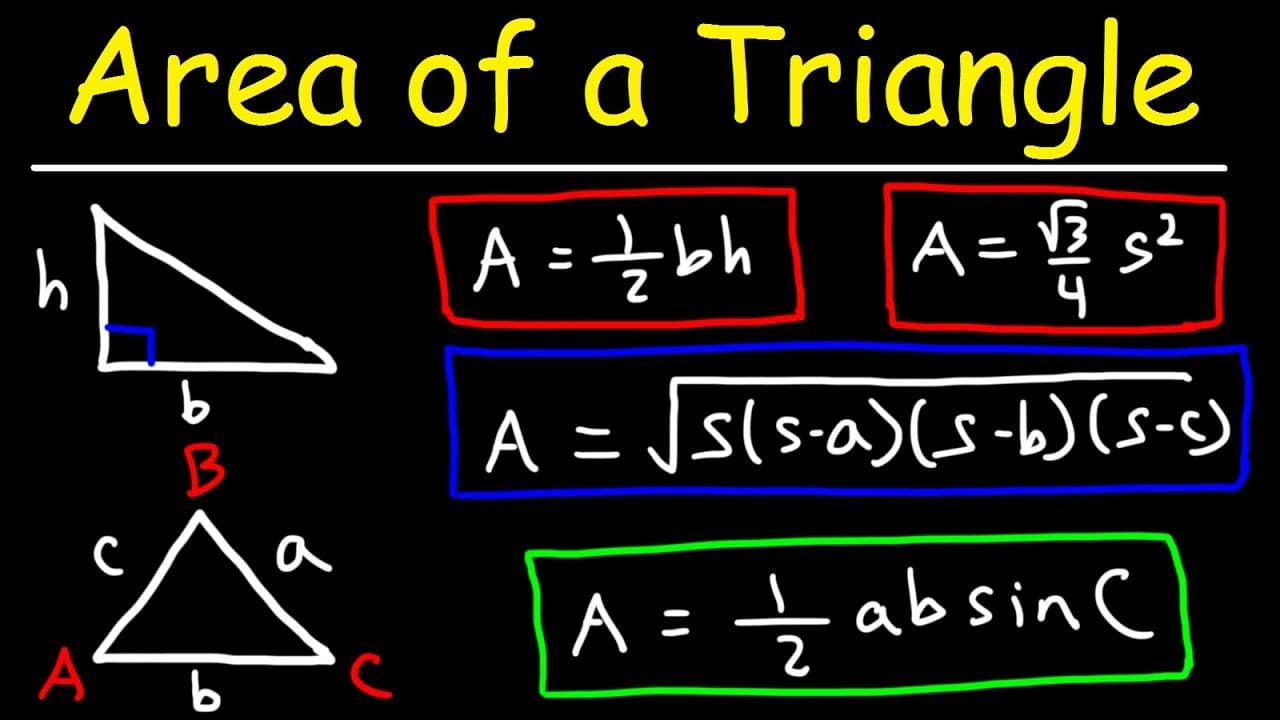
This video explores different methods to find the area of a triangle using formulas and concepts such as base, height, Pythagorean theorem, equilateral triangles, and Huron's formula.
Transcript
in this video we're going to focus on the many different ways of finding the area of a triangle so in our first example let's say that we have a right triangle let's say the base is 10 and the height is 12. go ahead and find the area so the first thing you need to know is the formula for use for any right triangle or any triangle that you know the ... Read More
Key Insights
- 🗯️ The area of a right triangle can be found using A = 1/2 * base * height.
- 🔺 For an isosceles triangle, splitting it into two right triangles allows for finding the height and calculating the area.
- ⚾ The area of an equilateral triangle can be found using A = (√3 / 4) * s^2 or by finding the height and applying A = 1/2 * base * height.
- 🚄 The formula A = 1/2 * a * b * sin(c) can be used to find the area of a triangle with two known sides and the included angle.
Install to Summarize YouTube Videos and Get Transcripts
Explore YouTube Video Summarizer or Get YouTube Transcript Extractor
Questions & Answers
Q: How can you find the area of a right triangle?
To find the area of a right triangle, use the formula A = 1/2 * base * height. In the given example with a base of 10 and height of 12, the area is 60 square units.
Q: How can you find the area of an isosceles triangle?
For an isosceles triangle, you can split it into two right triangles. Use the Pythagorean theorem to find the missing side, then apply the formula A = 1/2 * base * height. In the example with a base of 8, the height is found to be 3, resulting in an area of 12 square units.
Q: What is the formula to find the area of an equilateral triangle?
For an equilateral triangle, you can use the formula A = (√3 / 4) * s^2, where s is the length of a side. Alternatively, you can find the height and use the formula A = 1/2 * base * height. In the example, the area is calculated as 25√3 square units.
Q: How can you find the area of a triangle with two known sides and the included angle?
Use the formula A = 1/2 * a * b * sin(c), where a and b are the two sides and c is the included angle. In the given example, with side a = 15, side b = 10, and angle c = 30 degrees, the area is 37.5 square units.
Summary & Key Takeaways
-
The video demonstrates finding the area of a right triangle using the formula A = 1/2 * base * height.
-
It explains how to find the area of an isosceles triangle by splitting it into two right triangles and using the Pythagorean theorem.
-
The video showcases two approaches to find the area of an equilateral triangle: using the formula A = (√3 / 4) * s^2 or finding the height and using A = 1/2 * base * height.
-
It introduces the formula A = 1/2 * a * b * sin(c) to find the area of a triangle with two known sides and the included angle.
-
The video concludes with the use of Huron's formula to find the area of a triangle with three different sides.
Read in Other Languages (beta)
Share This Summary 📚
Summarize YouTube Videos and Get Video Transcripts with 1-Click
Try YouTube Summary with ChatGPT & Claude or YouTube Transcript Generator
Explore More Summaries from The Organic Chemistry Tutor 📚




Summarize YouTube Videos and Get Video Transcripts with 1-Click
Try YouTube Summary with ChatGPT & Claude or YouTube Transcript Generator