How to Calculate the Center of Mass in Physics Problems
TL;DR
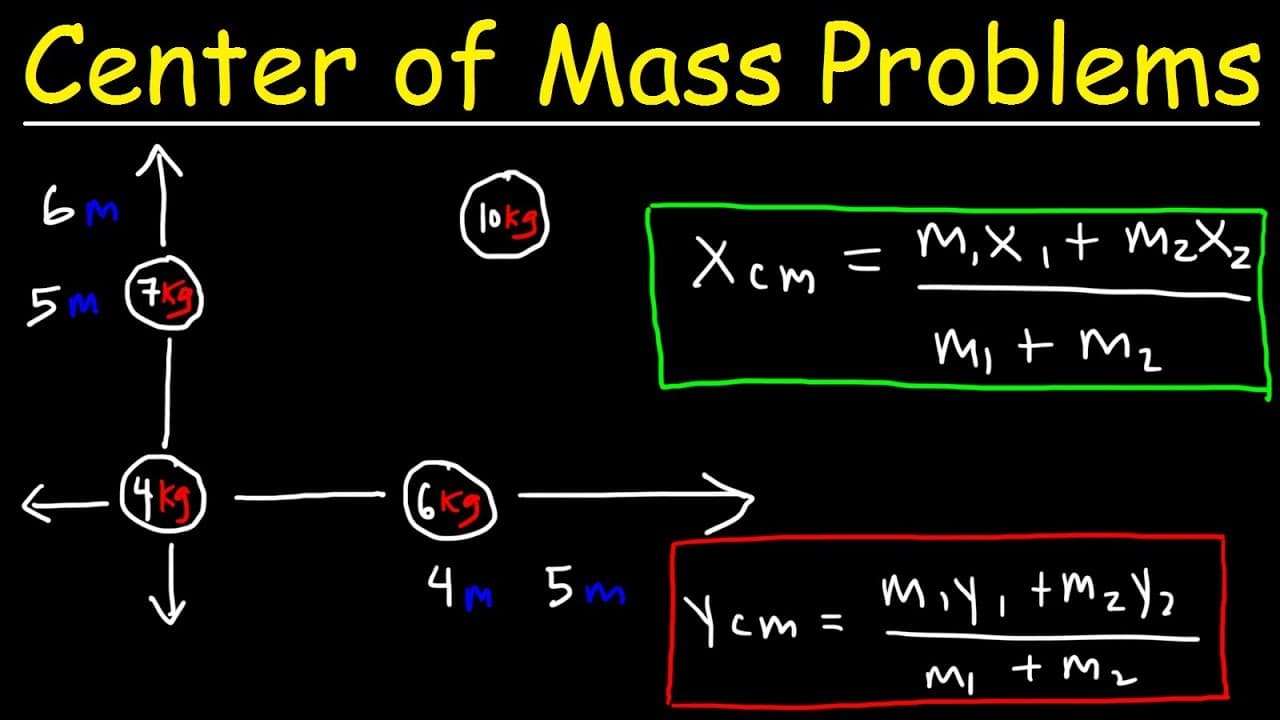
To calculate the center of mass, use the equation: (m1 * x1 + m2 * x2) / (m1 + m2), which determines the weighted average position of the objects based on their masses and distances. For multiple objects, apply the same principle using their corresponding coordinates and combine to find the overall center of mass.
Transcript
a five kilogram mass placed at the origin and a nine kilogram mass is placed at x equals two meters where is the center of mass so let's draw a picture so here's the five kilogram mass and this is going to be the 9 kilogram mass so this is at position 0 with respect to the origin and this is at x equals two so where do you think the center of mass ... Read More
Key Insights
- 💆 The center of mass is influenced by the mass and position of objects.
- 💆 The more massive an object, the greater its contribution to the center of mass.
- 💆 The center of mass can be calculated using the equation (mass1 * position1 + mass2 * position2) / (total mass).
- 😚 Placing an object closer to the more massive one will shift the center of mass towards it.
- 💆 Multiple masses can be considered in the center of mass calculation by summing their contributions using their respective positions and masses.
- 💁 The center of mass provides crucial information for understanding the balance and stability of objects and systems.
- 👻 Calculating and manipulating the center of mass allows for controlling the distribution of weight and optimizing stability.
Install to Summarize YouTube Videos and Get Transcripts
Explore YouTube Video Summarizer or Get YouTube Transcript Extractor
Questions & Answers
Q: How is the position of the center of mass determined when mass is distributed in different locations?
The position of the center of mass is determined by weighing the mass at each location and considering its distance from the origin. The more massive objects have a greater influence on the center of mass.
Q: What is the formula to calculate the position of the second mass for a specific center of mass location?
The formula is (mass2 * position2) = (center of mass * total mass) - (mass1 * position1). This allows us to find the placement of the second mass to achieve the desired center of mass location.
Q: How do we calculate the center of mass for a system with multiple masses?
For the x-coordinate, use the equation (m1 * x1 + m2 * x2 + m3 * x3 + m4 * x4) / (total mass). For the y-coordinate, use the equation (m1 * y1 + m2 * y2 + m3 * y3) / (total mass).
Q: Why is it important to calculate the center of mass?
Calculating the center of mass helps determine the balancing point of an object or system and is crucial in understanding stability, equilibrium, and rotational motion.
Summary & Key Takeaways
-
The center of mass is located closer to the more massive object.
-
To calculate the center of mass, use the equation: (mass1 * position1 + mass2 * position2) / (total mass).
-
To determine the position of the second mass for a specific center of mass location, use the equation: (mass2 * position2) = (center of mass * total mass) - (mass1 * position1).
-
To calculate the center of mass for a system with multiple masses, use the equations: (m1 * x1 + m2 * x2 + m3 * x3 + m4 * x4) / (total mass) for the x-coordinate, and (m1 * y1 + m2 * y2 + m3 * y3) / (total mass) for the y-coordinate.
Read in Other Languages (beta)
Share This Summary 📚
Summarize YouTube Videos and Get Video Transcripts with 1-Click
Try YouTube Summary with ChatGPT & Claude or YouTube Transcript Generator
Explore More Summaries from The Organic Chemistry Tutor 📚



Summarize YouTube Videos and Get Video Transcripts with 1-Click
Try YouTube Summary with ChatGPT & Claude or YouTube Transcript Generator