Is China About to Pop the AI Bubble and Undermine US Tech Dominance?
TL;DR
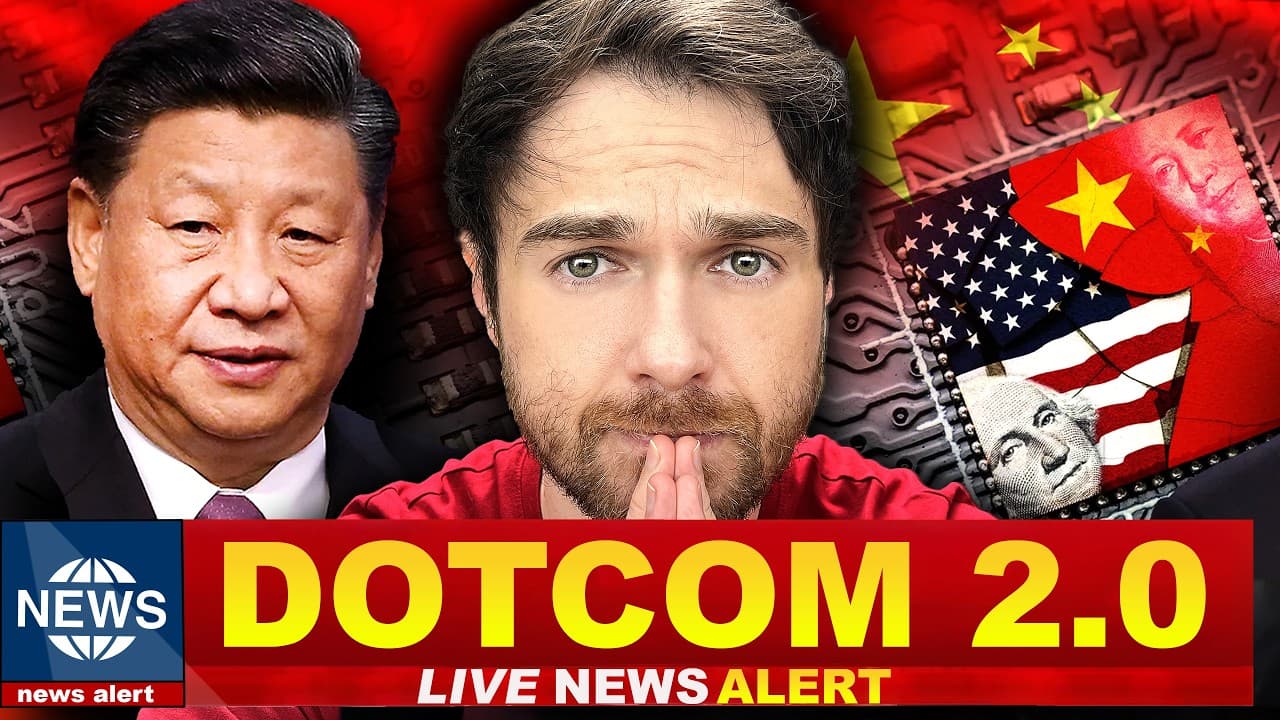
China could undermine US tech dominance by offering competitive AI models at far lower prices while the US spends $1 trillion annually on AI, about 3% of its economy. The page argues that token-based pricing, hallucinations, undisclosed AI revenue, and costs that rise with usage weaken the industry's profitability story. Read on to understand how cheaper Chinese models and changing international trust could expose the AI bubble.
Transcript
So the whole US stock market including your 401k, your index funds and the value of your retirement is based on a story that might be coming to an end. >> You mentioned earlier the dot bubble. Are we doing bubble 2.0 right now? >> Oh, this is much bigger. The AI the AI buildout relative to the TMT buildout of 992000 is multiples even as a percent o... Read More
Key Insights
- The US is investing heavily in AI, with spending reaching $1 trillion annually, which is 3% of its economy.
- China is spending significantly less on AI, yet producing competitive models that are much cheaper.
- Many US tech companies are not disclosing AI revenue, possibly indicating financial instability.
- AI's business model is broken as costs increase linearly with revenue, unlike traditional software models.
- China uses a method called distillation to create AI models by studying existing models, reducing costs.
- The bond market's low credit spreads suggest either confidence in AI or a potential oversight of risks.
- AI companies face challenges with trust and profitability, as their business models are not sustainable long-term.
- The AI market's sustainability is questioned due to China's cheaper alternatives and US companies' undisclosed revenues.
Install to Summarize YouTube Videos and Get Transcripts
Explore YouTube Video Summarizer or Get YouTube Transcript Extractor
Questions & Answers
Q: Is China about to pop the AI bubble?
China could help pop the AI bubble by producing competitive AI models while spending a fraction of what the US spends and offering alternatives that are 7 to 12 times cheaper. That competition challenges expectations that American companies will earn trillions of dollars in profits because the world must use US technology.
Q: How does China's AI strategy threaten US tech dominance?
China focuses on cost-effective AI models rather than matching the scale of US spending. By offering competitive technology at much lower prices, it gives businesses and countries an alternative to expensive American AI services.
Q: How much is the US spending on AI?
The US is spending $1 trillion a year building AI, according to the page. That equals about 3% of the entire US economy and is described as a larger buildout, relative to the economy, than the 1999–2000 technology, media, and telecommunications buildout.
Q: Why are countries reconsidering their dependence on US AI companies?
The transcript says Anthropic was ordered to cut off two powerful Claude models from foreign nationals, including people from France, Germany, and Japan. France's prime minister then warned against depending on partners capable of “turning off the tap,” while Germany, Spain, and Britain also moved away from such dependence.
Q: Why does token-based AI pricing raise doubts about its value?
AI companies charge for token usage, meaning customers pay for the words a model reads and writes whether its answer is useful or poor. Alex Karp argues that truly valuable AI could instead charge only when it produces a profitable result, such as taking 30% of the revenue from a billion-dollar business idea.
Q: How do hallucinations weaken the AI business case?
AI models can hallucinate, meaning they confidently make things up. The transcript says even their builders cannot reliably predict why hallucinations happen or completely fix them, making it difficult to promise customers payment based only on successful results.
Q: How does AI's business model differ from traditional software?
The page says AI costs increase with usage because providers continually incur expenses such as electricity and hardware wear. Traditional software can keep serving customers after its initial development without the same linear increase in operating costs, giving it a stronger path to profitability.
Q: What warning signs could indicate that the AI bubble is starting to pop?
The page identifies reduced capital expenditures, disclosed financial inefficiencies, undisclosed AI revenue, and pressure from cheaper Chinese alternatives as warning signs. A major company's spending pullback could trigger a broader reassessment of whether the industry's current investment and profitability expectations are sustainable.
Summary & Key Takeaways
-
China is leveraging cost-effective AI models to challenge the US, potentially disrupting the profitability of US tech giants. While the US invests heavily in AI, China's strategic approach offers competitive models at a fraction of the cost, raising questions about the sustainability of the US's AI market dominance.
-
US tech companies are heavily investing in AI without transparent revenue reporting, raising concerns about the industry's financial viability. China's ability to produce cheaper AI models could undermine the US's market position, as businesses prioritize cost-effectiveness over cutting-edge technology.
-
The AI market faces critical challenges as China's affordable AI models threaten the US's high-cost investments. The industry's future depends on its ability to adapt to these competitive pressures, as the current business model's sustainability is increasingly questioned amid undisclosed revenues and financial instability.
Read in Other Languages (beta)
Share This Summary 📚
Summarize YouTube Videos and Get Video Transcripts with 1-Click
Try YouTube Summary with ChatGPT & Claude or YouTube Transcript Generator
Explore More Summaries from Andrei Jikh 📚



Summarize YouTube Videos and Get Video Transcripts with 1-Click
Try YouTube Summary with ChatGPT & Claude or YouTube Transcript Generator