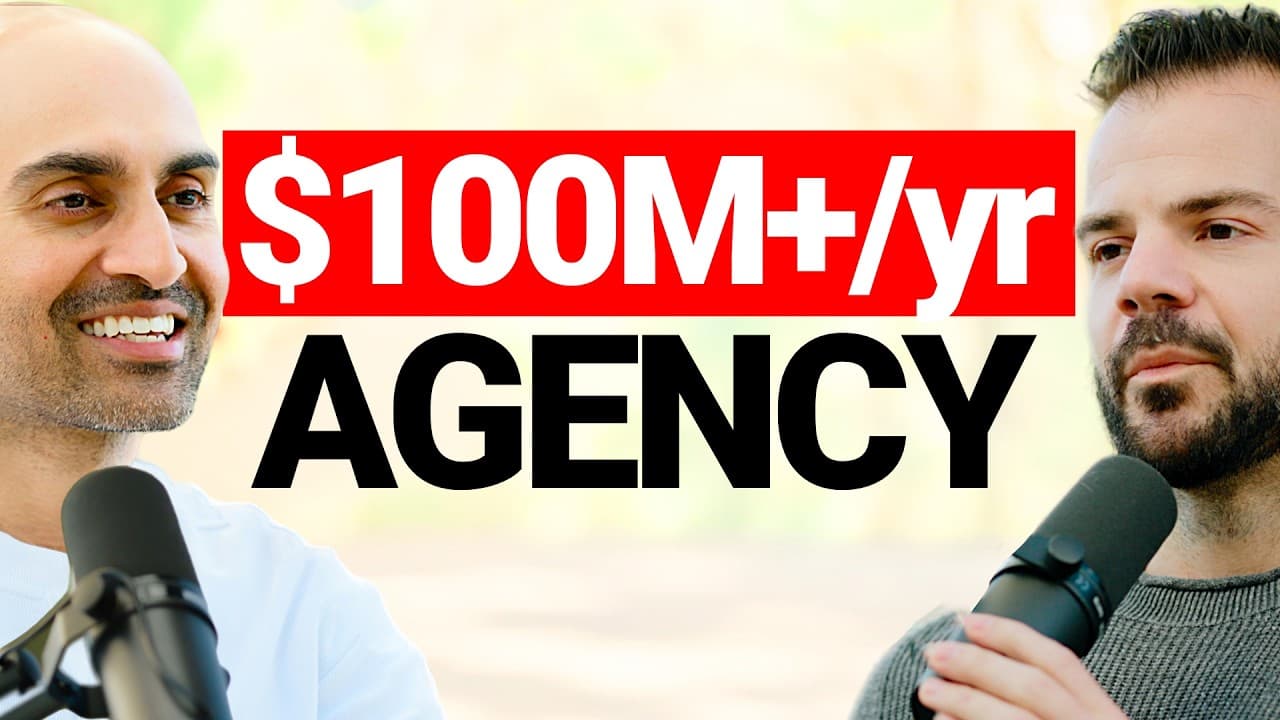
How did Neil Patel scale a $100M+ agency?
TL;DR
The key to scaling was starting from demand rather than planning a service business. By leveraging content, personal branding, and strategic partnerships, the agency grew from leads resale to a full-fledged firm, surpassing $100M in revenue and reaching its ninth year. The Brazil translation strategy also showed how global reach can accelerate growth when economics align.
Transcript
Most people think marketing agencies is a beginner level business to where if you're lucky, you might get to a 100 grand a month or if you're exceptional, you maybe get to a million a month, but Neil Patel has scaled his agency to over 150 million a year. So what I did in this podcast is I sat Neil down and we walked through every single stage of g... Read More
Key Insights
- The growth path of the agency is presented as a staged progression from 0 to 10M, 10M to 50M, and beyond, emphasizing scalable expansion.
- The origin story shows the business starting from selling leads and then evolving into an agency due to fulfillment challenges and demand signals.
- Translation of content into other languages, starting with Brazil, dramatically increased traffic and leads, illustrating the impact of localization on growth.
- The founder notes a long tenure in entrepreneurship, starting around age 16, and how early content marketing helped build a quasi personal brand that aided early client acquisition.
- Brazil economics are described as less attractive due to currency and revenue-based taxation, influencing strategic decisions on where to operate.
- The agency’s revenue is described as north of 100, with a ninth year milestone mentioned, indicating sustained growth and scale.
- The speaker discusses how personal brand contributed initially but the business matured beyond reliance on branding alone, implying a broader organizational capability.
- A mindset shift is described where demand creates business rather than a premeditated plan to start an agency, highlighting opportunistic growth.
Install to Summarize YouTube Videos and Get Transcripts
Explore YouTube Video Summarizer or Get YouTube Transcript Extractor
Questions & Answers
Q: How did the agency scale from 0 to 10 million and beyond?
The growth happened in stages, with the founder describing a progression from zero to ten million, then ten to fifty million, and finally past one hundred million in revenue. The process relied on capturing demand first, then building the service around that demand, and continuously refining delivery, operations, and client fulfillment to support larger contracts and more complex projects. This staged approach allowed for controlled scaling while maintaining service quality and profitability.
Q: Why did the founder move from an agency to a software emphasis, and what changed?
The founder initially explored software as a more scalable path, but the market and execution revealed that the demand for a services-based model could be capitalized on before expanding into software. The pivot involved leveraging existing client demand and fulfillment capabilities, then gradually integrating scalable processes and systems to support growth while maintaining the core expertise in marketing services.
Q: What role did content marketing and branding play in starting the agency?
Content marketing and a semi-personal brand were crucial in generating inbound inquiries when traditional growth channels were too expensive for a young entrepreneur. By blogging and presenting at events, the founder built reputation and credibility, which translated into leads and opportunities that eventually evolved into a formal agency offering.
Q: How did the Brazil translation strategy impact growth?
Translating content into multiple languages, starting with Brazil, significantly increased traffic and leads, sometimes surpassing the U.S. market. This localization expanded the reach of the founder’s content and opened new client opportunities, though currency exchange and revenue-based taxation in Brazil influenced the economics of that market.
Q: What challenges did currency and taxation create for Brazil operations?
The Brazil operation faced currency weakness and a tax regime that taxes revenue rather than profits, reducing economic attractiveness despite high lead volume. These factors necessitated careful consideration of where to focus growth and how to structure partnerships and revenue sharing to preserve profitability.
Q: How important was the founder’s personal brand to early growth?
The personal brand helped initiate inbound interest and credibility, easing early client acquisition. However, as the business matured, the model relied more on scalable systems, fulfillment capability, and organizational strength beyond individual branding, indicating a shift from sole reliance on personal reputation to institutional capacity.
Q: What is the role of the nine-year milestone in understanding scale?
Reaching a nine-year milestone signals long-term sustainability and cumulative experience in scaling a service business. It implies that the agency navigated multiple growth phases, refined its service delivery, and established a durable market position, which collectively contributed to sustained revenue growth beyond the initial thrill of rapid expansion.
Q: What mindset shift does the speaker emphasize about starting an agency?
The speaker emphasizes that the agency often begins from demand rather than a deliberate plan to create a services firm. By exploiting opportunities from existing inquiries and content-driven credibility, the business evolves into an agency as client needs arise, rather than following a traditional blueprint for starting a service business.
Summary & Key Takeaways
-
Neil Patel grew his agency by building demand first, then formalizing the service into a scaled business, surpassing $100 million in revenue by year nine.
-
Content marketing and personal branding created initial demand and credibility, which helped transition lead sales into a full agency model, expanding beyond the original market.
-
A Brazil-based translation and localization push boosted traffic and lead generation, demonstrating how regional strategies can unlock international growth while navigating currency and tax considerations.
Read in Other Languages (beta)
Share This Summary 📚
Summarize YouTube Videos and Get Video Transcripts with 1-Click
Try YouTube Summary with ChatGPT & Claude or YouTube Transcript Generator
Explore More Summaries from Cole Gordon 📚




Summarize YouTube Videos and Get Video Transcripts with 1-Click
Try YouTube Summary with ChatGPT & Claude or YouTube Transcript Generator