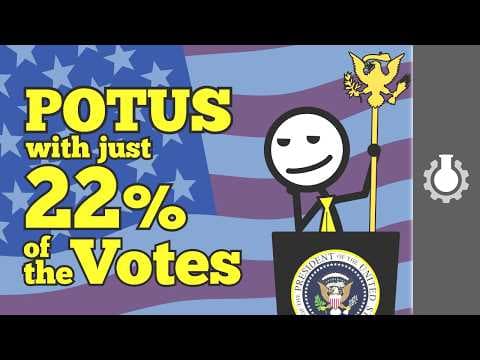
Minority Rule: First Past the Post Voting

TL;DR
First Past the Post can produce minority rule and pushes elections toward two dominant parties because the candidate with the most votes wins even without majority support. In the Animal Kingdom’s first election, Leopard wins with only 20%, while 80% prefer someone else; later, strategic voting leaves only Leopard and Gorilla. Read on to see how voter fear, candidate dropouts, and gerrymandering compound the problem.
Transcript
Welcome to the problem with first past the post voting explained by me, C. G. P. Grey The royal family has a problem. But this isn't just any royal family, these are the lions -- rulers of the jungle since time immemorial. There are protests over the monarchy's absolute power and the citizens of the Animal Kingdom want a say in how they are governe... Read More
Key Insights
- 🔌 The First Past the Post voting system can result in minority rule, where the elected candidate does not have the majority of support.
- ⏳ Over time, FPTP leads to a two-party system as voters strategically vote for the candidate with the best chance of winning.
- ❓ Strategic voting and the spoiler effect undermine the democratic process under FPTP.
- ❓ Gerrymandering can further manipulate the outcome of elections under FPTP.
Install to Summarize YouTube Videos and Get Transcripts
Explore YouTube Video Summarizer or Get YouTube Transcript Extractor
Questions & Answers
Q: What are the main problems with First Past the Post voting?
First Past the Post can elect a candidate whom most voters did not support. Over repeated elections, it also encourages strategic voting, candidate dropouts, and a trend toward two dominant parties, while divided voting groups can become susceptible to gerrymandering.
Q: How does First Past the Post voting work?
Each citizen receives one vote, and the candidate with the most votes wins. The transcript also calls this system Winner Take All and abbreviates First Past the Post as FPTP.
Q: How can First Past the Post produce minority rule?
A candidate needs more votes than each competitor, not support from most voters. Leopard therefore wins the first Animal Kingdom election with 20% even though 80% voted for someone else.
Q: Why does First Past the Post trend toward a two-party system?
Voters begin abandoning candidates who appear unable to win and instead support stronger candidates to prevent a disliked outcome. As Turtle, Snake, Owl, Monkey, and Tiger drop out over successive elections, only Leopard and Gorilla remain.
Q: How does strategic voting happen under First Past the Post?
Voters support a viable candidate instead of their genuine first choice because they fear another candidate winning. Snake voters strategically choose Leopard to avoid Gorilla rule, while Monkey and Tiger voters later abandon their preferred candidates for the same reason.
Q: What happened across the Animal Kingdom elections?
Leopard first wins with 20% of the vote, followed by Gorilla winning 28% to Leopard’s 26%. Leopard then wins 34% to 33%, and the final illustrated election gives Gorilla 51% against Leopard’s 49%, leaving a two-party system.
Q: Do Leopard and Gorilla represent most voters’ first choices?
No. Even after the system narrows to those two candidates, only two-fifths of citizens prefer Leopard or Gorilla as their first choice, while three-fifths prefer someone else.
Q: How can gerrymandering affect First Past the Post elections?
When citizens are divided into voting groups before casting ballots, whoever draws the boundaries can strongly influence the outcome. The transcript illustrates this with ten homes containing three Leopard voters, three Gorilla voters, and four Owl voters.
Summary & Key Takeaways
-
The Animal Kingdom transitions from a monarchy to a democracy, with the first election using the First Past the Post voting system.
-
FPTP leads to minority rule, as the winning candidate may not have the majority of support.
-
Over time, FPTP results in a two-party system, as voters strategically vote for the candidate with the best chance of winning.
Read in Other Languages (beta)
Share This Summary 📚
Summarize YouTube Videos and Get Video Transcripts with 1-Click
Try YouTube Summary with ChatGPT & Claude or YouTube Transcript Generator
Explore More Summaries from CGP Grey 📚

Summarize YouTube Videos and Get Video Transcripts with 1-Click
Try YouTube Summary with ChatGPT & Claude or YouTube Transcript Generator