How to write a 3000 word lit review in a weekend
TL;DR
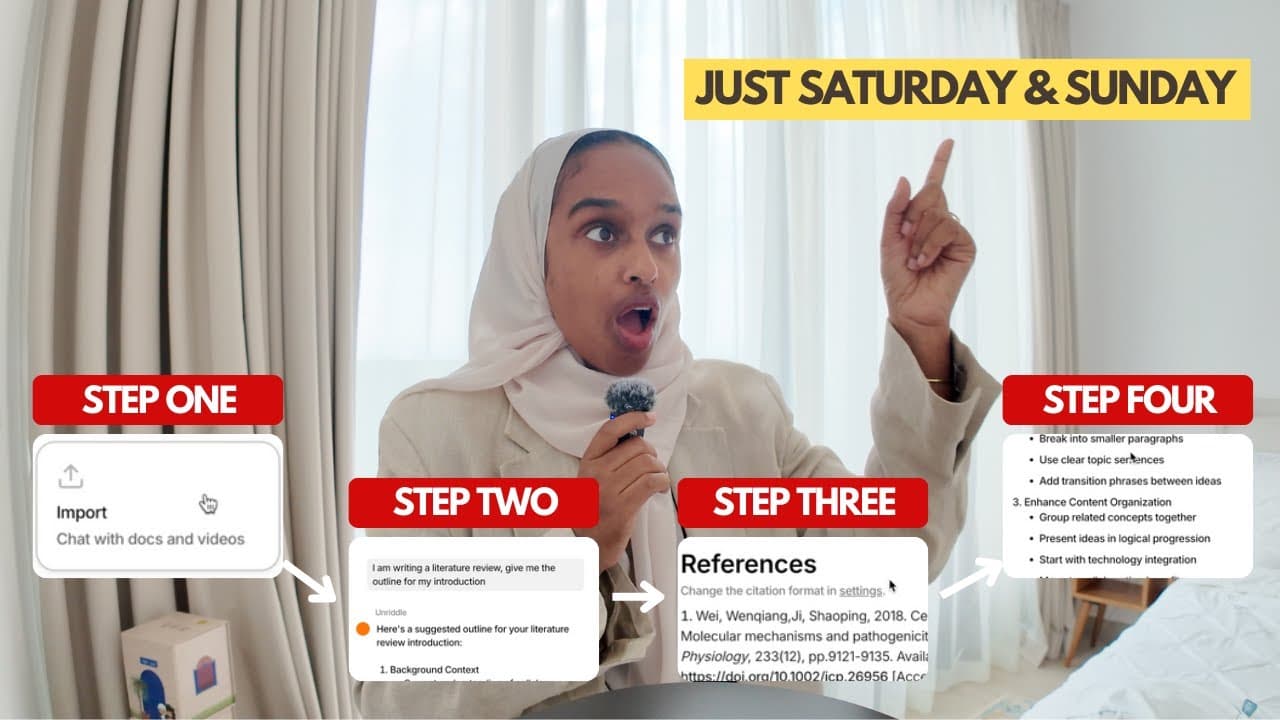
You can finish a 3000 word literature review in a weekend by following four steps and using AI tools. Start with reading and understanding sources, then brainstorm and outline, draft with citations, and finally refine the argument and proofs. The method centers on using Unriddle to import papers, summarize, outline, cite, and edit efficiently while organizing notes.
Transcript
all it takes is a Saturday and a Sunday you are here because you want to learn how to write a literature review quickly and I'm here because I can tell you exactly how you can do that using AI Tools in just one weekend there's four steps to this process step number one is reading and understanding research papers step number two is brainstorming id... Read More
Key Insights
- Reading and understanding research papers is the first step and can be accelerated with AI to extract main results and takeaways.
- Organizing papers into groups and building a shared outline helps align multiple sources and identify agreements and disagreements.
- Brainstorming and outlining should happen in the same workflow to create a cohesive introduction and paper structure.
- AI can generate a practical outline for the introduction, including research gaps and the current state of knowledge.
- Drafting involves citing sources seamlessly and expanding with new, diverse references to strengthen the argument.
- The tool can provide targeted feedback on structure, redundancy, and clarity to improve the writing.
- Ask the AI for specific examples and evidence to support arguments, including technical and clinical illustrations.
- Final refinements focus on logical flow, concrete examples, and concise presentation of ideas.
Install to Summarize YouTube Videos and Get Transcripts
Explore YouTube Video Summarizer or Get YouTube Transcript Extractor
Questions & Answers
Q: What is the first step to writing a lit review in a weekend?
The first step is reading and understanding research papers. This involves importing papers into the AI tool, asking questions about the main results and takeaways, and extracting the key points. By focusing on the core messages and figures, you build a solid foundation for your outline and argument. This step reduces the time you would spend on manual reading and note taking.
Q: How can AI help with outlining the literature review?
AI can help by generating an outline for the introduction and the overall structure. You can ask it to summarize the current state of knowledge, identify the research gap, and propose the sections and order for your write up. This makes the process faster and gives you a clear roadmap to draft your paper without starting from a blank page.
Q: What should you do after creating an outline?
After creating an outline you should begin drafting the literature review. Use AI to pull quotes, summarize sources, and insert citations from your imported papers. You can also request the AI to find additional sources to broaden the discussion and ensure you maintain originality while staying aligned with the topic.
Q: How does the video suggest handling citations during drafting?
The video suggests using the AI tool to search within your library or online sources and to insert citations directly into the text. It also shows how the tool can add end of paper citations automatically. This enables you to maintain proper attribution and streamline the writing process while drafting.
Q: What kind of feedback can AI provide during refinement?
AI can offer feedback on redundancy, structure, and logical progression. It can suggest breaking up sections, reorganizing content for coherence, and adding concrete examples. This helps you tighten arguments and improve the overall readability and impact of the literature review.
Q: What kinds of examples does the AI recommend adding?
The AI recommends adding technical examples, clinical examples, and references to research collaborations or cross disciplinary projects. It also suggests including statistical data on treatment effectiveness and patient response measurements to strengthen the argument and demonstrate real world relevance.
Q: How does the workflow prevent simply copying text from papers?
The workflow emphasizes using AI to summarize and outline while writing in your own words and citing sources. The aim is to understand and articulate the ideas with your own voice, supported by properly attributed references. This keeps the work ethical and avoids plagiarism while leveraging AI for efficiency.
Q: What is the role of figure interpretation in this method?
Figure interpretation helps you grasp complex data quickly. The AI assists by explaining figures and what the visuals show, which aids in integrating these findings into your narrative. This speeds up comprehension and allows you to reference figures accurately in your literature review.
Summary & Key Takeaways
-
The video presents a four step weekend plan for literature reviews, emphasizing speed through AI assisted reading, outlining, drafting and editing.
-
It uses the Unriddle tool to import documents, ask questions, summarize, and pull out key points and figures for quick understanding.
-
The approach includes drafting with proper citations and iterative refinement for a polished final piece.
Read in Other Languages (beta)
Share This Summary 📚
Summarize YouTube Videos and Get Video Transcripts with 1-Click
Try YouTube Summary with ChatGPT & Claude or YouTube Transcript Generator
Explore More Summaries from Dr Amina Yonis 📚


Summarize YouTube Videos and Get Video Transcripts with 1-Click
Try YouTube Summary with ChatGPT & Claude or YouTube Transcript Generator