What Distinguishes Math and Language Cognition?
TL;DR
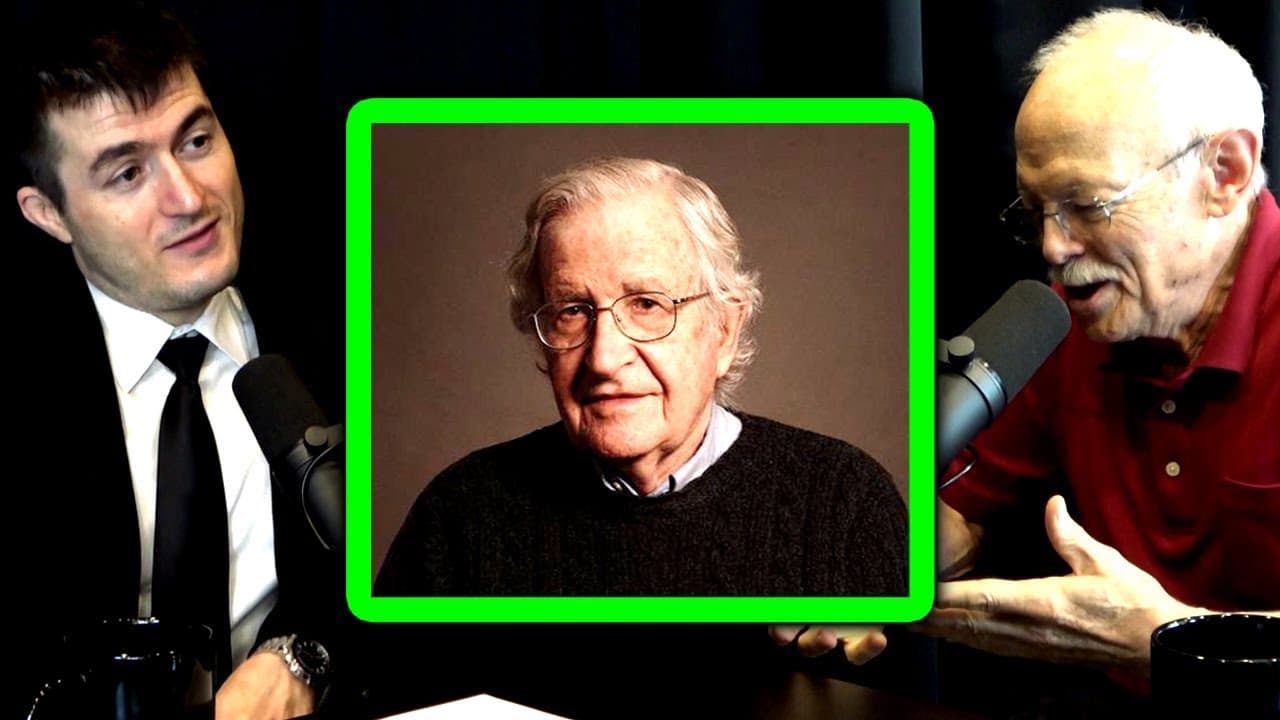
Mathematical cognition and linguistic cognition exhibit distinct characteristics, yet the boundary between them is intricate. Formally trained individuals engage with their disciplines in a way that may limit their understanding of more intuitive human thought processes. This immersion can create a perspective shaped by formal principles, potentially obscuring the natural operation of the mind.
Transcript
if we bring chomsky back into the conversation first of all is it unfair to draw a line between mathematical cognition and language linguistic cognition i think that's a very interesting question and i think um it's one of the ones that i'm actually very interested in right now um but i i think the answer is in important ways it is important to dra... Read More
Key Insights
- 👪 Chomsky's upbringing and immersion in an academic family influenced his deep engagement with formal systems and his significant insights into the structure of natural language.
- 👔 Formal linguists' intuitions about the meaning of phrases often differ from those of non-experts, highlighting the impact of formal training on linguistic cognition.
- 😀 The concept of an "expert blind spot" explains the difficulty experts face in explaining their understanding to non-experts due to self-evident knowledge that is not easily transferable.
- 🧑🔬 The innate nature of natural numbers was once believed by many cognitive scientists but is now widely accepted as a cultural construction.
- 💨 The way language and geometry are understood can become so ingrained that the need for explicit teaching is often overlooked.
- 🎙️ More videos with Noam Chomsky:
Install to Summarize YouTube Videos and Get Transcripts
Explore YouTube Video Summarizer or Get YouTube Transcript Extractor
Questions & Answers
Q: Is there a clear distinction between mathematical cognition and linguistic cognition?
While there is a distinction between these two types of cognition, the line between them is not absolute. It is important to recognize the subtleties and differences while exploring the overlap.
Q: How does formal training in disciplines like linguistics and mathematics affect the understanding of natural language?
Formal training can provide insights into the structure of natural language, but the intuitive knowledge gained through this training is limited compared to the intuitions of individuals without formal training. This was discovered by Lyla Gleitman in her research.
Q: Does immersion in a specific discipline impact the way individuals engage with experience?
Yes, individuals who are formally trained in disciplines like linguistics, philosophy, cognitive science, computer science, machine learning, and mathematics tend to have a mode of engagement that is structured around systematicity and conformity to principles. This differs from the natural human mind without such immersion.
Q: Does formal training in linguistics or mathematics hinder the ability to introspect?
Yes, the different fields and approaches used in studying the mind can take individuals away from the natural operation of their own minds, making it difficult for them to effectively introspect.
Summary & Key Takeaways
-
There is a distinction between mathematical cognition and linguistic cognition, though the line between the two is complex and nuanced.
-
Linguists and other formally trained academics have a unique mode of engagement with experience that is rooted in systematicity and conformity to principles.
-
Immersion and enculturation in specific disciplines can lead to a limited perspective on human belief and knowledge.
Read in Other Languages (beta)
Share This Summary 📚
Summarize YouTube Videos and Get Video Transcripts with 1-Click
Try YouTube Summary with ChatGPT & Claude or YouTube Transcript Generator
Explore More Summaries from Lex Clips 📚




Summarize YouTube Videos and Get Video Transcripts with 1-Click
Try YouTube Summary with ChatGPT & Claude or YouTube Transcript Generator