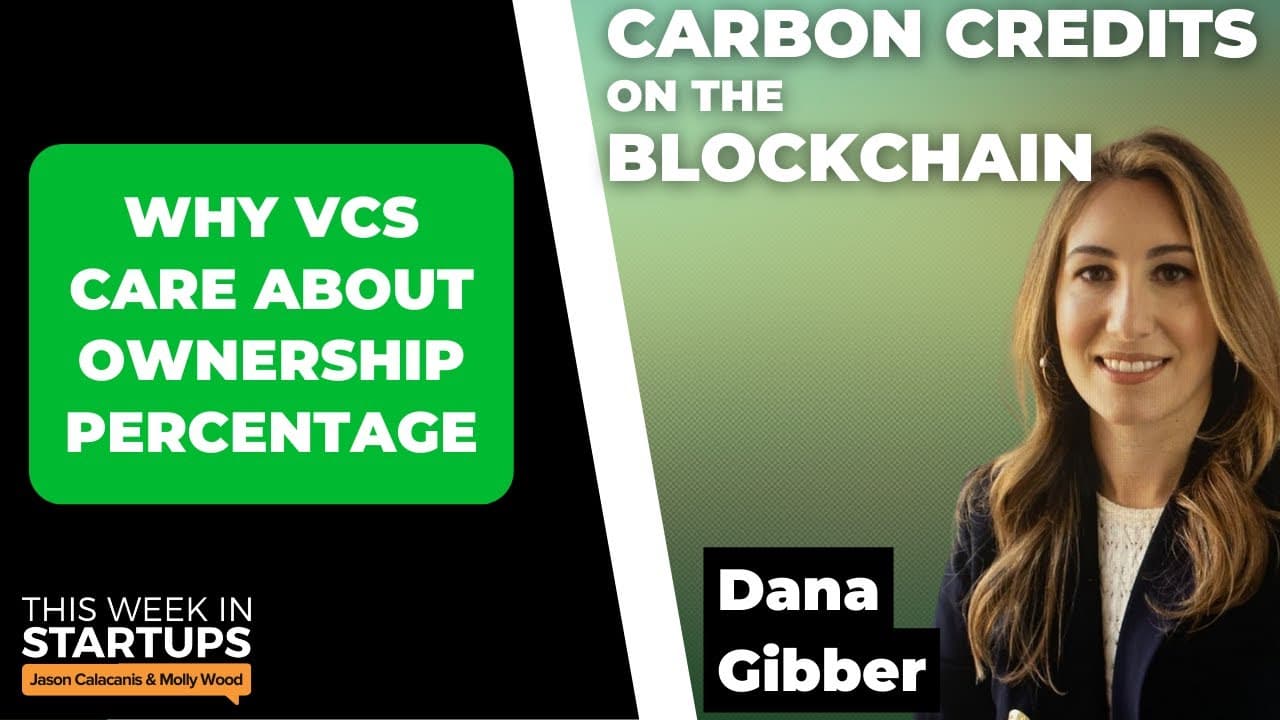
Why VCs care about ownership percentage + Flowcarbon CEO Dana Gibber | E1581
TL;DR
Venture capitalists prioritize ownership percentage to maximize returns and influence in their investments. A minimum target ownership ensures they are invested enough to take an active role, particularly as dilution occurs in subsequent funding rounds. This strategy helps VCs manage their time effectively, as owning a significant stake allows for better engagement and decision-making within the companies they support.
Transcript
hey everybody welcome back to Sunday you made it to Sunday first up VC Sunday school we're going to talk about your ownership percentage and why certain VCS say in order to do this deal we need a certain ownership percentage or else we're out and then Molly has an amazing interview I do have an amazing interview I interviewed Dana gamer the CEO of ... Read More
Key Insights
- 📽️ The voluntary carbon market relies on carbon credits to create a market incentive for emission reduction projects beyond regulatory compliance.
- 🖤 Challenges in the market include inflated baselines, double counting, and lack of transparency in trading carbon credits.
- 💐 Flow Carbon is leveraging tokenization to improve transparency, liquidity, and traceability in the carbon offset market.
- 👻 Tokenization allows for the bundling and trading of carbon credits, promoting price transparency and access to the market for various participants.
- 💳 The retirement of carbon credits after purchase ensures the environmental impact is properly accounted for, despite potential trading activities.
- 👨💼 Flow Carbon aims to build additional businesses on top of its tokenization protocol to enable diverse applications for tokenized carbon credits.
- 📽️ Blockchain verification enhances the certification process for carbon projects, ensuring data-driven transparency and traceability in the market.
Install to Summarize YouTube Videos and Get Transcripts
Explore YouTube Video Summarizer or Get YouTube Transcript Extractor
Questions & Answers
Q: How does the voluntary carbon market differ from compliance markets, and what role do carbon credits play in incentivizing emission reduction projects?
The voluntary carbon market operates without regulatory mandates, relying on carbon credits to incentivize projects that reduce or remove carbon emissions.
Q: What are the historical challenges in the carbon offset market, and how is Flow Carbon addressing these issues with tokenization?
Historical challenges include inflated baselines, double counting, and lack of transparency. Flow Carbon is using tokenization to improve transparency, liquidity, and traceability in carbon credit trading.
Q: How does Flow Carbon plan to build businesses on top of its open-source tokenization protocol, and what are the potential applications for tokenized carbon credits?
Flow Carbon charges a nominal fee for tokenization to cover costs, but plans to build businesses on top of the protocol to enable applications like loyalty rewards programs, nft platforms, and offsetting historical emissions for dows.
Q: What role does blockchain verification play in certifying carbon projects and ensuring transparency in the carbon offset market?
Blockchain verification enables data-driven certification of projects, ensuring transparency in the issuance and traceability of carbon credits back to their source projects.
Summary
In this video, Jason Calacanis discusses the importance of ownership percentage for venture capitalists (VCs) and the reasons why they may set minimum ownership thresholds for investing in startups. He also interviews Dana Gamer, the CEO of flow carbon, a company involved in the voluntary carbon market. They discuss the role of carbon offsets and the challenges in implementing an effective carbon market. The interview clarifies that flow carbon is a separate company from the new residential venture announced by Adam Newman.
Questions & Answers
Q: Should VCs have a minimum ownership percentage requirement for investing in startups?
Yes, VCs often have minimum ownership percentage requirements because of the power law in venture capital. The top investments in a VC's portfolio pay for all the other investments, and owning a significant portion of a winning company maximizes returns for the limited partners. Time is also a constraint for VCs, as they have a limited amount of time to allocate to their portfolio companies. Therefore, having a minimum ownership percentage ensures that VCs can dedicate sufficient time and resources to their investments.
Q: Are there situations where VCs would not invest due to a minimum ownership percentage requirement?
There might be cases where VCs are more flexible with their ownership percentage requirements. For example, prominent founders such as Elon Musk or Travis Kalanick may have the ability to dictate terms and ownership percentages for their new ventures. However, for first-time founders or less influential entrepreneurs, VCs usually have more leverage in setting ownership requirements.
Q: What are the consequences of owning a small percentage of a startup as a VC?
When VCs own a small percentage of a startup, they often have less control and influence over the company. They might not have board seats or major investor rights, which can impact their ability to guide the company's direction. Additionally, owning a small percentage means they have less exposure to potential upside if the company succeeds. It also leads to a higher number of investments and increased demand on a VC's time.
Q: What are the alternatives for VCs to maintain diversification without compromising ownership percentage?
Some VCs adopt a strategy of not taking board seats and owning smaller percentages in a larger number of companies. By spreading their investment across multiple companies, they increase diversification but may have less influence and control. However, this approach has its own challenges and may limit access to major investor rights and preferred shares.
Q: What mistakes do founders make when using their personal phone numbers for their startups?
One common mistake founders make is using their personal phone numbers as their company's main contact number. This can lead to increased spam text messages and privacy concerns. It also creates issues if the founder hires a sales representative who continues to use their personal number. In such cases, if the sales executive leaves, the founder might lose the entire customer history associated with that number.
Q: How can startups avoid the mistake of using personal phone numbers?
Startups can avoid this mistake by using business phone numbers for communication. OpenPhone provides an easy solution to get business phone numbers for the founder and the team. With OpenPhone, founders can have separate business numbers on their existing devices, eliminating the need to give out personal numbers and maintaining privacy.
Q: Can VCs maintain their ownership percentage as a startup goes through funding rounds?
It can be challenging for VCs to maintain their ownership percentage as a startup goes through multiple funding rounds. Dilution often occurs as more investors come in and raise the company's valuation. To maintain ownership, VCs need to participate in subsequent funding rounds with proportional investments, which can strain their resources. In some cases, VCs might seek additional funds from their limited partners or facilitate specific investments by larger partners to maintain their position.
Q: How does ownership percentage get diluted over time for VCs?
Ownership percentage can get diluted over time as a startup raises subsequent funding rounds. Each round brings in new investors who receive a portion of the company's equity. If VCs don't participate in these rounds or have a smaller investment, their ownership percentage decreases. Dilution becomes more pronounced in later funding rounds when larger investors enter, leading to further dilution. However, successful companies can still provide significant returns even with diluted ownership.
Q: Why is ownership percentage important for VCs in the context of a seed fund?
Ownership percentage is vital for VCs in a seed fund because it determines their potential returns. If a VC invests early and maintains a high ownership percentage as the company grows, they can benefit from the power law and earn substantial returns. Seed funds need to strike a balance between owning enough of a company to maximize returns while diversifying their portfolio. The ownership percentage becomes even more crucial when deciding whether to invest in subsequent funding rounds.
Q: What mistakes do startups make with their phone numbers?
Startups often make the mistake of using personal phone numbers instead of business numbers. This creates privacy and logistical issues, such as spam text messages and the loss of customer history if a sales representative uses a personal number. It's essential for startups to separate personal and business phone numbers from the start to avoid these complications.
Takeaways
Ownership percentage is a crucial factor for VCs in venture capital funding. Maintaining a significant ownership stake allows VCs to maximize returns and have greater influence over the success of a portfolio company. However, maintaining ownership is a challenge as startups go through multiple funding rounds and attract new investors. Dilution is a common occurrence, and VCs need to carefully manage their investments and participate in subsequent rounds to preserve their ownership percentage. Startups should also prioritize using business phone numbers to avoid privacy and communication issues associated with personal numbers.
Summary & Key Takeaways
-
Exploring the voluntary carbon market and the essential role of carbon credits in incentivizing projects that reduce or remove carbon emissions.
-
Challenges in the market include lack of transparency, inflated baselines, and double counting of carbon offsets.
-
Flow Carbon is innovating with tokenization protocols to improve transparency, liquidity, and traceability in carbon credit trading.
Read in Other Languages (beta)
Share This Summary 📚
Summarize YouTube Videos and Get Video Transcripts with 1-Click
Try YouTube Summary with ChatGPT & Claude or YouTube Transcript Generator
Explore More Summaries from VC Sunday School / This Week in Climate Startups 📚


Summarize YouTube Videos and Get Video Transcripts with 1-Click
Try YouTube Summary with ChatGPT & Claude or YouTube Transcript Generator