How Does Life Emerge From Randomness? AI Experiment Explained
TL;DR
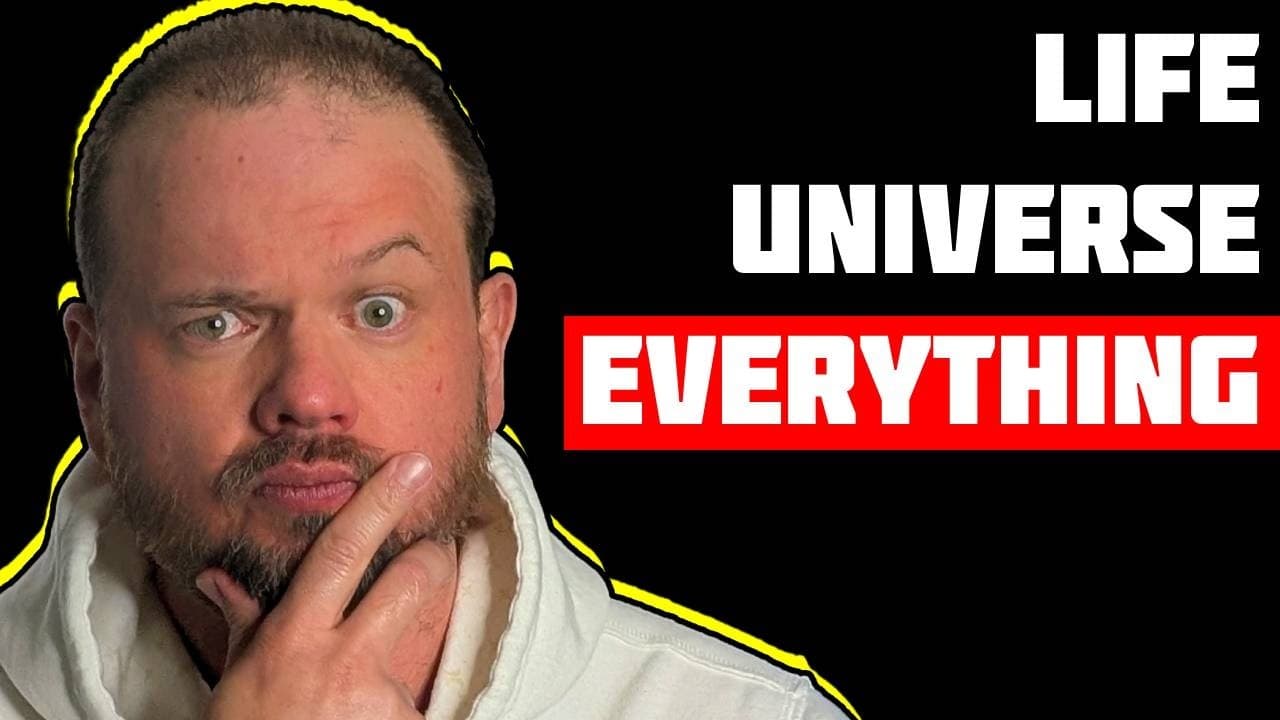
Random code running in a minimal programming language spontaneously produced self-replicating structures, mirroring how life may have begun on Earth. The pattern echoes Von Neumann's self-replicating automaton, which anticipated how DNA works before DNA was discovered. Self-replication appears to be partly built into the universe, emerging from chaos into order.
Transcript
All right, we got quite an interesting show for you today. This is going to be a little bit shorter than our long form interviews, but we want to talk today about life, the universe, and everything. We're going to reveal to you the meaning of life today, basically is what we're trying to say. Uh, how's that for a clickbait title, but um but basical... Read More
Key Insights
- Von Neumann imagined a self-replicating robot that needed a tape of instructions plus a mechanism to copy that tape, guessing at the logic of DNA before Watson and Crick actually discovered its structure.
- The self-replicating tape concept maps directly onto biology: DNA acts as a long string of information read by proteins, resembling how early tape-based computers stored and processed instructions.
- A Turing-complete system can run any calculation or algorithm, while limited devices like a basic calculator cannot, because they lack enough operations to express arbitrary computation.
- Brainfuck (referred to as BFF) is a minimal Turing-complete language built by a grad student to find the fewest commands needed for full computation, using only eight characters.
- Blaise Agüera y Arcas ran an experiment shuffling and mutating short tapes of these commands, letting purely random output run for many iterations with no order or meaning at first.
- Emergence of life appeared when entropy rapidly collapsed: random chaos suddenly shifted into highly ordered structure once a fragment capable of self-replication arose and began copying itself.
- Self-replicating fragments combined into symbiotic structures over time, producing non-trivial algorithms, suggesting the tendency toward replication may be somewhat built into the universe.
- Conway's Game of Life shows how simple rules repeated many times generate complex, biology-like patterns, reinforcing that intricate order can spring from tiny patterns and minimal instructions.
Install to Summarize YouTube Videos and Get Transcripts
Explore YouTube Video Summarizer or Get YouTube Transcript Extractor
Questions & Answers
Q: What did Von Neumann's self-replicating automaton idea predict about DNA?
Von Neumann imagined a robot, likened to one made of Lego pieces, that could gather parts and build copies of itself. He reasoned it would need a tape carrying instructions for building a replica, plus a mechanism to print another copy of that tape. This anticipated how DNA functions, storing and copying instructions, before Watson and Crick discovered DNA's structure, meaning he guessed the logic of biological self-replication in advance.
Q: How does DNA resemble early computers according to the video?
The hosts describe DNA as a long string of information built from the four nucleotides, read by proteins in a way that mirrors how early tape-based computers worked. Just as a computer read instructions written on a tape moving left to right, biology reads a genetic tape. They note these analogies still hold for modern computers with their components, long-term and short-term memory, processing, and bandwidth for moving data around.
Q: What is a Turing-complete language or system?
A Turing-complete system is one capable of running any calculation or algorithm you give it. Modern computers with programming languages qualify because they can execute anything. By contrast, a limited device like a basic calculator is not Turing-complete, since it lacks enough operations to express arbitrary computation. This concept matters because it defines whether a system is powerful enough to, in principle, simulate any computable process.
Q: What is the Brainfuck (BFF) programming language?
Brainfuck, which the hosts call BFF, is a minimal programming language reportedly created by a grad student in the '90s who asked what the fewest commands needed for Turing completeness would be. The result uses only eight characters or commands, such as symbols that move a pointer or increment a value. Writing real programs in it is extremely tedious, but it can technically express any algorithm, making it a stripped-down testbed for computation.
Q: How did the AI experiment show life-like self-replication emerging?
Blaise Agüera y Arcas set up short tapes of Brainfuck commands that were randomly shuffled, mutated, and recreated to simulate slight structural changes. He let this run for many iterations, and for a long time the output was pure random chaos with no order. Then entropy rapidly collapsed, and structure emerged suddenly because one fragment capable of self-replication appeared and began copying itself, producing ordered, non-trivial patterns.
Q: Why do the hosts think life might be built into the universe?
Because self-replicating structures arose from purely random permutations without being designed, the hosts argue that the tendency toward replication and order seems somewhat inherent to the universe. Once a self-replicating fragment emerged, it multiplied and combined with others into symbiotic structures very quickly. They suggest this is a plausible reason life appeared on Earth and possibly elsewhere, since the same emergence could happen wherever the right conditions and rules exist.
Q: How does Conway's Game of Life relate to the emergence of complexity?
Conway's Game of Life is a simple checkerboard-style game driven by a few basic rules. When those rules run repeatedly across many iterations, they generate incredibly complex patterns that resemble biology. The hosts use it to show that intricate, life-like order can arise from minimal instructions, supporting the idea that a tiny pattern, like a single equation, can mostly do nothing yet occasionally produce something remarkable and highly structured.
Q: What connection do the hosts draw between DNA and saving data?
The hosts recall describing DNA as being like a save-game feature. In the early Earth, they say, nothing was happening until DNA emerged as a form of memory that let information be stored. Once data could be saved, and potentially replicated, everything changed. They connect this to the experiment's findings, noting that self-replicating structures work similarly by preserving and copying information, marking a pivotal shift from meaninglessness toward persistent, ordered systems.
Summary & Key Takeaways
-
The hosts explore an intuition shared by many machine learning researchers: that progress in AI could deepen our understanding of consciousness, reality, and the point of existence, connecting the study of intelligence to physics, psychology, and the nature of the human brain.
-
Von Neumann envisioned a self-replicating automaton needing a tape of build instructions and a copier for that tape, essentially predicting how DNA functions before its discovery, paralleling the RNA-world idea of sticky amino acids forming information-carrying strings read by proteins.
-
Blaise Agüera y Arcas used the minimal Turing-complete language Brainfuck to run randomly mutating tapes; after long stretches of chaos, entropy suddenly collapsed as self-replicating structures emerged, which he presents as a model for how life itself arose.
Read in Other Languages (beta)
Share This Summary 📚
Summarize YouTube Videos and Get Video Transcripts with 1-Click
Try YouTube Summary with ChatGPT & Claude or YouTube Transcript Generator
Explore More Summaries from Wes Roth 📚

Summarize YouTube Videos and Get Video Transcripts with 1-Click
Try YouTube Summary with ChatGPT & Claude or YouTube Transcript Generator