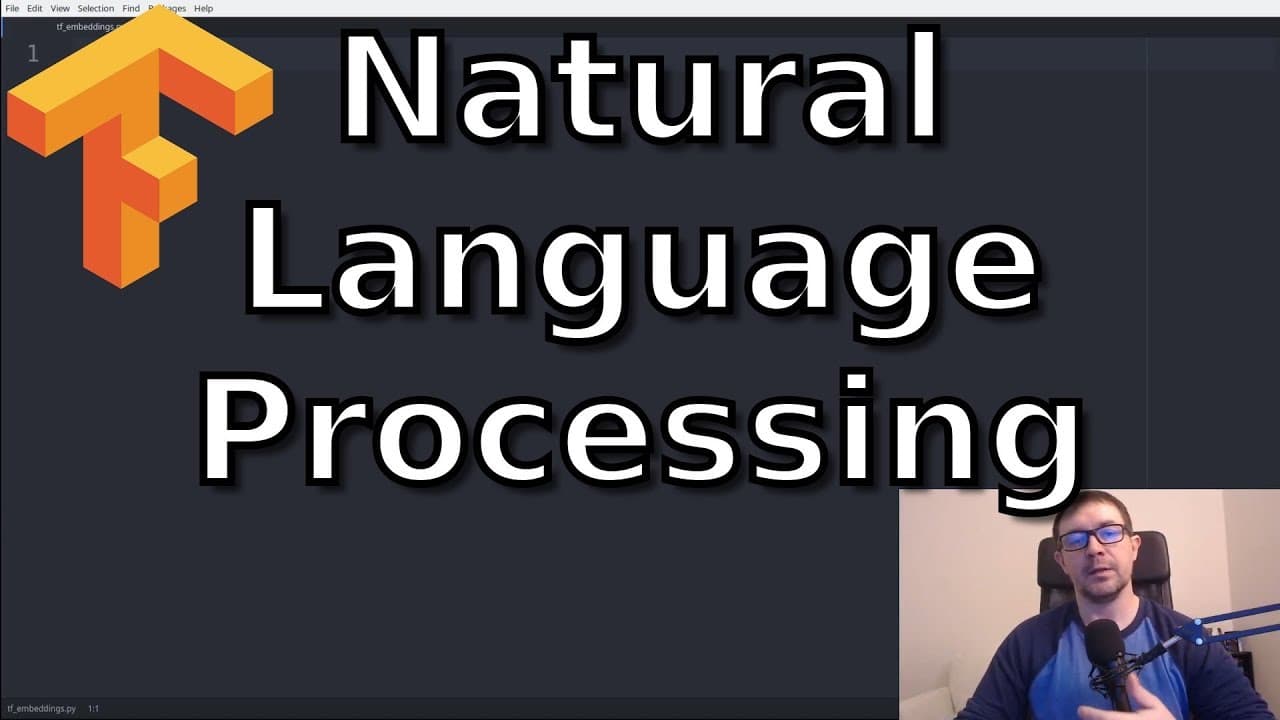
How to Use Word Embeddings in TensorFlow 2.0
TL;DR
To effectively use word embeddings in TensorFlow 2.0, represent words as dense vectors to capture their semantic relationships. This method surpasses traditional one-hot and integer encodings by allowing for calculations of word relationships, enabling more efficient natural language processing. The IMDB dataset serves as a practical example for demonstrating these concepts.
Transcript
in this tutorial you are gonna learn how to do word embeddings with tensorflow 2.0 if you don't know what that means don't worry I'm gonna explain what it is and why it's important as we go along let's get started before we begin with our imports a couple of housekeeping items first of all I am basically working through the tensorflow tutorial from... Read More
Key Insights
- 🔑 Word embeddings provide a more efficient and meaningful way to represent words and their relationships for machine learning models.
- 😅 The traditional methods of one-hot encoding and integer encoding have limitations in capturing semantic relationships between words.
- 🔑 Word embeddings use a transformation to a different vector space to represent words, allowing for the calculation of relationships between words.
- 🔑 By training on a large dataset, word embeddings can learn the correlations between words that lead to positive or negative sentiment in text data.
- 🔑 Word embeddings can be visualized and analyzed to gain insights into the relationships between words.
- 🚂 The IMDB movie dataset is used as an example to train a word embedding model in TensorFlow 2.0.
- 🔑 The accuracy of the word embedding model can be improved by adjusting the number of dimensions in the embedding layer.
Install to Summarize YouTube Videos and Get Transcripts
Explore YouTube Video Summarizer or Get YouTube Transcript Extractor
Questions & Answers
Q: How do word embeddings solve the problem of representing words efficiently?
Word embeddings use a transformation to a different vector space, allowing for more efficient representation of words and capturing semantic relationships between them.
Q: How are word embeddings trained using the IMDB movie dataset?
The model takes a large number of movie reviews from the IMDB dataset and predicts whether they are positive or negative. By training on this data, the model learns the correlations between words in the reviews that lead to a positive or negative sentiment.
Q: What are some advantages of word embeddings over traditional encoding methods?
Word embeddings provide a more efficient representation of words and capture semantic relationships between them, allowing for better analysis of text data.
Q: Can word embeddings be used for sentiment analysis on Twitter data?
It is possible to use word embeddings for sentiment analysis on Twitter data as long as there is significant overlap between the dictionary words used in the embedding model and the words in the Twitter data.
Summary & Key Takeaways
-
Word embeddings are a way to represent words and their relationships in a more efficient and meaningful way for machine learning models.
-
The traditional methods of one-hot encoding and integer encoding are inefficient and don't capture semantic relationships between words.
-
Word embeddings use a transformation to a different vector space to represent words, allowing for the calculation of relationships between words.
Read in Other Languages (beta)
Share This Summary 📚
Summarize YouTube Videos and Get Video Transcripts with 1-Click
Try YouTube Summary with ChatGPT & Claude or YouTube Transcript Generator
Explore More Summaries from Machine Learning with Phil 📚




Summarize YouTube Videos and Get Video Transcripts with 1-Click
Try YouTube Summary with ChatGPT & Claude or YouTube Transcript Generator