How to understand free will in a deterministic universe
TL;DR
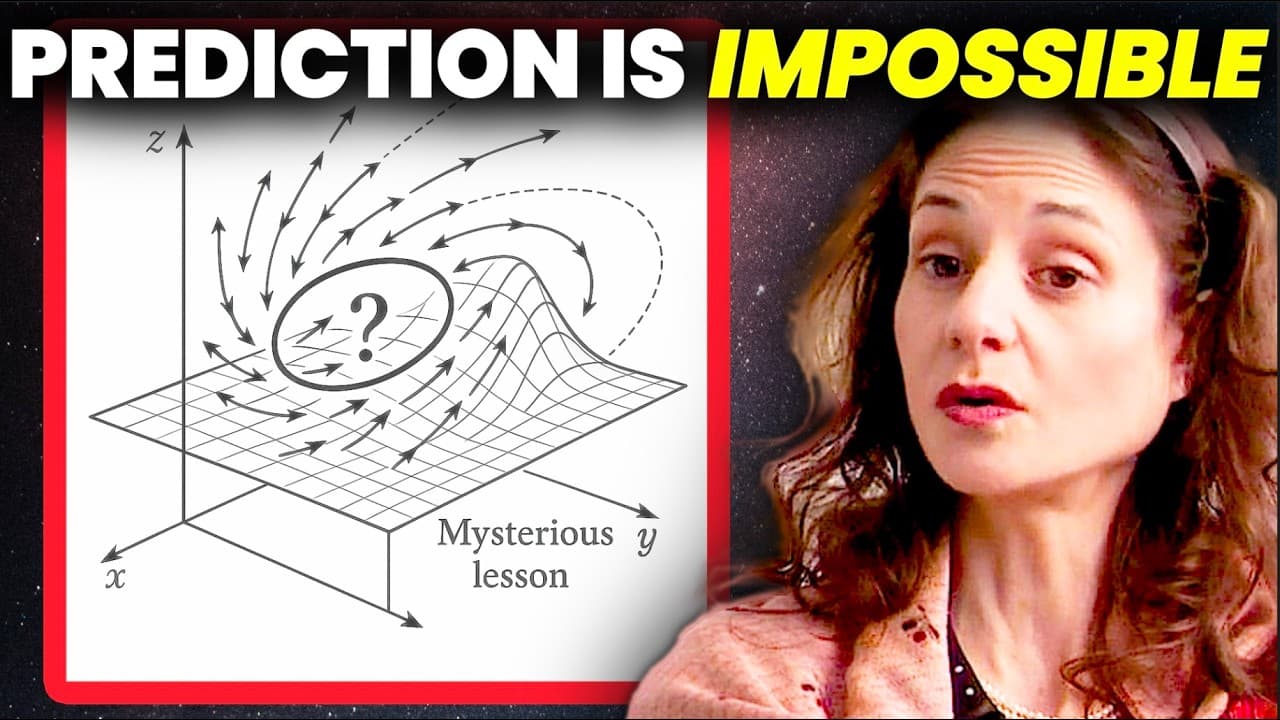
Free will can be understood within a deterministic framework by examining how a system with computable laws handles self reference and prediction. Some questions remain unanswerable from inside the system due to its structure, revealing limits of predictability even with perfect models. This perspective aligns physics with a nuanced view of agency and time.
Transcript
Sort of, it's just going to be a computer sitting in a room, whatever you like, or a person or an oracle, whatever you like. It's just going to be a system such that we're going to feed into it the laws of physics and, you know, information about, you know, I don't know, what's happening on a particular mountaintop on a particular day and about... Read More
Key Insights
- Deterministic systems can be fed complete laws and information and still fail to truthfully answer certain self referential questions.
- The self referential paradox demonstrates that some yes no questions cannot be truthfully resolved by a system within its own constraints.
- A Turing machine like model shows that even computable laws leave room for unanswerable queries when the system must predict its own output.
- Counter predictive devices illustrate a clash between prediction and action, revealing limits of complete foresight.
- Philosophers and physicists differ in how they describe freedom, with a spectrum from libertarian to compatibilist views.
- A middle ground treats freedom without requiring breaking physical laws, focusing on alignment with physics and cognitive realism.
- Relativity enriches the discussion by placing time and information flow in a broader causal framework.
- Understanding onboard machinery and external influences clarifies how agency could emerge within a deterministic setting.
Install to Summarize YouTube Videos and Get Transcripts
Explore YouTube Video Summarizer or Get YouTube Transcript Extractor
Questions & Answers
Q: What is a counter predictive device in a deterministic model
A counter predictive device is a system that takes a prediction about its own action and intentionally does the opposite. This creates a paradox where the predictor cannot guarantee the predicted outcome, illustrating limits of prediction even when the laws are fully known. It helps examine the boundaries of determinism and control.
Q: Why does self reference matter for determinism
Self reference matters because a system that must predict its own output introduces a loop that can defy straightforward prediction. The internal structure of the model makes certain questions undecidable from inside the system, showing that determinism does not guarantee omniscience or complete foreknowledge of all facts.
Q: How do philosophers view free will in physics
Philosophers view free will along a spectrum from compatibilist to libertarian to hard determinalist. They consider agency and moral responsibility while trying to reconcile them with physical laws. The discussion often centers on how to describe freedom without assuming the ability to break the laws of physics.
Q: What role does relativity play in this discussion
Relativity introduces how time and information are structured in the universe, affecting predictions and models of cognition. It emphasizes that understanding free will requires considering how life and decision making fit within a relativistic causal order rather than a Newtonian, absolute framework.
Q: Can a fully informed agent predict its own decisions
If an agent is supplied with complete information, initial conditions, and laws, it may still fail to predict its own decisions due to self referential constraints. The paradox shows that prediction cannot be guaranteed when the outcome depends on the system’s own future state and actions.
Q: What is the main takeaway about free will from the discussion
The main takeaway is that a nuanced concept of free will can align with physics by acknowledging limits imposed by self reference and relativistic causality. This view respects the intuitive sense of freedom while embracing a rigorous framework where not all questions are deterministically answerable.
Q: How does the idea of a Laplacian demon relate to the argument
A Laplacian demon would predict every fact in a deterministic universe, yet the presence of self referential questions shows such a demon cannot truthfully answer all yes no questions about its own outputs. This illustrates that complete predictability is incompatible with certain logical structures and self awareness.
Q: What is the practical impact of these ideas on time and decision making
The ideas imply that time and decision making are informed by the interplay of deterministic laws and cognitive limits. Rather than denying agency, they suggest that meaningful freedom arises within the constraints of physics, enabling responsible action while acknowledging unsolved questions about prediction and intention.
Summary & Key Takeaways
-
In a deterministic universe, a system can be imagined to compute all information and answer yes or no questions, but self reference creates unanswerable questions for that system.
-
Understanding this self referential limit helps bridge intuitive notions of free will with scientific models, showing that limits arise not from randomness but from logical structure.
-
Relativity and counter predictive interactions illuminate how cognition and life emerge within physics, guiding a reconciled view of freedom and determinism.
Read in Other Languages (beta)
Share This Summary 📚
Summarize YouTube Videos and Get Video Transcripts with 1-Click
Try YouTube Summary with ChatGPT & Claude or YouTube Transcript Generator
Explore More Summaries from Curt Jaimungal 📚





Summarize YouTube Videos and Get Video Transcripts with 1-Click
Try YouTube Summary with ChatGPT & Claude or YouTube Transcript Generator