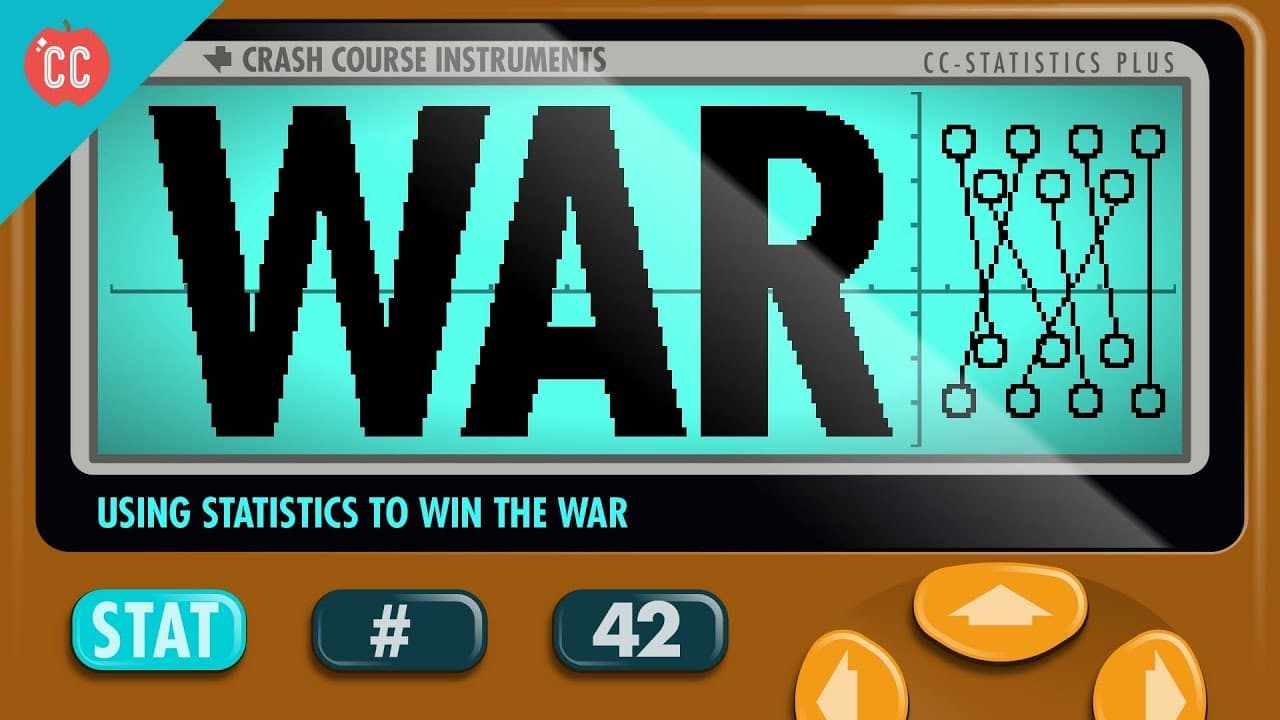
War: Crash Course Statistics #42
TL;DR
Statistics played a crucial role in WWII codebreaking and strategy.
Transcript
Hi, I’m Adriene Hill, and Welcome back to Crash Course Statistics. Statistics and probability have been used in applications beyond the ones we usually think of like research science and business analytics. One of the most consequential applications of statistics is helping countries survive and win wars. Today, we’ll talk about how people applied ... Read More
Key Insights
- Statistics and probability have been crucial in military applications, notably in codebreaking and strategic planning during World War II.
- The Enigma machine, used by the Germans, was cracked by Alan Turing and his team using statistical methods, significantly impacting the war's outcome.
- Bayesian reasoning was employed to locate German U-boats, optimizing search efforts and improving military strategies.
- Serial number analysis allowed the Allies to accurately estimate German tank production, showcasing the power of statistical inference.
- Bayesian Search Theory has been applied beyond war, such as in locating missing submarines and planes, proving its versatility.
- Statistical models are now used to predict the likelihood of future global conflicts, analyzing historical patterns of war and peace.
- Mathematical advancements during wartime often lead to significant progress in fields like encryption and statistical analysis.
- The role of statisticians in military planning continues to evolve, highlighting the enduring importance of data-driven decision-making.
Install to Summarize YouTube Videos and Get Transcripts
Explore YouTube Video Summarizer or Get YouTube Transcript Extractor
Questions & Answers
Q: How did Alan Turing contribute to codebreaking during WWII?
Alan Turing and his team developed methods to crack the Enigma code used by the Germans. By using statistical techniques, such as Bayesian reasoning, they were able to significantly reduce the number of possible settings for the Enigma machine, making it feasible to decode messages. This breakthrough in codebreaking is credited with shortening the war by several years.
Q: What role did Bayesian reasoning play in WWII?
Bayesian reasoning was crucial in several military strategies during WWII. It was used to locate German U-boats by updating probability estimates based on available information. This approach allowed for more efficient allocation of resources in searching for enemy submarines, thereby enhancing the effectiveness of military operations.
Q: How were serial numbers used to estimate German tank production?
The Allies used captured German tanks' serial numbers to estimate production rates. By analyzing the range of serial numbers, they could infer the total number of tanks produced. This statistical approach provided a more accurate estimate than traditional intelligence methods, revealing that the Germans produced significantly fewer tanks than initially believed.
Q: What is Bayesian Search Theory, and how has it been applied?
Bayesian Search Theory involves using prior knowledge and probability to locate objects, such as missing submarines or planes. It was notably applied by John Craven to find the USS Scorpion, a missing nuclear submarine. By incorporating expert opinions and available data, Bayesian Search Theory creates a probability map to guide search efforts effectively.
Q: How do statisticians predict future wars?
Statisticians use historical data and statistical models to predict the likelihood of future conflicts. By analyzing patterns and trends in past wars and periods of peace, they can estimate the probability of major conflicts occurring. This approach helps in understanding the dynamics of global peace and conflict over time.
Q: What advancements in mathematics were driven by wartime needs?
Wartime needs have historically driven advancements in mathematics, particularly in areas like encryption and statistical analysis. The development of techniques to crack codes, such as the Enigma, and the use of Bayesian reasoning in strategic planning are examples of how military challenges have spurred mathematical innovation.
Q: Why is the study of statistics important in military planning?
Statistics is crucial in military planning because it allows for data-driven decision-making. By analyzing probabilities and trends, military strategists can optimize resource allocation, predict enemy movements, and estimate enemy capabilities. This analytical approach enhances strategic effectiveness and can significantly impact the outcome of conflicts.
Q: What modern applications have emerged from wartime statistical techniques?
Modern applications of wartime statistical techniques include advancements in encryption, data analysis, and search algorithms. Techniques like Bayesian reasoning are now applied in various fields, from cybersecurity to search and rescue operations. The foundational work done during wartime continues to influence contemporary technology and analytical methods.
Summary & Key Takeaways
-
Statistics have been pivotal in military history, aiding in codebreaking and strategic operations during World War II. Techniques developed during wartime, such as Bayesian reasoning, have had lasting impacts on both military and civilian applications.
-
Alan Turing's work on the Enigma machine exemplifies the intersection of mathematics and military strategy, demonstrating how statistical insights can alter the course of history by shortening conflicts and saving lives.
-
The use of statistical models to estimate enemy capabilities and predict future conflicts underscores the importance of data analysis in both historical and contemporary military contexts, illustrating the ongoing relevance of statistical methods.
Read in Other Languages (beta)
Share This Summary 📚
Summarize YouTube Videos and Get Video Transcripts with 1-Click
Try YouTube Summary with ChatGPT & Claude or YouTube Transcript Generator
Explore More Summaries from CrashCourse 📚





Summarize YouTube Videos and Get Video Transcripts with 1-Click
Try YouTube Summary with ChatGPT & Claude or YouTube Transcript Generator