What Are Algorithms and How Do They Work in Computing?
TL;DR
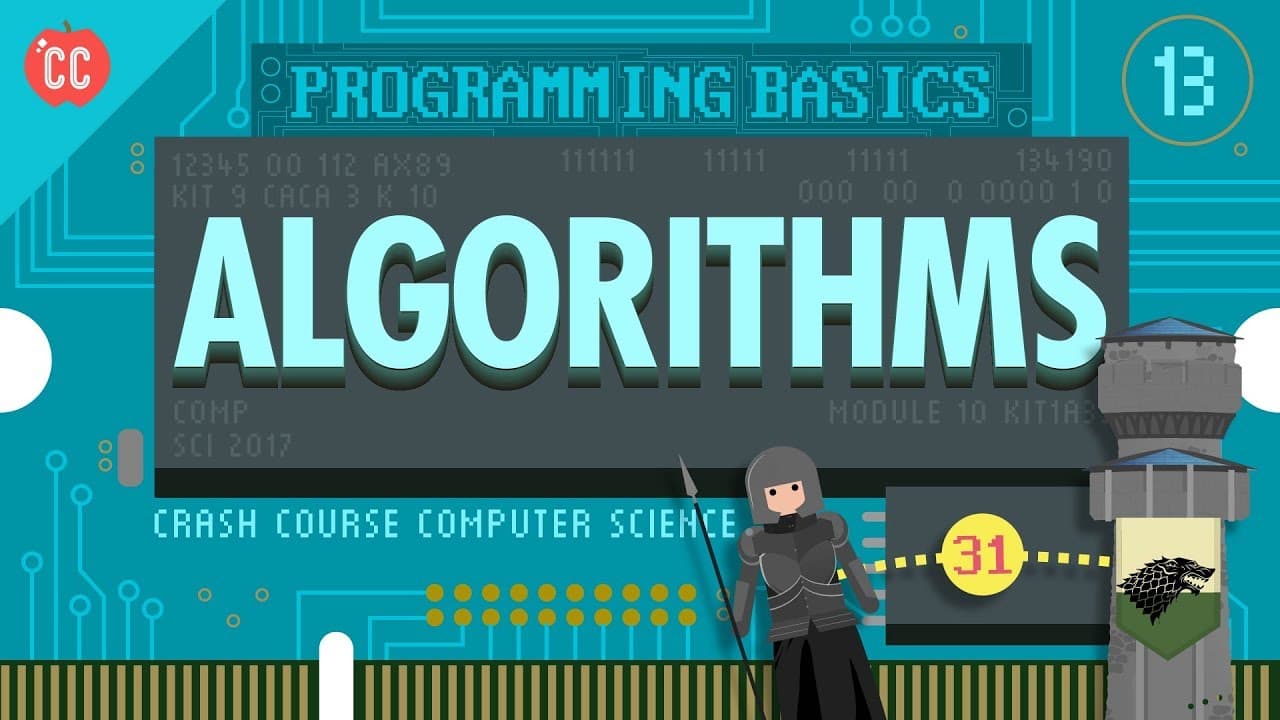
Algorithms provide structured steps to solve computational problems and are essential in computer science. This video explains two key types: sorting algorithms, like the less efficient Selection Sort and the more efficient Merge Sort, as well as graph search algorithms, such as Dijkstra's algorithm, that find the shortest paths in networks. Understanding these algorithms and their complexities is vital for efficient problem-solving.
Transcript
Hi, I’m Carrie Anne, and welcome to CrashCourse Computer Science! Over the past two episodes, we got our first taste of programming in a high-level language, like Python or Java. We talked about different types of programming language statements – like assignments, ifs, and loops – as well as putting statements into functions that perform a computa... Read More
Key Insights
- Algorithms are fundamental to computing, providing the steps needed to solve problems efficiently, with historical roots in mathematics.
- Sorting algorithms like Selection Sort and Merge Sort are used to order data, with Merge Sort being more efficient due to its logarithmic complexity.
- Selection Sort is a basic algorithm with a complexity of N squared, making it less efficient for large datasets compared to other sorting algorithms.
- Merge Sort divides data into smaller arrays and merges them in sorted order, offering a complexity of N log N, which is more scalable.
- Graph search algorithms like Dijkstra's are used to find the shortest paths in networks, vital for applications like GPS navigation.
- Dijkstra's algorithm has been optimized to handle larger graphs efficiently, reducing its complexity from N squared to N log N.
- Understanding different algorithms and their complexities is crucial for computer scientists to create efficient solutions for various computational problems.
- The modern world relies heavily on algorithms for everyday tasks, from finding directions to sorting data, underscoring their importance in technology.
Install to Summarize YouTube Videos and Get Transcripts
Explore YouTube Video Summarizer or Get YouTube Transcript Extractor
Questions & Answers
Q: What is the significance of algorithms in computer science?
Algorithms are essential in computer science as they provide the structured steps necessary to solve computational problems efficiently. They are the core of what computers do, enabling tasks like sorting data, searching networks, and optimizing processes. Understanding and developing algorithms is crucial for creating effective and scalable solutions.
Q: How does Selection Sort work and what are its limitations?
Selection Sort works by repeatedly finding the smallest element from the unsorted portion of an array and swapping it with the first unsorted element. Its main limitation is its inefficiency for large datasets due to its N squared complexity, making it slow compared to more advanced sorting algorithms like Merge Sort.
Q: Why is Merge Sort considered more efficient than Selection Sort?
Merge Sort is more efficient than Selection Sort because it divides the array into smaller sub-arrays, sorts them, and then merges them in sorted order. This divide-and-conquer approach results in a complexity of N log N, which scales better with larger datasets compared to the N squared complexity of Selection Sort.
Q: What is Dijkstra's algorithm used for in computing?
Dijkstra's algorithm is used for finding the shortest path between nodes in a graph, which is crucial for applications like GPS navigation and network routing. It calculates the minimum cost to reach a destination from a starting point, optimizing routes in terms of time or distance, and is fundamental in graph theory.
Q: How has Dijkstra's algorithm been optimized for larger graphs?
Dijkstra's algorithm was originally N squared in complexity, but it has been optimized to N log N by incorporating data structures like priority queues. This optimization allows it to handle larger graphs efficiently, reducing the number of operations needed and making it feasible for large-scale applications like mapping entire countries.
Q: What role do algorithms play in everyday technology?
Algorithms are integral to everyday technology, powering tasks like data sorting, search engine results, GPS navigation, and more. They enable devices and applications to perform complex computations quickly and accurately, making them indispensable in the digital age where efficiency and speed are paramount.
Q: What is the importance of understanding algorithm complexity?
Understanding algorithm complexity is crucial for assessing the efficiency and scalability of algorithms. It helps computer scientists predict how an algorithm will perform as the size of the input data increases, guiding the selection of the most appropriate algorithm for a given problem to ensure optimal performance.
Q: How do sorting algorithms impact data processing?
Sorting algorithms impact data processing by organizing data in a specific order, which is essential for efficient searching, retrieval, and analysis. Efficient sorting algorithms like Merge Sort improve the speed and performance of data-intensive applications, making them vital for handling large volumes of information in various fields.
Summary & Key Takeaways
-
Algorithms are the backbone of computer science, providing structured steps to solve computational problems efficiently. This episode explores sorting and graph search algorithms, emphasizing their significance in modern computing.
-
Sorting algorithms like Selection Sort and Merge Sort are crucial for organizing data. While Selection Sort is basic and inefficient for large datasets, Merge Sort offers better scalability with its N log N complexity.
-
Graph search algorithms, exemplified by Dijkstra's algorithm, are essential for finding shortest paths in networks. These algorithms have evolved to handle large-scale problems efficiently, proving indispensable in applications like GPS.
Read in Other Languages (beta)
Share This Summary 📚
Summarize YouTube Videos and Get Video Transcripts with 1-Click
Try YouTube Summary with ChatGPT & Claude or YouTube Transcript Generator
Explore More Summaries from CrashCourse 📚




Summarize YouTube Videos and Get Video Transcripts with 1-Click
Try YouTube Summary with ChatGPT & Claude or YouTube Transcript Generator