Theory of Peltier cooling
TL;DR
This content explains how thermoelectric cooling devices work and their principles.
Transcript
welcome everyone today's topic is the thermoelectric cooling or perche a cooling I would like to talk about this because I saw many videos in the internet on YouTube and I saw that many people are messing up these things and they don't understand how these devices work so I want to make it clear or I try to make it clear how they work and hopefully... Read More
Key Insights
- 😎 Thermoelectric devices utilize temperature gradients to create electrical energy, impacting both heating and cooling processes.
- 🥵 The Peltier effect is central to the function of thermoelectric coolers, enabling heat absorption on one end while dissipating it on the opposite side.
- 🌸 Joule heating represents a significant efficiency loss in thermoelectric systems, driven by the resistance encountered by electrical currents.
- 🥵 Thermal gradient-induced heat flow impacts device performance, as heat will naturally transfer from hot to cold areas.
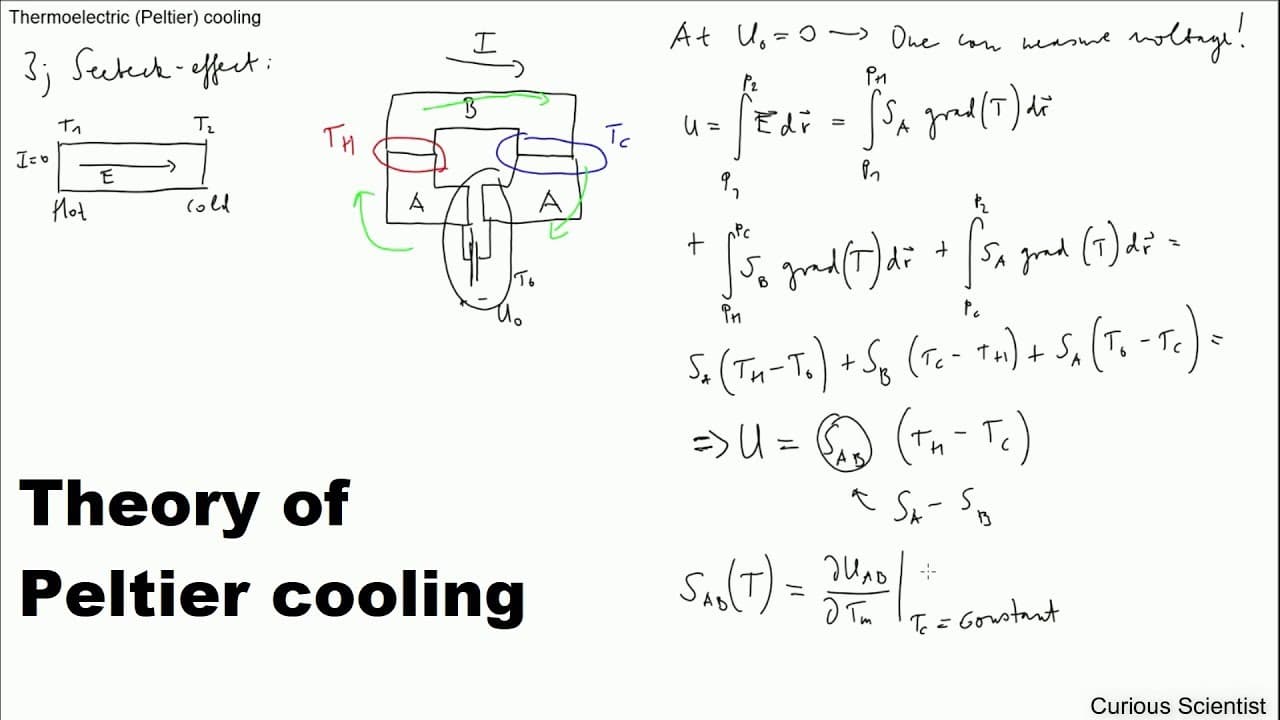
- 💁 The Seebeck effect illustrates how temperature differences can generate electric fields within a material, forming a basis for other thermoelectric applications.
- 😎 Managing temperature and current is critical in improving the efficiency of thermoelectric cooling devices.
- 😒 The design of device materials, such as the use of semiconductors and ceramics, influences overall thermal management and performance.
Install to Summarize YouTube Videos and Get Transcripts
Explore YouTube Video Summarizer or Get YouTube Transcript Extractor
Questions & Answers
Q: What is the primary principle behind thermoelectric cooling?
Thermoelectric cooling works based on the interaction between temperature gradients and electrical currents. When a current flows through a thermoelectric material, it can create a temperature difference—one side becomes cooler, while the other side heats up. This process is rooted in the Peltier effect, which describes how energy is absorbed or released during electronic transitions between different materials.
Q: What are the main effects discussed that influence thermoelectric devices?
The main effects include Joule heating, which is the heat generated by electrical resistance, heat conduction, which describes how heat moves from hot to cold areas, and three reversible effects: the Seebeck effect, the Peltier effect, and the Thomson effect. Each of these effects plays a crucial role in the operational efficiency and effectiveness of thermoelectric cooling systems.
Q: Why is managing current levels important in thermoelectric devices?
Managing current levels is crucial because using a current that is too high can lead to excessive Joule heating, overwhelming the cooling effect generated by the Peltier effect. This could result in the device overheating instead of cooling down, thus reducing efficiency. Therefore, finding an optimal current is essential for effective thermoelectric cooling performance.
Q: How can thermal insulation improve thermoelectric device performance?
Using effective thermal insulation reduces heat leakage between the hot and cold sides of a thermoelectric device. This ensures that the cold side can maintain its lower temperature without being influenced by heat from the environment or the hot side. Insulating materials help minimize energy losses, thus enhancing overall cooling efficiency.
Q: What practical advice is given for improving thermoelectric cooling?
Practical advice includes using a support mechanism to maintain the hot side at a relatively constant temperature, optimizing the current applied to avoid excessive Joule heating, and employing insulating materials to reduce heat exchange. These strategies collectively enhance the cooling effectiveness and longevity of thermoelectric devices.
Q: Can the Seebeck coefficient be measured practically?
Yes, the Seebeck coefficient can be measured by applying a constant temperature at one side of the thermoelectric device and observing the output voltage produced across the device. By varying the temperature at the cold side, one can plot voltage against temperature changes, allowing for the calculation of the Seebeck coefficient, which defines the effectiveness of the device.
Summary & Key Takeaways
-
The video provides a detailed explanation of thermoelectric cooling, emphasizing the relationship between temperature gradients and electricity generation in devices like thermocouples and Peltier elements.
-
It clarifies the key effects involved in thermoelectric cooling, including Joule heating and the Seebeck effect, and how these impact device efficiency and functioning.
-
The speaker highlights common misconceptions surrounding these devices and offers practical advice on enhancing thermoelectric cooling performance, such as managing current levels and thermal insulation.
Read in Other Languages (beta)
Share This Summary 📚
Summarize YouTube Videos and Get Video Transcripts with 1-Click
Try YouTube Summary with ChatGPT & Claude or YouTube Transcript Generator
Explore More Summaries from Curious Scientist 📚
![Building a Peltier cooler-based cooling box - First iteration, improvements [Part 2/6] thumbnail](/_next/image?url=https%3A%2F%2Fi.ytimg.com%2Fvi%2F0YlNw0EGnzI%2Fhqdefault.jpg&w=750&q=75)





Summarize YouTube Videos and Get Video Transcripts with 1-Click
Try YouTube Summary with ChatGPT & Claude or YouTube Transcript Generator