How Does Open-Source Text-to-Video Synthesis Work?
TL;DR
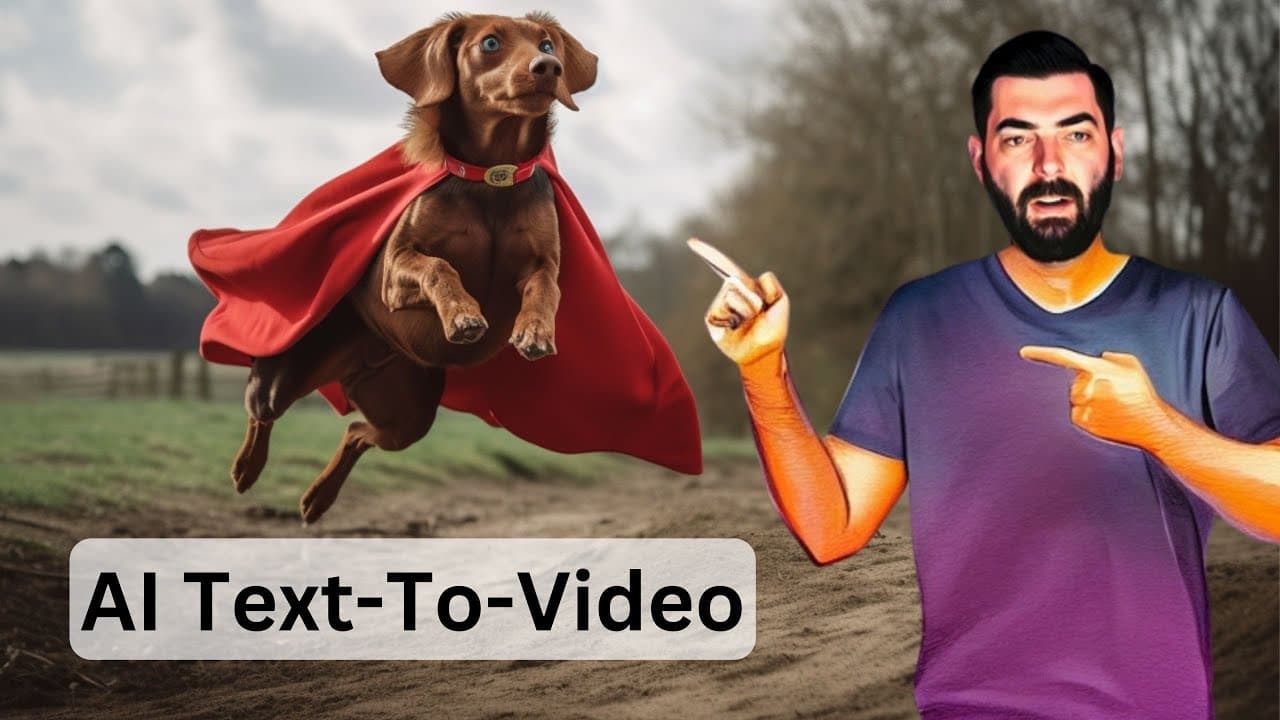
Open-source text-to-video synthesis allows users to create videos from written prompts, showcasing various examples like landscapes and animals. While results may sometimes include Shutterstock watermarks, the technology is in its early stages and has significant potential for developing realistic video content, albeit requiring multiple attempts for desirable results.
Transcript
so up until now we haven't really seen real text to video we've seen some demos from companies like meta and companies like Google showing off what text to video is coming and we've had some really cool tools like deforum and this plasma Punk tool and this decoherence tool which sort of merge image to image to image and give kind of a cool animatio... Read More
Key Insights
- 🎮 Text-to-video synthesis technology has made significant strides, allowing users to generate videos based on written prompts.
- 🤗 The open-source model showcased in the content demonstrates the potential of the technology, despite some limitations.
- 🎮 While the current technology requires refinement, it has the potential to revolutionize video creation and content generation.
- 🎮 The model's reliance on Shutterstock videos for training highlights the need for diverse training datasets to improve the generated video quality.
- ❓ The technology is in its early stages, and improvements are expected as researchers and developers continue to refine the models.
- ✋ Generating high-quality and detailed videos through text prompts may require multiple attempts and experimentation.
- 🤗 Open-source models like the one demonstrated in the content provide opportunities for further research and development in text-to-video synthesis.
Install to Summarize YouTube Videos and Get Transcripts
Explore YouTube Video Summarizer or Get YouTube Transcript Extractor
Questions & Answers
Q: What is text-to-video synthesis?
Text-to-video synthesis refers to the process of generating videos based on written prompts. It involves using AI models to convert text descriptions into visual representations.
Q: How does the open-source text-to-video synthesis model work?
The open-source model utilizes a 1.7 billion parameter diffusion model to generate videos. Users can input prompts and the model will process them, producing video clips based on the text descriptions.
Q: Are the generated videos of high quality?
The quality of the generated videos varies. While some examples showcased in the content are impressive and realistic, many require multiple attempts or specific prompts to achieve the desired results.
Q: What are the limitations of the current text-to-video synthesis technology?
One limitation is the reliance on Shutterstock videos for training the model, resulting in watermarked videos. Additionally, generating specific or detailed content may require numerous attempts or trial and error.
Summary & Key Takeaways
-
Text-to-video synthesis technology has made significant progress, with the release of an open-source model that enables users to generate videos from written prompts.
-
The model has been demonstrated with various examples, including landscapes, animals, and objects, showcasing its versatility.
-
While the generated videos sometimes contain Shutterstock watermarks, the technology shows great potential in creating realistic and detailed video content.
Read in Other Languages (beta)
Share This Summary 📚
Summarize YouTube Videos and Get Video Transcripts with 1-Click
Try YouTube Summary with ChatGPT & Claude or YouTube Transcript Generator
Explore More Summaries from Matt Wolfe 📚

Summarize YouTube Videos and Get Video Transcripts with 1-Click
Try YouTube Summary with ChatGPT & Claude or YouTube Transcript Generator