How to Grow Tin Crystals Quickly and Effectively
TL;DR
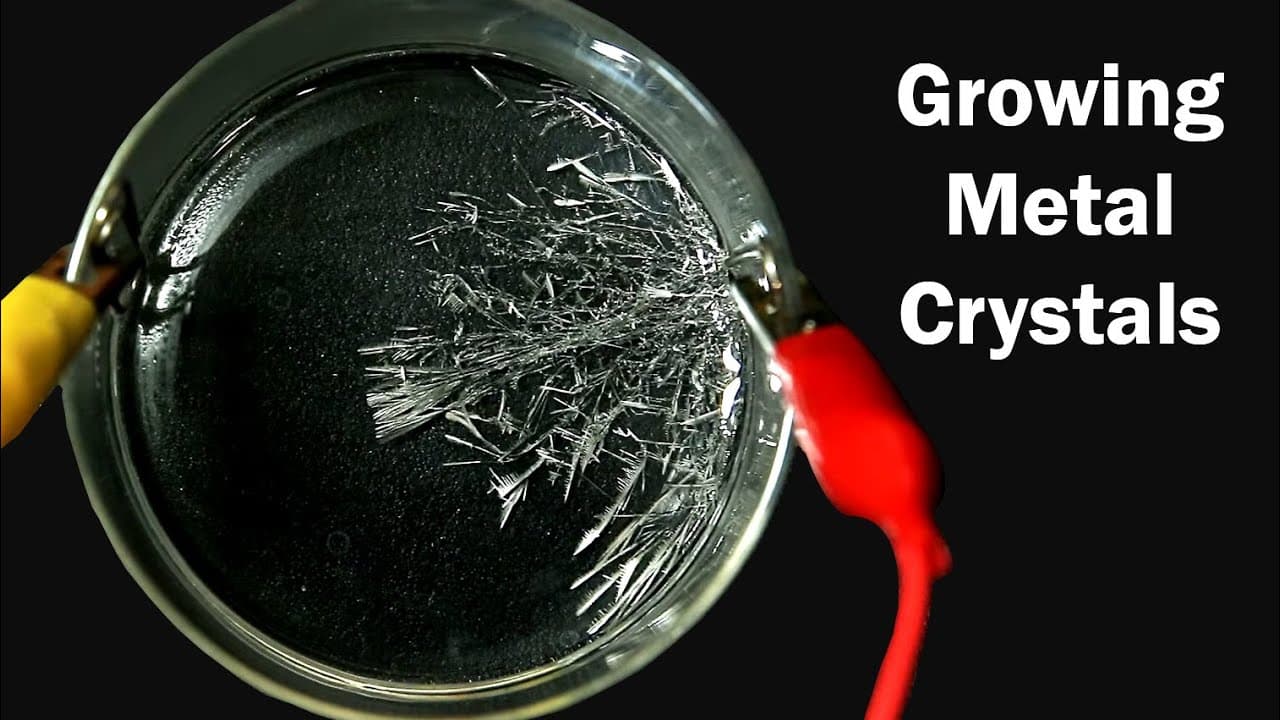
To grow tin crystals efficiently, use a powerful power supply instead of a battery. This method accelerates the growth process, allowing for larger crystal formations. Be mindful that increased power can heat the solution and lead to boiling, making careful monitoring essential.
Transcript
So this is basically what you need to carry out this experiment: You need; a stannous chloride solution, a dish to hold it in, some alligator clips, some paper clips and a power source. Each of the paper clips will serve as an electrode, and they're clamped to either side of the dish using the alligator clips. The dishes then filled with a few mill... Read More
Key Insights
- 📎 Alligator clips and paper clips can be used as electrodes to grow tin crystals in a stannous chloride solution.
- 🔋 Using a powerful power supply instead of a regular battery accelerates crystal growth, but can also lead to solution heating and boiling.
- 😆 The crystal growth process is a redox reaction, with tin ions being oxidized and reduced at different ends.
- 😆 Reversing the terminals can shrink existing tin crystals.
- 🔮 Lighting conditions and temperature can affect the appearance of the crystal growth.
- 😆 The process demonstrates the ability of tin metal to give up or receive electrons to form tin ions.
- 🔁 The experiment can be repeated for better results and aesthetics.
Install to Summarize YouTube Videos and Get Transcripts
Explore YouTube Video Summarizer or Get YouTube Transcript Extractor
Questions & Answers
Q: What materials are needed to carry out the experiment?
The experiment requires stannous chloride solution, a dish, alligator clips, paper clips, and a power source such as a powerful power supply.
Q: How are the electrodes set up in the dish?
Each paper clip serves as an electrode and is clamped to either side of the dish using alligator clips.
Q: Why did the crystals grow slowly with a regular battery?
The regular battery provided insufficient current, resulting in slow crystal growth and a low quantity of crystals.
Q: Why did the solution start boiling when using the powerful power supply?
The increased power input from the powerful power supply caused the solution to heat up, leading to boiling on one side.
Q: What happens during the redox reaction?
The tin ions in the stannous chloride solution are oxidized at the positive side, giving away electrons, and reduced at the negative side, receiving electrons.
Summary & Key Takeaways
-
Alligator clips and paper clips are used as electrodes in a dish filled with a stannous chloride solution to grow tin crystals.
-
The process is slow and produces few crystals initially, prompting the use of a more powerful power supply.
-
Using the powerful power supply, the crystals grow faster, but the solution heats up and starts to boil due to increased power input.
-
The process is a redox reaction, with tin ions being oxidized and reduced at different ends.
Read in Other Languages (beta)
Share This Summary 📚
Summarize YouTube Videos and Get Video Transcripts with 1-Click
Try YouTube Summary with ChatGPT & Claude or YouTube Transcript Generator
Explore More Summaries from NileRed 📚


Summarize YouTube Videos and Get Video Transcripts with 1-Click
Try YouTube Summary with ChatGPT & Claude or YouTube Transcript Generator