How Does Penicillin Synthesize to Fight Bacteria?
TL;DR
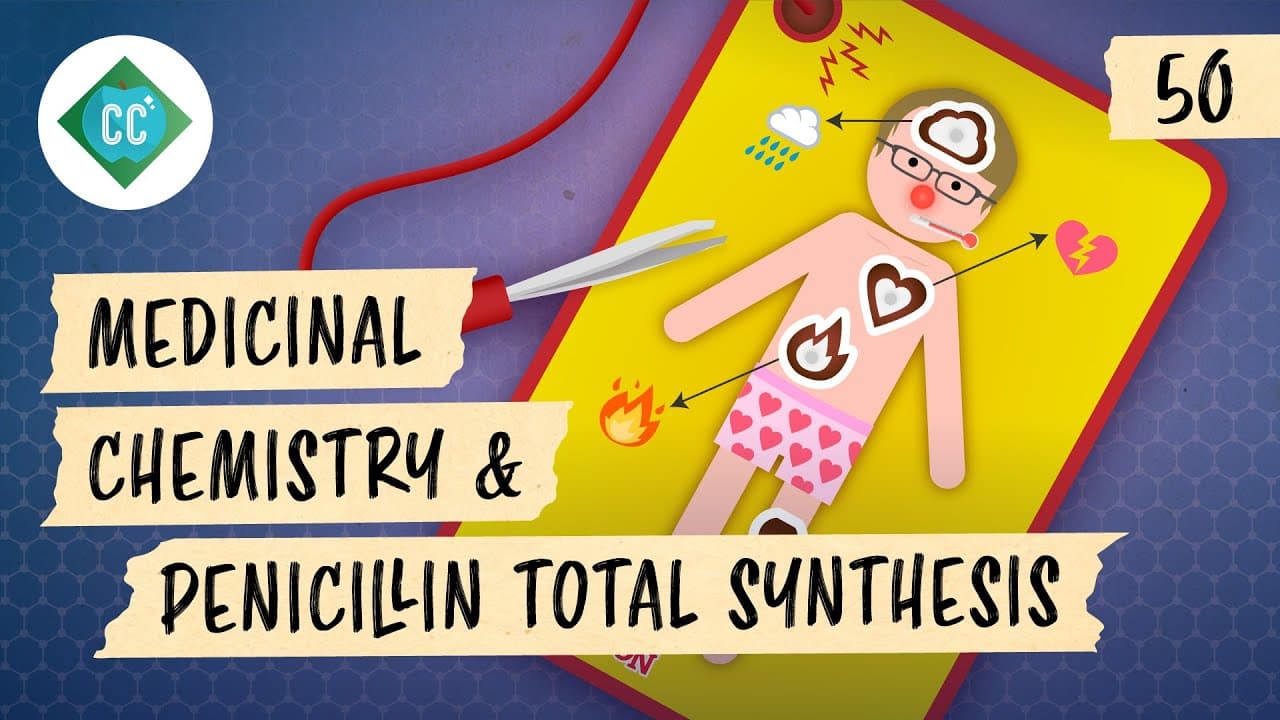
Penicillin fights bacterial infections by irreversibly binding to the transpeptidase enzyme, which prevents cell wall construction, leading to bacterial death. This video also explores the intricate synthesis of penicillin and the methods used to create it, highlighting the importance of organic chemistry in medicine.
Transcript
you can review content from crash course organic chemistry with the crash course app available now for android and ios devices hi i'm daboki chakravarti and welcome to our last episode of crash course organic chemistry early one morning in 1926 the silent film sensation rudolph valentino died at the age of 31. people packed the streets to pay their... Read More
Key Insights
- ⛽ Proton pump inhibitors emerged as effective treatments for ulcers post-1926.
- 👷 Transpeptidase enzyme inhibition by penicillin disrupts bacterial cell wall construction.
- 💁 Synthetic chemistry tools like protecting groups enable precise peptide bond formations.
- 🙅 Penicillin's irreversible binding permanently deactivates enzymes, halting bacterial growth.
- 💊 Understanding organic chemistry aids in developing medicines addressing various health issues.
- 👶 Bacterial resistance challenges necessitate ongoing development of new antibacterial treatments.
- ❓ Synthetic chemistry methods streamline complex compound synthesis, like penicillin.
Install to Summarize YouTube Videos and Get Transcripts
Explore YouTube Video Summarizer or Get YouTube Transcript Extractor
Questions & Answers
Q: How did Rudolph Valentino's death impact medical advancements?
Valentino's death highlighted the need for ulcer treatments, leading to the development of proton pump inhibitors we have today.
Q: How does penicillin affect bacterial cell wall formation?
Penicillin binds irreversibly to transpeptidase enzymes, inhibiting the cross-linking process of peptidoglycan chains needed for cell wall integrity.
Q: What are some synthetic chemistry techniques used in penicillin synthesis?
Protecting groups and peptide coupling reagents are employed to control reactions and ensure precise assembly of penicillin's structure.
Q: How does penicillin's mechanism contribute to fighting bacterial infections?
Penicillin disrupts the formation of bacterial cell walls, weakens them, and causes bacterial cells to burst and die, effectively combating infections.
Summary & Key Takeaways
-
Rudolph Valentino's untimely death from ulcers in 1926 sparked advancements in ulcer treatments like proton pump inhibitors.
-
The chemical inhibition mechanism of penicillin involves binding to transpeptidase enzymes, disrupting bacterial cell wall formation.
-
Synthetic chemistry methods, like utilizing protecting groups and peptide coupling reagents, enable the complex synthesis of penicillin.
Read in Other Languages (beta)
Share This Summary 📚
Summarize YouTube Videos and Get Video Transcripts with 1-Click
Try YouTube Summary with ChatGPT & Claude or YouTube Transcript Generator
Explore More Summaries from CrashCourse 📚





Summarize YouTube Videos and Get Video Transcripts with 1-Click
Try YouTube Summary with ChatGPT & Claude or YouTube Transcript Generator