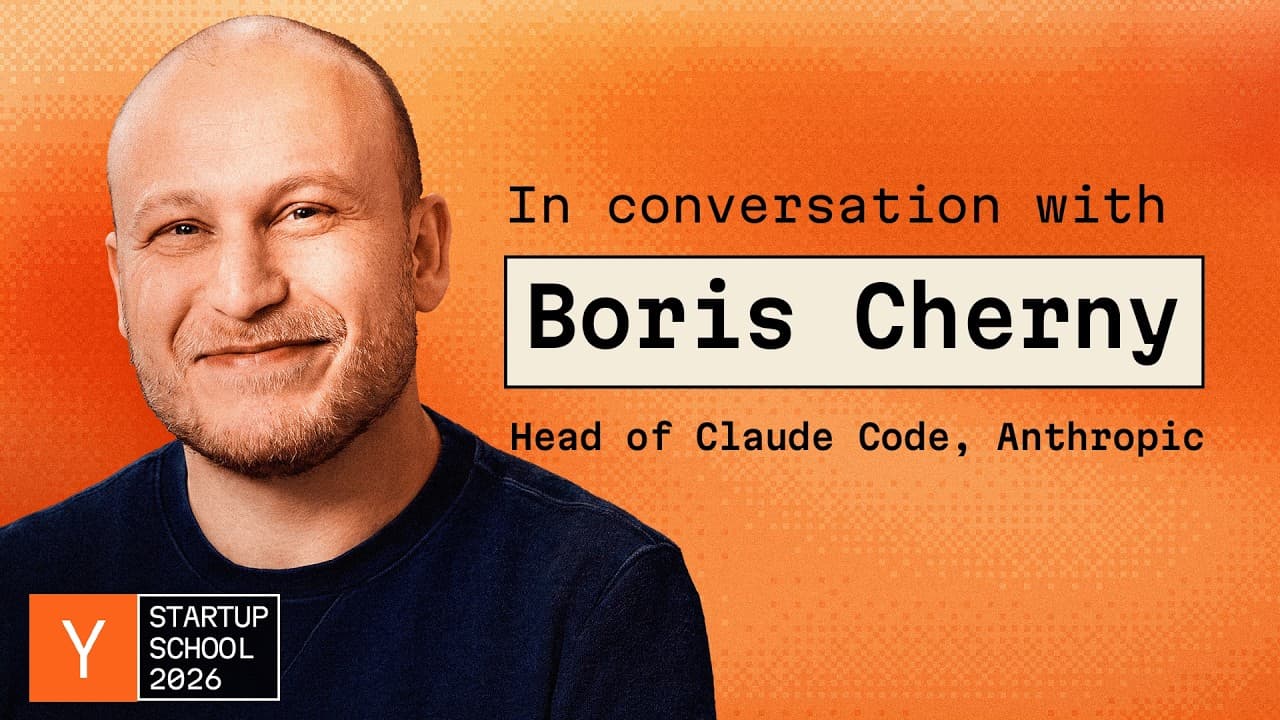
Why Did Boris Cherny Cut 80% of Claude Code’s System Prompt?
TL;DR
Boris Cherny says Claude Code cut 80% of its system prompt because Opus 5 can now handle behaviors that earlier prompts had to correct. His team tests each model release through ablation: they remove the entire system prompt, restore it line by line, and evaluate each instruction’s impact. Read on to see how simple mode, prompt-injection defenses, and long-running tasks shape this approach.
Transcript
All right, Boris, we're so excited to have you here, the creator of Cloud Code. Thank you. >> It's great to be here. >> Fresh off the press, you guys just shipped Opus 5 yesterday. >> Yes. And it seems that model performance keeps accelerating. You guys got took Arc AGI 3 to 30%. Which is incredible. >> Yes. >> And for context, before the best scor... Read More
Key Insights
- Opus 5 is capable of running tasks for extended periods without requiring scaffolding.
- The model is less susceptible to prompt injection, enhancing security.
- Claude Code deleted 80% of its system prompt, relying on the model's intelligence.
- Developers should frequently start from scratch, allowing models to demonstrate new capabilities.
- Product overhang occurs when a product's design limits a model's potential.
- Dynamic workflows enable efficient orchestration of multiple AI agents.
- Routine tasks can be automated, freeing engineers for more creative work.
- Experimentation is crucial for discovering new model capabilities.
Install to Summarize YouTube Videos and Get Transcripts
Explore YouTube Video Summarizer or Get YouTube Transcript Extractor
Questions & Answers
Q: Why did Boris Cherny cut 80% of Claude Code’s system prompt?
Much of the system prompt corrected behaviors that earlier models should have understood but did not. According to Boris Cherny, Opus 5 now handles many of those behaviors on its own, allowing the Claude Code team to remove 80% of the prompt.
Q: How does the Claude Code team optimize its system prompt for each model?
For every new model, the team removes the entire system prompt and restores it line by line. This ablation process evaluates the effect of each instruction and identifies which parts are still useful.
Q: Can Claude Code run without its normal system prompts?
Yes. Setting the environment variable “claude code simple equals 1” activates an undocumented simple mode that removes all system prompts, including prompts attached to tools. The team uses this mode as an ablation to test whether the prompts improve behavior.
Q: Does removing prompts make Opus 5 more intelligent?
Boris Cherny says the team has found that the model can be a little more intelligent without the prompts. However, Claude Code retains some prompts because they help the product and model behave as a person using the product would want.
Q: How long can Opus 5 run on a task?
Combined with auto mode, Opus 5 can keep working for days, weeks, or months, according to the transcript. Boris says it does not need scaffolding because it recognizes that it must continue completing the task.
Q: How does Opus 5 resist prompt injection?
The described defense combines a well-aligned model, a prompt-injection classifier used for all traffic, and an auto mode classifier. The prompt-injection classifier looks for model neurons that activate when an injection occurs, allowing the system to diagnose it even when the model does not report it.
Q: Why does Claude Code change its prompts and tools whenever a new model arrives?
Each model behaves differently, so techniques created for a model three months earlier may not transfer to the next one. The team therefore adds and removes system-prompt instructions, changes available tools, rewrites tool prompts, and deletes harness code as needed.
Q: What is ablation in Claude Code development?
Ablation means deleting elements to measure their individual impact. In Claude Code, the team removes the full system prompt and then brings instructions back one line at a time, using evaluation to determine whether each line is useful.
Summary & Key Takeaways
-
Opus 5 exhibits remarkable improvements in performance, capable of handling tasks for extended durations without prompt injection vulnerabilities. Its intelligence allows for significant reductions in system prompts, encouraging developers to simplify and let the model explore tasks independently. This approach can uncover unexpected capabilities, such as rewriting entire codebases or drawing with OpenCV, highlighting the importance of experimentation in AI development.
-
The concept of 'product overhang' is introduced, where product design limits a model's potential. By removing unnecessary prompts and letting the model operate freely, developers can discover new capabilities. Opus 5's ability to run thousands of agents simultaneously through dynamic workflows showcases its efficiency and opens new possibilities for AI applications.
-
Experimentation and empirical approaches are emphasized as vital for leveraging AI models like Opus 5. By frequently starting from scratch and allowing the model to demonstrate its capabilities, developers can uncover new functionalities and improve product design. Routine tasks can be automated, enabling engineers to focus on more creative and rewarding work.
Read in Other Languages (beta)
Share This Summary 📚
Summarize YouTube Videos and Get Video Transcripts with 1-Click
Try YouTube Summary with ChatGPT & Claude or YouTube Transcript Generator
Explore More Summaries from Y Combinator 📚



Summarize YouTube Videos and Get Video Transcripts with 1-Click
Try YouTube Summary with ChatGPT & Claude or YouTube Transcript Generator