What would Canada EU associate membership mean?
TL;DR
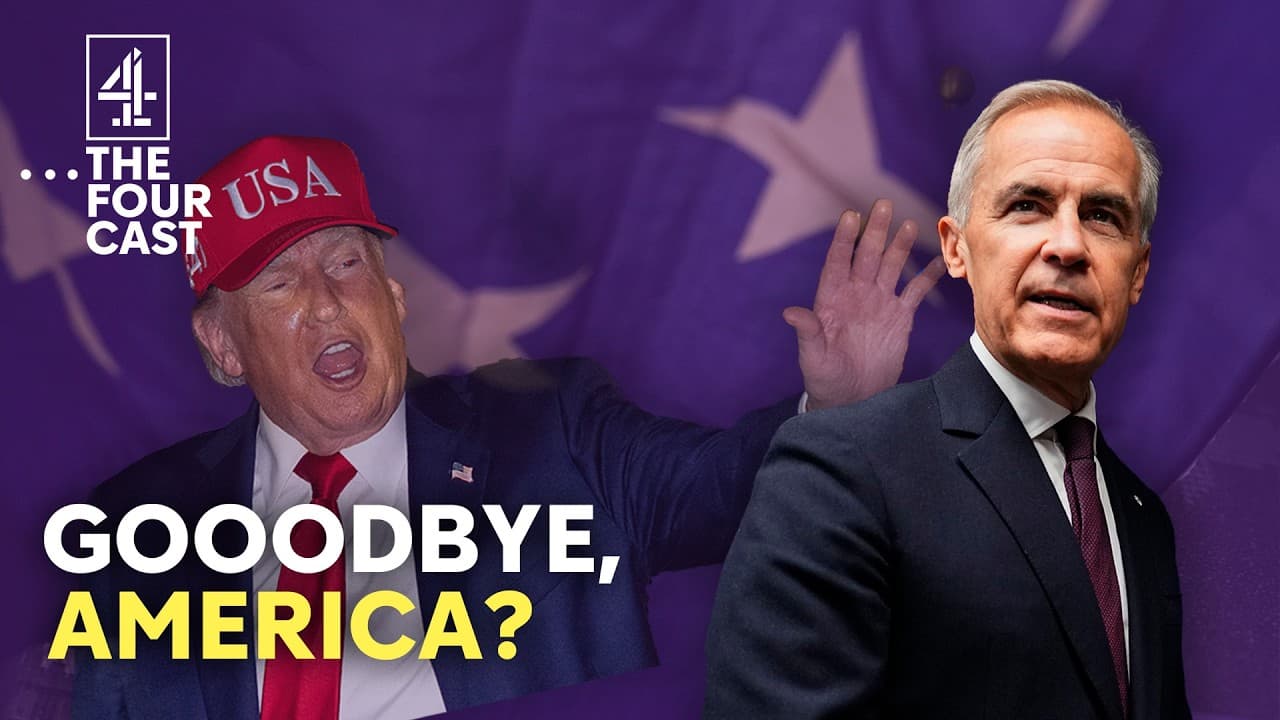
Canada pursuing an EU associate membership signals a push for a values based bloc in response to US policy. The move could deepen trade and defense ties, but delivering a formal agreement would be complex and face both US and European domestic hurdles.
Transcript
We're not going to be your 51st state, King Trump. [music] >> I think it's really interesting here in Europe how nearly hysteric everybody is about Mark Carney coming over. Here in Europe, we lack in a way this kind of future oriented positive narrative that we are still someone something in the world. >> Trump doesn't do together, does he? If you'... Read More
Key Insights
- Canada is pursuing closer EU ties through an associate membership concept.
- The idea is framed as a beacon for democracies to cooperate on governance, economy, and security.
- Associate membership is described as normative rather than a real treaty due to EU treaty constraints.
- Carney is portrayed as a symbol of middle powers united against external pressure.
- The move is presented as a response to US President Trump and the current geopolitics.
- Europe and Canada are depicted as seeking to balance values with practical cooperation.
- Delivering any formal agreement would be extremely complex and politically sensitive.
- Inclusive democracy and rule of law are central themes driving the discussion.
Install to Summarize YouTube Videos and Get Transcripts
Explore YouTube Video Summarizer or Get YouTube Transcript Extractor
Questions & Answers
Q: What is meant by an associate membership between Canada and the EU?
An associate membership is described as a normative concept rather than an actual pathway to full EU membership. It would signify a close connection covering economic, security, and people to people ties without creating a formal EU membership status for Canada, which is not a European country and thus cannot join the union in the traditional sense.
Q: Why is Canada pursuing closer EU ties now?
The discussion presents Canada’s move as motivated by a desire to strengthen democracies and rule of law in response to the policies associated with President Trump, and to counterbalance competition from the US and China in tech and AI. It is portrayed as a strategic effort to shape a shared liberal order.
Q: Who is Mark Carney in this context and why is he important?
Mark Carney is described as a key figure who embodies middle powers united against perceived threats from the east and west. His leadership and public positions are seen as central to signaling a stance that favors democratic values and open cooperation between Canada, Europe, and other democracies against threats to liberal norms.
Q: What challenges would an EU-Canada associate membership face?
The challenges include the lack of a formal EU mechanism for associate membership, political skepticism in Europe, and the difficulty of coordinating trade, defense, and regulatory frameworks across different legal and constitutional systems. The agreement would require navigating complex negotiations and long term commitments that are not currently provided for in EU treaties.
Q: How does the transcript describe the US reaction to the idea?
The transcript notes that President Trump has threatened tariffs and trade restrictions in response to closer Canada EU ties, describing these ties as a potential affront. It suggests that Washington views any move away from a transactional relationship as a challenge, while the other speakers urge restraint and emphasize a broader strategic objective.
Q: What role does democracy and the rule of law play in this narrative?
Democracy and the rule of law are positioned as the core values guiding the Canada EU dialogue. The speakers argue that aligning Canada with EU standards on governance could strengthen cooperative efforts, set a counterweight to aggressive economic nationalism, and provide a beacon for other democracies seeking aligned norms.
Q: How is the idea connected to global competition with China and tech?
The idea is connected to broader global competition in technology and AI, where Europe and Canada are seen as jointly pursuing strategic autonomy and resilient supply chains. By fostering closer ties, they aim to maintain an open, rules based framework that can compete with non liberal models and protect shared interests.
Q: What would be the practical outcomes if such association materialized?
If realized, practical outcomes could include enhanced trade links, deeper regulatory cooperation, joint security or defense planning, and people to people exchanges. However, the transcript emphasizes that these outcomes would require extensive negotiations, strong political will, and likely new institutional arrangements within Europe and Canada.
Summary & Key Takeaways
-
The episode explains that Ursula von der Leyen offered Canada associate membership of the EU, a move that would create closer ties without full membership due to Canada not being European. It frames the shift as a response to Donald Trump and a broader contest with China in tech and AI.
-
A key point is that the idea is aspirational and will be difficult to implement because there is no existing EU mechanism for associate membership and no European framework for Canada to join as a full member.
-
The discussion highlights how Mark Carney is central to the narrative, seen as a symbol of middle powers uniting around democratic values, rule of law, and cooperation against adversarial pressures, while still acknowledging Canada must navigate its geography and relations with the United States.
Read in Other Languages (beta)
Share This Summary 📚
Summarize YouTube Videos and Get Video Transcripts with 1-Click
Try YouTube Summary with ChatGPT & Claude or YouTube Transcript Generator
Explore More Summaries from Channel 4 News 📚



Summarize YouTube Videos and Get Video Transcripts with 1-Click
Try YouTube Summary with ChatGPT & Claude or YouTube Transcript Generator