Why Boston Dynamics Atlas Beats Other Humanoid Robots
TL;DR
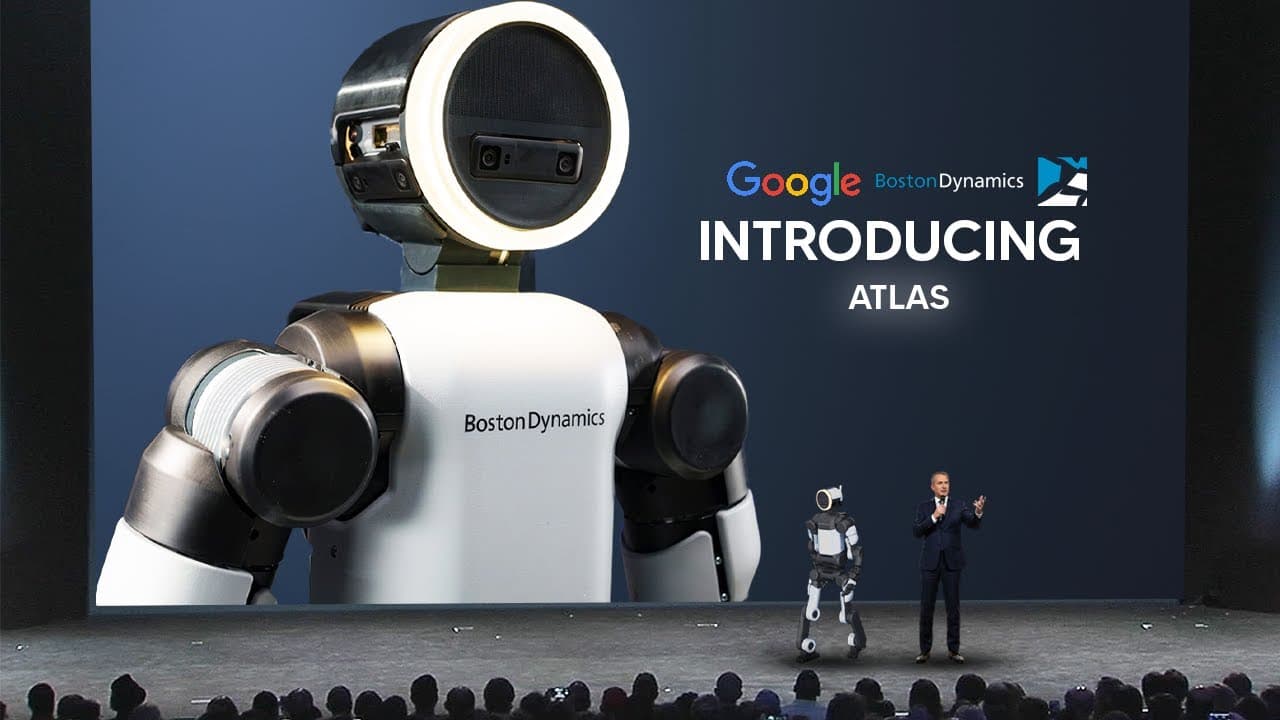
Boston Dynamics Atlas is the first humanoid robot doing real factory work autonomously, picking up car parts and organizing them for assembly without remote control. Hyundai plans to deploy them, producing 30,000 robots per year. Unlike rivals optimized for viral demos, Atlas learns a new task in 48 hours and repeats it reliably.
Transcript
So, Boston Dynamics is the first humanoid robot that actually matters. And I'm going to tell you why. And most people don't realize just how crazy this robot is. Because they didn't just build another robot that did the impressive demos that we've been seeing for time and time again. You know, all those demos where the robots are walking, fighting,... Read More
Key Insights
- Boston Dynamics Atlas is described as the first humanoid robot that will do real work in real factories, picking up car parts, moving them between containers, and organizing them in the right sequence for assembly, all autonomously without remote control.
- The key distinction the video draws is that 'walking isn't working' - viral demos of robots walking, dancing, or fighting show the easiest parts of robotics, while actual autonomous factory labor is the genuinely hard achievement.
- Atlas can learn a new task in 48 hours and then repeat it thousands of times without failing, making decisions on its own for hours when something does not go as planned.
- Boston Dynamics has worked on this for over three decades (30 years), while most competitors have less than five years, so comparing Atlas to Optimus or Figure is like comparing different generations of technology.
- Atlas's advanced hands can grip irregular objects, apply the right amount of force, and adjust in real time if something slips, unlike most humanoid robots that have basic grippers needing perfectly positioned objects.
- Boston Dynamics partnered with Google DeepMind on 'large behavior models,' described as the ChatGPT of robot movement, letting Atlas learn tasks through simulation and real-world practice and execute them without constant oversight.
- Atlas uses a modular design where parts can be swapped, upgraded, or replaced on-site by maintenance teams, so a broken component can be fixed on the factory floor rather than shipping the whole robot back.
- Boston Dynamics has manufacturing capacity for 30,000 robots per year and a software platform called Orbit that integrates robots with existing factory systems, giving it infrastructure rivals still lack.
Install to Summarize YouTube Videos and Get Transcripts
Explore YouTube Video Summarizer or Get YouTube Transcript Extractor
Questions & Answers
Q: What makes Boston Dynamics Atlas different from other humanoid robots?
According to the video, Atlas is the first humanoid robot that does real work in real factories rather than staged demos. It picks up car parts, moves them between containers, and organizes them in the right sequence for assembly, all autonomously without anyone controlling it remotely. While other robots show off walking, dancing, or fighting, Atlas figures out where parts are, grabs them, and places them correctly for hours, making decisions on its own when something does not go as planned.
Q: How does Atlas learn new tasks?
The video says Atlas can learn a new task in 48 hours and then perform that task thousands of times without screwing up. Boston Dynamics partnered with Google DeepMind to build what they call large behavior models, described as basically the ChatGPT of robot movement and decision-making. The robot learns new tasks through a combination of simulation and real-world practice, then executes those tasks autonomously without constant human oversight, adjusting in real time when conditions change.
Q: How far ahead is Boston Dynamics compared to competitors?
The video states Boston Dynamics has been working on humanoid robots for over three decades, about 30 years, while most competitors have worked on them for less than five years. This means comparing Atlas to Tesla's Optimus or Figure's robots is like comparing different generations of technology, likened to a modern Formula 1 race car versus a supercar. Atlas can do backflips, parkour over obstacles, recover balance when pushed, and rotate joints a full 360 degrees while remaining useful.
Q: Why does the video say walking robots are not that impressive?
The video argues that having a robot walk, dance, wave, or do a kick or fight scene are actually the easiest parts of robotics, even though they look futuristic. It calls these robots concept cars at an auto show that turn heads but you do not drive home. The key distinction is that 'walking isn't working.' Real value comes from autonomous, repetitive factory labor, which is what Atlas does, compared to rivals optimizing walking gaits for social media clips.
Q: How many Atlas robots does Boston Dynamics plan to produce?
The video says Boston Dynamics has the manufacturing capability to produce 30,000 robots per year, rolling off production lines and going straight into Hyundai factories where they will do actual jobs alongside real people. These are described as production-ready models, not prototypes or test units. Hyundai is going to put them to work building cars, and the video presents this scale of real deployment as a major advantage over competitors still trying to prove their robots can work at all.
Q: Why is Atlas designed to be modular?
The video explains Atlas has an incredibly modular structure where parts can be swapped out, upgraded, or replaced on-site by maintenance teams. Because a robot running 24/7 in a factory will inevitably break, this design means you do not have to send the entire robot back to the manufacturer. A maintenance tech can swap out a broken component right there on the factory floor and get it back to work, which is a huge advantage for industrial deployment and durability over years.
Q: How does Atlas compare to Tesla Optimus and Figure robots?
The video calls Tesla's Optimus impressive and relatively affordable, but says it can only do basic tasks in carefully controlled environments and is not ready for real-world deployment at scale despite Elon Musk's claims. Figure is described as the closest competitor with some of the most impressive demos, and although Figure works in a few BMW factories, it is not yet operating at Atlas's level. The video predicts Figure could catch up quickly because it innovates faster than others.
Q: Why aren't other companies copying the modular design?
The video offers a few theories. First, modularity is genuinely hard to engineer because it requires standardized interfaces and parts that work in multiple configurations, and most startups are still struggling to make a robot that works at all. Second, there is little incentive in the consumer market, since companies like Tesla and Apple prefer you buy new products rather than repair them. But for industrial use, modularity is huge because Hyundai would rather swap a burned-out motor than discard an entire robot.
Summary & Key Takeaways
-
Boston Dynamics Atlas is presented as the first humanoid robot to do real factory work rather than staged demos. It autonomously picks up car parts, moves them between containers, and sequences them for assembly for hours, making its own decisions when something goes wrong, with no human controlling it remotely.
-
The video argues walking robots that dance or fight represent the easiest part of robotics and are optimized for social media, while Atlas handles the hard problems of balance, manipulation, spatial awareness, and autonomous decision-making, learning a new task in 48 hours and repeating it thousands of times reliably.
-
Atlas leads through three decades of development, DeepMind-built large behavior models, advanced hands for irregular objects, and a modular design allowing on-site part swaps. With capacity for 30,000 robots per year, the Orbit software platform, and Hyundai deployment, its edge is infrastructure, not just capability.
Read in Other Languages (beta)
Share This Summary 📚
Summarize YouTube Videos and Get Video Transcripts with 1-Click
Try YouTube Summary with ChatGPT & Claude or YouTube Transcript Generator
Explore More Summaries from TheAIGRID 📚


Summarize YouTube Videos and Get Video Transcripts with 1-Click
Try YouTube Summary with ChatGPT & Claude or YouTube Transcript Generator