How to prep a literature review with Consensus AI?
TL;DR
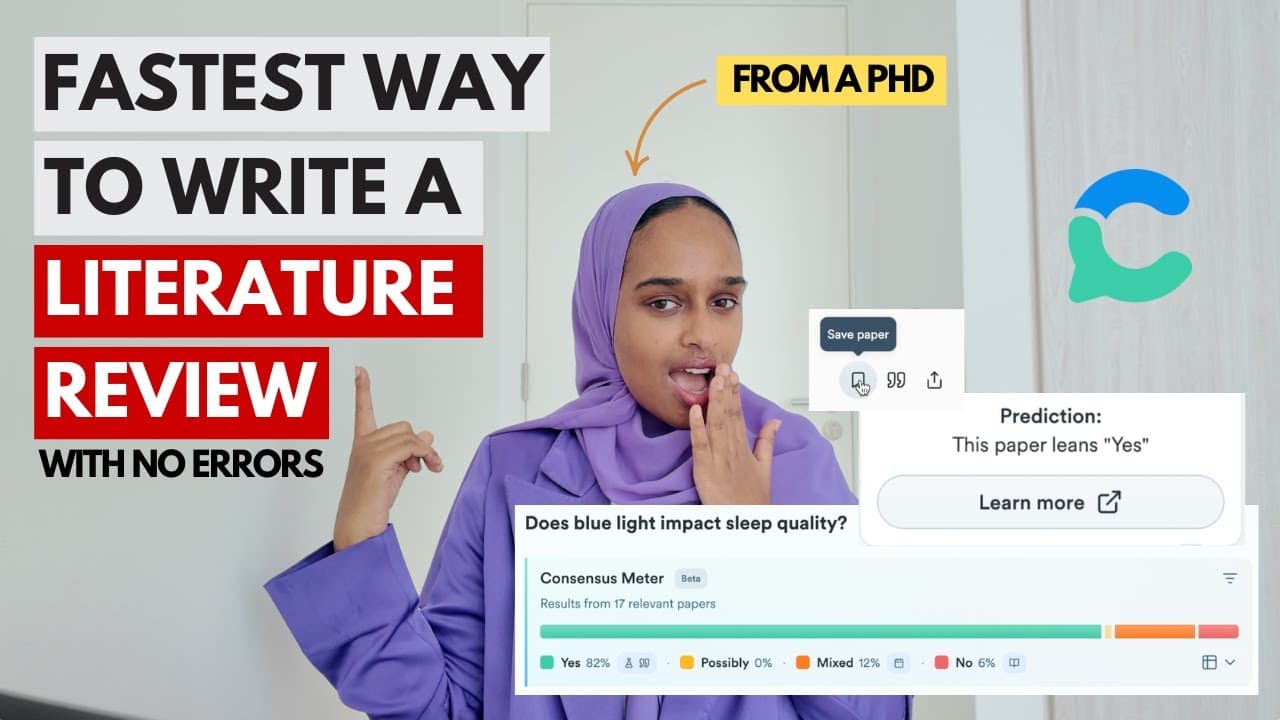
The video shows how to prepare a literature review before writing, using Consensus AI to gather and synthesize scientific papers. It covers defining a focused research question, evaluating evidence with the consensus meter, using Threads for follow ups, and building a claim based outline to structure the review. It also demonstrates how to inspect papers and save or share findings.
Transcript
Writing a literature review is actually really easy. The hard part is the part that comes before the writing. The part where you're doing the research, you're refining your research question, you're finding the most appropriate papers, you're asking follow-up questions, and you're building the outline ready for you to write. What you write is only ... Read More
Key Insights
- A focused research question defines the boundaries of what you will look for.
- The consensus meter shows whether the literature leans yes, no, or mixed on a question.
- Threads enables follow up questions within the same search for deeper understanding.
- A claim based outline helps organize literature into evidence for, against, and alternative explanations.
- Paper level insights allow quick summaries and credibility checks without reading every paper.
- Saved papers and library features support easy retrieval and collaboration.
- Methods used in papers matter for comparing results and understanding discrepancies.
- Consensus claims to cover 200+ million papers, facilitating broad literature coverage.
Install to Summarize YouTube Videos and Get Transcripts
Explore YouTube Video Summarizer or Get YouTube Transcript Extractor
Questions & Answers
Q: A real search query question about the video (e.g. 'How to...', 'What is...', 'Why does...', 'When should...'). Question 1
How can you start a literature review effectively using Consensus AI and why is a focused research question important? A focused research question sets boundaries and helps you target specific aspects to investigate rather than wandering through vague topics. Consensus AI then provides a concise, evidence based answer from scientific papers, enabling you to gauge the current state of evidence quickly and decide the direction of your review.
Q: Question 2
What is the role of the consensus meter in evaluating literature with Consensus AI? The consensus meter gives a high level sense of current evidence by showing the proportion of papers leaning yes, no, or mixed on the research question. This helps you determine whether the literature supports a particular conclusion and where there is disagreement, guiding your critical discussion and framing of your review.
Q: Question 3
How do Threads enhance the research process in Consensus AI? Threads let you ask follow up questions within the same search, allowing you to refine the topic, break it into sub questions, and explore different mechanisms or variables. This creates a more nuanced understanding and helps build a robust outline before writing your literature review.
Q: Question 4
What is a claim based outline and why is it recommended? A claim based outline organizes the review around key claims supported by evidence. It helps you structure the narrative into sections such as evidence for the main effect, mixed evidence, and alternative explanations, making the review clear and persuasive.
Q: Question 5
How can you use paper level insights to deepen your review without reading every paper? Paper level insights let you ask targeted questions about a single paper, like its main methods or findings, and get concise summaries. This lets you compare methods and results between studies and assess credibility efficiently.
Q: Question 6
What advantages does Consensus offer for literature reviews in terms of breadth and depth? Consensus provides access to a large corpus of papers and tools to filter by timeline, open access, citations, journals, and more. This breadth is paired with depth through tasks like summarization and paper level questioning, speeding up the review process.
Q: Question 7
How does saving and sharing work in Consensus and why is it useful? You can save papers to lists, create favorites, and share individual papers or entire threads with colleagues. This facilitates collaboration, allows teammates to access the same sources, and helps maintain a reproducible trail for your literature review.
Q: Question 8
What final steps are suggested before writing a literature review using Consensus AI? The final steps include building a claim based outline from the gathered evidence, using threads for follow ups to refine the questions, reading selected papers deeply with paper level inquiries, and organizing the material so you can write a well argued, evidence based review.
Summary & Key Takeaways
-
The speaker emphasizes starting with a clear, focused research question to define the scope and boundaries of the literature review, ensuring the research stays targeted and coherent.
-
Consensus AI is presented as a tool to extract and synthesize evidence from scientific papers, providing a quick high level view of what the literature says and how it leans toward particular conclusions.
-
The workflow includes using Threads for follow up questions, forming a claim based outline, and reading papers through the ask paper feature to gain depth without exhaustive reading.
Read in Other Languages (beta)
Share This Summary 📚
Summarize YouTube Videos and Get Video Transcripts with 1-Click
Try YouTube Summary with ChatGPT & Claude or YouTube Transcript Generator
Explore More Summaries from Dr Amina Yonis 📚


Summarize YouTube Videos and Get Video Transcripts with 1-Click
Try YouTube Summary with ChatGPT & Claude or YouTube Transcript Generator