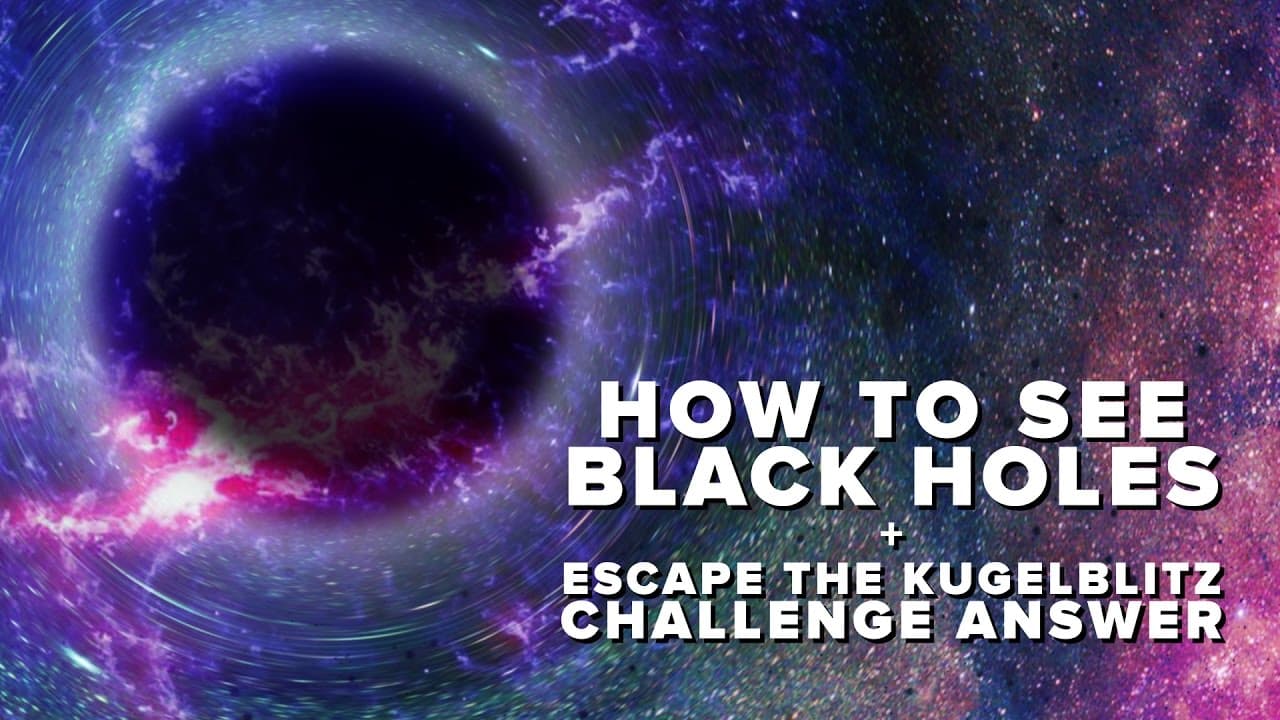
How to See Black Holes + Kugelblitz Challenge Answer
TL;DR
Explores black holes and theoretical solutions to a Kugelblitz threat.
Transcript
We've been talking a bit about black holes lately and we'll continue to do so. We tend to be pretty theoretical in how we think of them, partly because the theory predicts some fun stuff that no human will likely ever experience. In fact, the second part of this episode will be the answer to our Escape the Kugelblitz Challenge, which is highly theo... Read More
Key Insights
- Black holes, though invisible, can be detected by their effects on surrounding matter, such as quasars and X-ray binaries.
- The Event Horizon Telescope (EHT) is a collaboration of multiple radio telescopes, aiming to map the space around the Milky Way's supermassive black hole, Sag A star.
- EHT uses very long baseline interferometry (VLBI) to achieve high-resolution observations, potentially detecting the event horizon of black holes.
- Gravitational microlensing studies can help map smaller black holes by observing the light bending effects when they pass in front of distant stars.
- Theoretical scenarios like the Kugelblitz Challenge explore advanced alien threats and potential solutions using Dyson spheres and reflective force shields.
- A Dyson sphere could theoretically absorb the energy of an incoming light shell, preventing the formation of a Kugelblitz black hole.
- Reflective force shields, although capable of bouncing back incoming light, may not prevent the formation of a singularity once an event horizon forms.
- These studies and theoretical scenarios test the predictions of Einstein's general theory of relativity and could reveal new insights into the behavior of black holes.
Install to Summarize YouTube Videos and Get Transcripts
Explore YouTube Video Summarizer or Get YouTube Transcript Extractor
Questions & Answers
Q: How are black holes detected if they emit no light?
Black holes are detected by observing their gravitational effects on nearby matter. When matter falls into a black hole, it accelerates and heats up, emitting radiation that we can observe. For example, quasars are bright regions around supermassive black holes, and X-ray binaries involve a visible star orbiting an invisible black hole, revealing its presence through X-ray emissions.
Q: What is the Event Horizon Telescope and how does it work?
The Event Horizon Telescope (EHT) is a global collaboration of radio telescopes that uses very long baseline interferometry (VLBI) to achieve high-resolution observations of black holes. By synthesizing data from multiple telescopes, EHT effectively creates a virtual telescope with a spatial resolution equivalent to a telescope thousands of kilometers in diameter. This allows it to map the area around black holes like Sag A star in the Milky Way.
Q: What is the Kugelblitz Challenge and what solutions were proposed?
The Kugelblitz Challenge is a hypothetical scenario where an advanced alien race threatens to destroy Earth by creating a black hole from concentrated light. Two solutions were proposed: Project Phoenix Egg, involving a Dyson sphere to absorb the incoming light, and Project Disco Ball, a reflective shield to bounce back the light. The Dyson sphere was deemed the more viable solution, as it could absorb the energy before a black hole forms.
Q: Why is the Dyson sphere solution considered more viable than the reflective shield?
The Dyson sphere solution is considered more viable because it can absorb the energy of the incoming light shell before an event horizon forms, preventing the creation of a black hole. In contrast, the reflective shield would only delay the inevitable, as once the event horizon forms, all paths, including reflected light, lead to the singularity, making it ineffective in stopping the black hole's formation.
Q: How does gravitational microlensing help in studying black holes?
Gravitational microlensing occurs when a black hole passes in front of a distant star, bending and focusing the star's light due to its gravitational field. This effect can temporarily brighten the star, allowing astronomers to study the black hole's properties. Advanced techniques like interferometry can map these events with high resolution, providing insights into the distribution and behavior of smaller black holes in the galaxy.
Q: What role does Einstein's general theory of relativity play in understanding black holes?
Einstein's general theory of relativity predicts the behavior of black holes, describing how their immense gravity warps spacetime. The theory helps scientists understand phenomena like event horizons, singularities, and gravitational waves. Ongoing studies and observations, such as those by LIGO and the EHT, test these predictions, potentially revealing discrepancies or new physics that could refine our understanding of black holes and gravity.
Q: What are some potential real-world applications of studying black holes?
Studying black holes enhances our understanding of fundamental physics, including gravity and spacetime. This knowledge can lead to technological advancements in fields like telecommunications, navigation, and materials science. Additionally, techniques developed for black hole research, such as interferometry and data processing, have broader applications in astronomy and other scientific disciplines, driving innovation and discovery.
Q: How do quasars and X-ray binaries provide evidence of black holes?
Quasars are extremely bright regions around supermassive black holes, where infalling matter emits intense radiation as it accelerates and heats up. X-ray binaries consist of a visible star orbiting an invisible black hole, with the star's motion and X-ray emissions from accreting matter revealing the black hole's presence. These phenomena provide indirect evidence of black holes by showcasing their gravitational influence on surrounding matter.
Summary & Key Takeaways
-
The video discusses the nature of black holes, their detection through effects like quasars and X-ray binaries, and ongoing studies to map them using advanced technologies like the Event Horizon Telescope.
-
The Kugelblitz Challenge presents a hypothetical scenario where Earth faces destruction by a black hole formed from concentrated light, exploring two theoretical solutions: a Dyson sphere and a reflective force shield.
-
The Dyson sphere solution is deemed more viable, as it can absorb the energy of the incoming light shell, preventing a black hole's formation, while the reflective shield fails post-event horizon formation.
Read in Other Languages (beta)
Share This Summary 📚
Summarize YouTube Videos and Get Video Transcripts with 1-Click
Try YouTube Summary with ChatGPT & Claude or YouTube Transcript Generator
Explore More Summaries from PBS Space Time 📚
Summarize YouTube Videos and Get Video Transcripts with 1-Click
Try YouTube Summary with ChatGPT & Claude or YouTube Transcript Generator