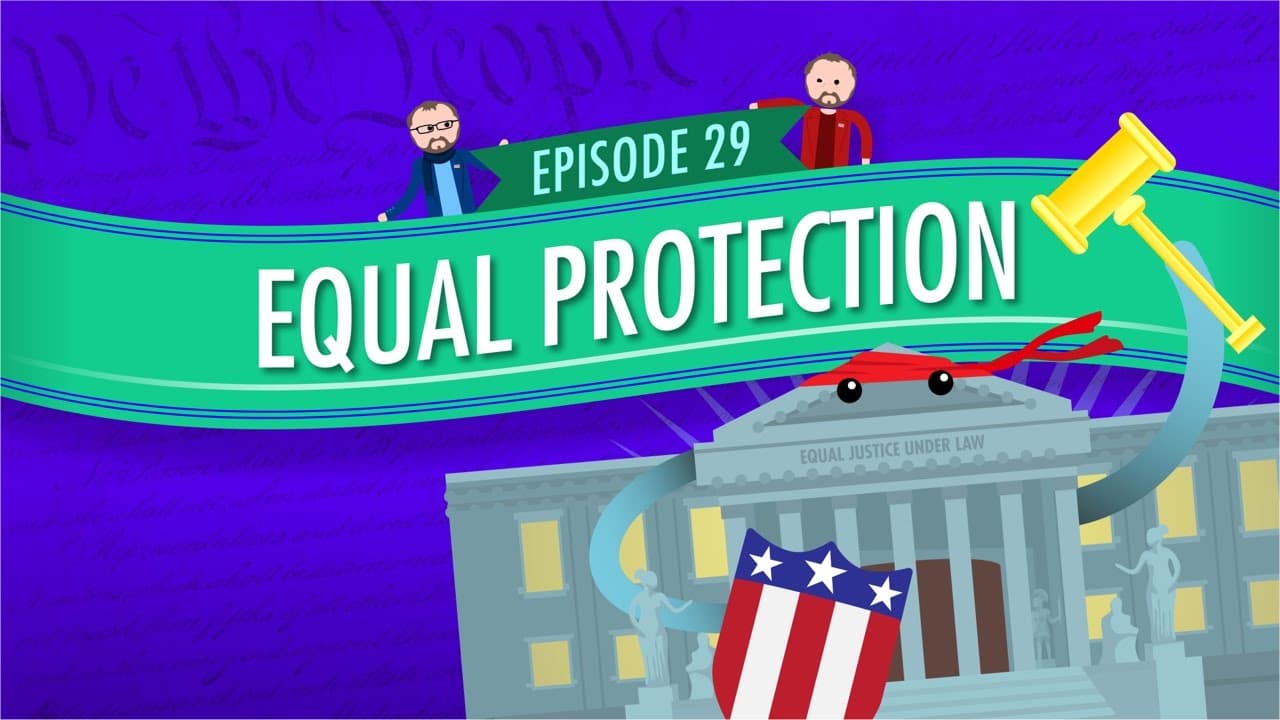
Equal Protection: Crash Course Government and Politics #29
TL;DR
Exploration of the Fourteenth Amendment's impact on civil rights.
Transcript
Hi I’m Craig and this is Crash Course Government and Politics, and today we’re going to finally get into why many people, including me, think that the Fourteenth Amendment is the most important part of the Constitution. At the same time, we will attempt – successfully, I hope – to unravel the difference between civil liberties and civil rights, and... Read More
Key Insights
- The Fourteenth Amendment is crucial for civil rights, particularly its 'equal protection' clause which addresses how laws treat different groups.
- Civil rights differ from civil liberties as they focus on how citizens treat each other under the law, often involving minority groups.
- The Supreme Court uses strict scrutiny to evaluate laws affecting protected classes, requiring a compelling government interest to justify such laws.
- Protected classes include minorities like racial, national, and religious groups, which the courts examine closely due to their political disadvantages.
- Brown v. Board of Education was a landmark case that challenged the 'separate but equal' doctrine, emphasizing that segregation is inherently unequal.
- The decision in Brown v. Board of Education laid the groundwork for the Civil Rights Movement and federal civil rights legislation in the 1960s.
- Levels of scrutiny, including strict scrutiny, intermediate scrutiny, and rational basis, determine the rigor of judicial review in civil rights cases.
- Civil rights issues evolve over time, reflecting societal changes, such as the shift in focus to same-sex marriage as a civil rights issue.
Install to Summarize YouTube Videos and Get Transcripts
Explore YouTube Video Summarizer or Get YouTube Transcript Extractor
Questions & Answers
Q: What is the significance of the Fourteenth Amendment in civil rights?
The Fourteenth Amendment is significant in civil rights due to its 'equal protection' clause, which mandates that no state shall deny any person equal protection under the law. This clause is foundational in addressing how laws treat different groups, particularly minorities, and is central to many landmark civil rights cases.
Q: How do civil rights differ from civil liberties?
Civil rights differ from civil liberties in that they focus on how citizens treat each other under existing laws, often involving discrimination against minority groups. Civil liberties, on the other hand, are protections individuals have against government interference in their personal freedoms and rights.
Q: What is strict scrutiny and when is it applied?
Strict scrutiny is a judicial review standard applied by courts when laws or government actions affect protected classes, such as racial or religious minorities. It requires the government to prove that the law serves a compelling interest and is narrowly tailored to achieve that interest, making it difficult for such laws to be upheld.
Q: What role did Brown v. Board of Education play in civil rights?
Brown v. Board of Education was a pivotal Supreme Court case that challenged the 'separate but equal' doctrine in public education. The Court ruled that segregated schools are inherently unequal, which helped dismantle segregation and laid the foundation for the Civil Rights Movement and subsequent federal civil rights legislation.
Q: What are protected classes and why are they important?
Protected classes are groups that the courts recognize as needing special protection due to their minority status, such as racial, national, and religious minorities. These classes are important because they are often disadvantaged in the political process, making it easier for majority groups to pass laws that discriminate against them.
Q: How does the Supreme Court's scrutiny levels impact civil rights cases?
The Supreme Court uses different scrutiny levels—strict scrutiny, intermediate scrutiny, and rational basis—to evaluate civil rights cases. These levels determine the rigor of judicial review, with strict scrutiny being the most rigorous, ensuring that laws affecting protected classes are examined thoroughly to prevent discrimination.
Q: Why is the concept of civil rights considered to evolve over time?
Civil rights evolve over time because they reflect societal changes and new understandings of equality and justice. Issues that were once not considered, such as same-sex marriage, can become defining civil rights issues as society's views and legal interpretations progress, highlighting the dynamic nature of civil rights.
Q: What is the impact of the 'equal protection' clause on state laws?
The 'equal protection' clause impacts state laws by ensuring that no state can enact laws that deny individuals equal protection under the law. This clause is a critical tool in challenging discriminatory laws and practices, requiring states to justify any differential treatment and ensuring that laws do not unfairly target minority groups.
Summary & Key Takeaways
-
The Fourteenth Amendment is pivotal in understanding civil rights, particularly through its 'equal protection' clause, which addresses how laws impact different groups of citizens, often minorities. The Supreme Court employs strict scrutiny to evaluate such laws, ensuring they serve a compelling government interest.
-
Civil rights focus on how citizens treat each other under existing laws, contrasting with civil liberties that protect individuals from government actions. Landmark cases like Brown v. Board of Education highlight the evolving nature of civil rights, challenging segregation and paving the way for the Civil Rights Movement.
-
The Supreme Court's scrutiny levels, including strict scrutiny, intermediate scrutiny, and rational basis, guide its evaluation of civil rights cases. These frameworks ensure that laws affecting protected classes, such as racial minorities, undergo rigorous examination to prevent discrimination and uphold equal protection.
Read in Other Languages (beta)
Share This Summary 📚
Summarize YouTube Videos and Get Video Transcripts with 1-Click
Try YouTube Summary with ChatGPT & Claude or YouTube Transcript Generator
Explore More Summaries from CrashCourse 📚
Summarize YouTube Videos and Get Video Transcripts with 1-Click
Try YouTube Summary with ChatGPT & Claude or YouTube Transcript Generator