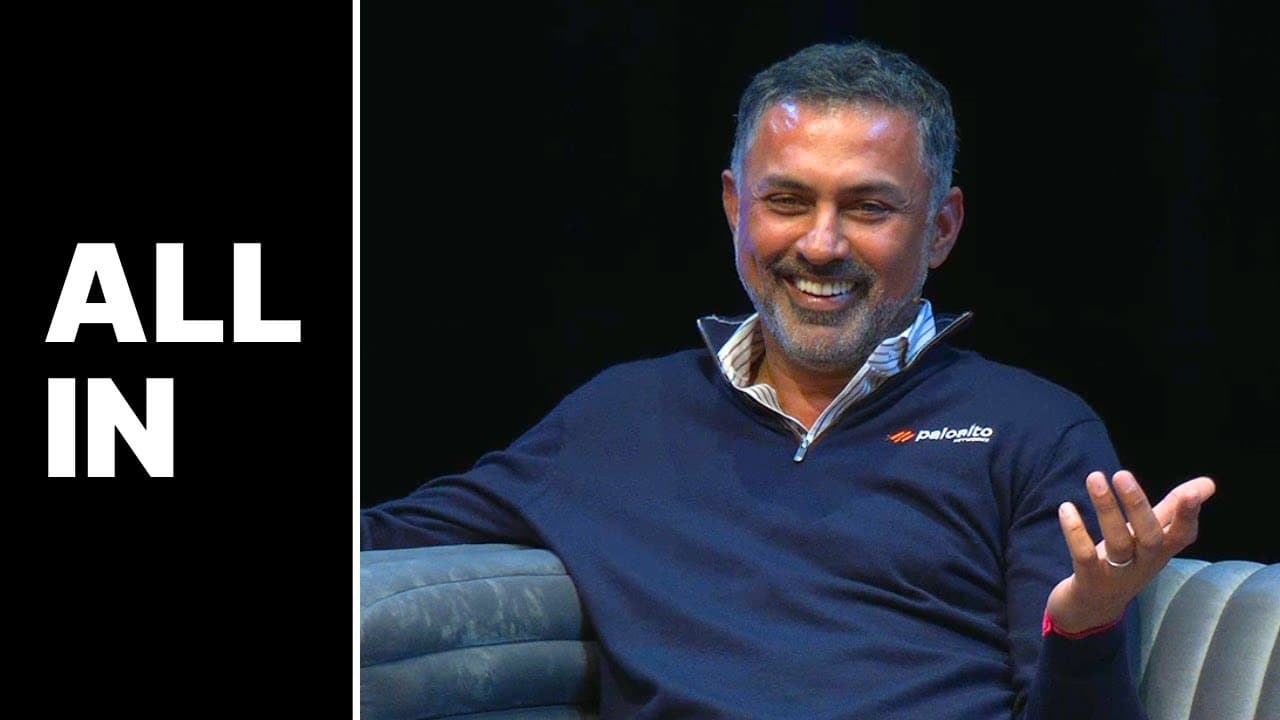
How Does Nikesh Arora Scale Technology Firms?
TL;DR
Great technology businesses begin with strong products, then scale through focused execution, detailed inspection, and teams aligned around a repeatable system. Nikesh Arora contrasts Google’s consumer flywheel with enterprise distribution, describes Masayoshi Son’s unusually increasing appetite for risk, and argues that money is best treated as a way to measure progress rather than the goal itself.
Transcript
our next speaker is actually fortunate enough to have had seen his brand name turn into a verb one of the probably most fific Executives in this current generation is mesh Aurora the Big Daddy of the cyber security space these guys are really at the Forefront of the industry there are very few people who consistently time and time again find a way ... Read More
Key Insights
- A great product is the foundation of a durable business. Arora says product obsession was central at Google, where Larry Page and Sergey Brin maintained a constant focus on what users received, and it became his first priority when leading Palo Alto Networks.
- Consumer and enterprise businesses scale differently. A consumer company can build a compelling product and strengthen the flywheel around its adoption, while an enterprise company must also create an effective system for delivering its product to a broad population of organizational customers.
- Execution at scale is a team achievement. Arora says one person cannot manage every necessary task, so leaders must recruit capable people, place them on the same organizational path, and enable them to perform consistently through focus, detailed inspection, and shared systems.
- Google Search had a powerful consumer flywheel. Arora describes it as a product people wanted to use because it was simple, free, and easy to operate, allowing the business organization to concentrate on monetizing advertising and attracting advertisers across many countries.
- International growth can distinguish an executive inside a rapidly expanding company. During Arora’s tenure, the European business moved from 24 percent to 49 percent of global revenue, briefly making Europe larger than the United States for Google, according to his account.
- Career growth can follow a desire for broader responsibility. Arora says he left Google because he wanted to participate more fully in the overall business and undertake product work, an area outside the sales-focused responsibilities he had held there.
- Masayoshi Son’s risk appetite increased as he grew older. Arora contrasts Son with people who generally reduce risk over time, describing him as increasingly willing to go all in, borrow substantial amounts, and pursue ambitious plans based on deep personal conviction.
- Money is a measurement tool rather than necessarily the underlying goal. Arora says Son used financial outcomes to keep score, but was driven more by intuition and conviction than by a narrowly financial orientation, sometimes maintaining that belief to a fault.
Install to Summarize YouTube Videos and Get Transcripts
Explore YouTube Video Summarizer or Get YouTube Transcript Extractor
Questions & Answers
Q: How do leaders build a great technology business?
Leaders begin by ensuring that the company has a great product, because a weak product cannot support a durable business. They then apply sustained focus, inspect operational details, and organize talented people around the same objective. At enterprise companies, leadership must also create a repeatable way to distribute the product broadly, since one executive cannot personally execute every task at scale.
Q: How does scaling a consumer business differ from scaling an enterprise business?
A consumer business can build a strong product, identify the flywheel that drives adoption, and work to keep that cycle operating. An enterprise business must do more than create the product. It also needs a coordinated system for reaching many customers, supported by focused execution, detailed inspection, and numerous capable employees who can perform consistently across the organization.
Q: What made Google Search’s early business model effective?
Google Search combined a product people wanted with a straightforward experience that was simple, free, and easy to use. Arora says it required little customer support, while the commercial team could focus on monetizing advertising. Scaling the model internationally required systems that attracted many advertisers and enabled thousands of employees around the world to execute a common program.
Q: How did Nikesh Arora distinguish himself while working at Google?
Arora helped expand Google’s business outside the United States, particularly in Europe. He says Europe represented 24 percent of global revenue when he joined and 49 percent when he moved to the United States. For a brief period, European revenue exceeded United States revenue. That performance attracted attention and preceded Eric Schmidt asking him to assume his retiring manager’s responsibilities.
Q: Why did Nikesh Arora leave Google?
Arora says he wanted more responsibility and broader involvement in the overall business. He also wanted opportunities to work on products, since his Google positions had largely identified him as a sales executive. His later role at Palo Alto Networks gave him extensive product responsibilities, which matched his desire to operate beyond the commercial work he had previously led.
Q: What did Nikesh Arora learn about execution at scale?
Execution at scale requires a system, not dependence on a single leader. Arora emphasizes building a programmatic operating model, inspecting what is happening, and surrounding the work with talented people motivated to perform at their best. The leader’s task is to align those people on the same path so the organization can execute consistently across markets and functions.
Q: How did Masayoshi Son approach business risk?
Masayoshi Son approached risk with an appetite that increased as he grew older, according to Arora. While many people gradually reduce exposure to uncertainty, Son became more willing to commit heavily to ideas he believed in. Arora illustrates this with Son’s willingness to combine a relatively small amount of capital with much larger borrowing and pursue exceptionally ambitious corporate goals.
Q: Was Masayoshi Son motivated mainly by money?
Arora says Son was not primarily financially oriented, even though he frequently framed plans around trillion-dollar outcomes. Money functioned as a method of keeping score. His decisions were driven more by intuition, conviction, and the founder-like tendency to commit fully when he believed in an idea. That intensity enabled bold action, but Arora also says it could persist to a fault.
Summary & Key Takeaways
-
Nikesh Arora says lasting businesses depend first on great products. Consumer companies can build a product, discover its flywheel, and keep that flywheel working. Enterprise companies face an additional challenge: they must distribute a strong product to many customers through disciplined execution, detailed inspection, and coordinated teams operating effectively at scale.
-
At Google, Arora helped monetize search advertising and expand the business internationally. He describes search as simple, free, and easy to use, which reduced the need for customer support. His team built systems for attracting advertisers globally, while European revenue rose from 24 percent to 49 percent of Google’s global revenue.
-
Arora portrays Masayoshi Son as a founder whose risk appetite increased with age. Son repeatedly pursued trillion-dollar ambitions, relied heavily on conviction and intuition, and was willing to borrow aggressively. Arora distinguishes this approach from purely financial thinking, saying money served as a scorekeeping mechanism rather than Son’s fundamental objective.
Read in Other Languages (beta)
Share This Summary 📚
Summarize YouTube Videos and Get Video Transcripts with 1-Click
Try YouTube Summary with ChatGPT & Claude or YouTube Transcript Generator
Explore More Summaries from All-In Podcast 📚


Summarize YouTube Videos and Get Video Transcripts with 1-Click
Try YouTube Summary with ChatGPT & Claude or YouTube Transcript Generator