What Is an IPv4 Address and Its Structure?
TL;DR
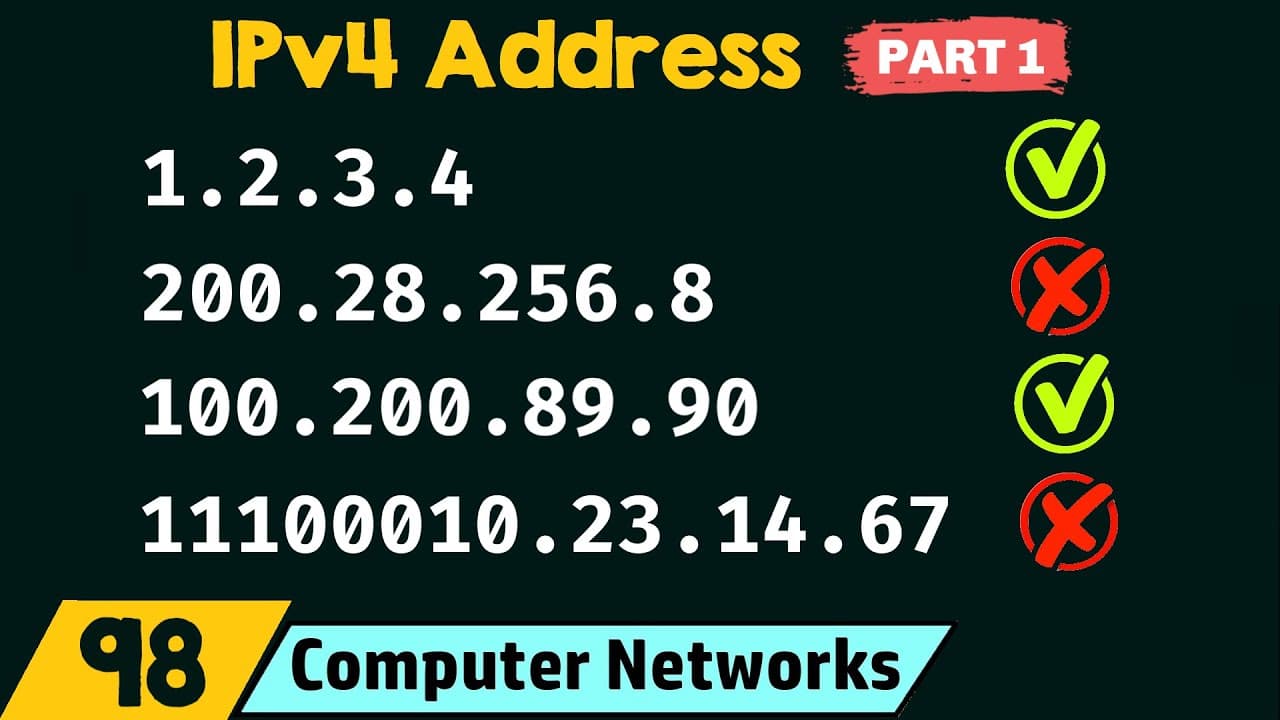
An IPv4 address is a 32-bit identifier that uniquely connects devices to the internet. It consists of four octets, with each ranging from 0 to 255. Invalid addresses may include extra octets or lead with zeros, impacting their usability.
Transcript
in today's lecture let's see the part one of ipv4 addresses we will start the session with the outcomes in today's session we have three outcomes let's see what are they upon the completion of the session the learner will be able to outcome number one we will understand the ipv4 address in detail outcome number two we will see the notations of ipv4... Read More
Key Insights
- ❓ IPv4 addresses are essential in identifying devices on the internet, with each address being unique.
- 😷 The subnet mask determines the network and host portions of an IPv4 address.
- 🍵 Network Address Translation (NAT) technology helps handle the scarcity of IPv4 addresses by converting private addresses to public addresses.
- 🫥 IPv4 addresses can be represented in binary or dotted decimal notation.
- ❓ Valid IPv4 addresses have four octets and values between 0 and 255.
- 🥺 Invalid IPv4 addresses may have extra octets, leading zeros, or values outside the valid range.
- 👻 The address space of IPv4 allows for over 4 billion unique addresses, but NAT helps in managing the increasing number of devices.
Install to Summarize YouTube Videos and Get Transcripts
Explore YouTube Video Summarizer or Get YouTube Transcript Extractor
Questions & Answers
Q: What is the purpose of an IPv4 address?
IPv4 addresses are used to identify devices, such as computers or routers, on the internet. They help in packet routing and establishing connections.
Q: How is uniqueness of IP addresses ensured?
Two devices on the internet cannot have the same IP address at the same time. Network Address Translation (NAT) technology helps in handling the limited number of IPv4 addresses by converting private IP addresses to unique public IP addresses.
Q: What is the notation used for representing IPv4 addresses?
There are two prevalent notations for representing IPv4 addresses: binary notation and dotted decimal notation. Binary notation represents the address in binary form, while dotted decimal notation uses four decimal values separated by dots.
Q: How are valid and invalid IP addresses identified?
Valid IPv4 addresses have exactly four octets, with each octet's value between 0 and 255. Invalid addresses can have extra octets, leading zeros, or octets with values outside the valid range.
Key Insights:
- IPv4 addresses are essential in identifying devices on the internet, with each address being unique.
- The subnet mask determines the network and host portions of an IPv4 address.
- Network Address Translation (NAT) technology helps handle the scarcity of IPv4 addresses by converting private addresses to public addresses.
- IPv4 addresses can be represented in binary or dotted decimal notation.
- Valid IPv4 addresses have four octets and values between 0 and 255.
- Invalid IPv4 addresses may have extra octets, leading zeros, or values outside the valid range.
- The address space of IPv4 allows for over 4 billion unique addresses, but NAT helps in managing the increasing number of devices.
- Private and public IP addresses, along with loopback addresses, are covered in future lectures.
Summary & Key Takeaways
-
IPv4 addresses are 32-bit addresses that uniquely identify devices connected to the internet.
-
IPv4 addresses consist of four octets, or four sets of eight binary bits.
-
The range of each octet is between 0 and 255, and any address outside of this range is considered invalid.
Read in Other Languages (beta)
Share This Summary 📚
Summarize YouTube Videos and Get Video Transcripts with 1-Click
Try YouTube Summary with ChatGPT & Claude or YouTube Transcript Generator
Explore More Summaries from Neso Academy 📚






Summarize YouTube Videos and Get Video Transcripts with 1-Click
Try YouTube Summary with ChatGPT & Claude or YouTube Transcript Generator