How to Calculate Rectangular Prism Surface Area Almost Instantly
TL;DR
Calculate a rectangular prism’s total surface area by adding any two side lengths, multiplying that sum by the third length, adding the product of the original two lengths, and multiplying the result by 2. For a prism measuring 4 by 7 by 3 units, the calculation gives 122 square units. Read on for the exact steps, the reason the shortcut works, and another example.
Transcript
good day welcome to the tech maath Channel I'm Josh today I'm going to show you a trick for working at the total surface area of any rectangular prism something like this almost instantly so let's start off with an example we see how fast you can solve the total surface area of this rectangular prism right here we have a height of four units a widt... Read More
Key Insights
- 🪜 The shortcut method involves adding two side lengths, multiplying by the third, and summarizing for quick surface area calculation.
- ❓ Understanding the concepts of area calculation for different rectangles within a prism is essential.
- ❓ By applying the shortcut, one can easily find the total surface area of any rectangular prism using basic arithmetic operations.
- ❓ Examples provided in the content offer practical demonstrations of the shortcut method for better comprehension.
- 🌍 This trick can be utilized to solve surface area problems efficiently in mathematics and real-world applications.
- 🈸 The consistent application of the shortcut method reinforces mathematical skills and enhances problem-solving abilities.
- ❓ By following the step-by-step instructions, individuals can master the technique and apply it to various rectangular prism scenarios.
Install to Summarize YouTube Videos and Get Transcripts
Explore YouTube Video Summarizer or Get YouTube Transcript Extractor
Questions & Answers
Q: How can you quickly calculate the total surface area of a rectangular prism?
Choose any two side lengths, add them, and multiply the sum by the third side length. Multiply the two chosen lengths together, add that product to the first result, and then multiply the total by 2.
Q: What is the rectangular prism surface area shortcut shown by Josh on the Tech Math Channel?
The shortcut is to add any two side lengths and multiply their sum by the remaining length. Then multiply the two initially chosen lengths, add the two results, and double the sum.
Q: Why does the rectangular prism surface area trick work?
A rectangular prism contains three different pairs of matching rectangular faces. Multiplying the sum of two side lengths by the third calculates the areas of two different rectangles, while multiplying the two chosen lengths calculates the remaining rectangle; doubling their sum accounts for both faces in every pair.
Q: How do you find the surface area of a 4-by-7-by-3 rectangular prism?
Add 7 and 3 to get 10, then multiply by 4 to get 40. Multiply 7 by 3 to get 21, add 40 and 21 to get 61, and multiply by 2 for a total surface area of 122 square units.
Q: How do you find the surface area of a 6-by-9-by-5 rectangular prism?
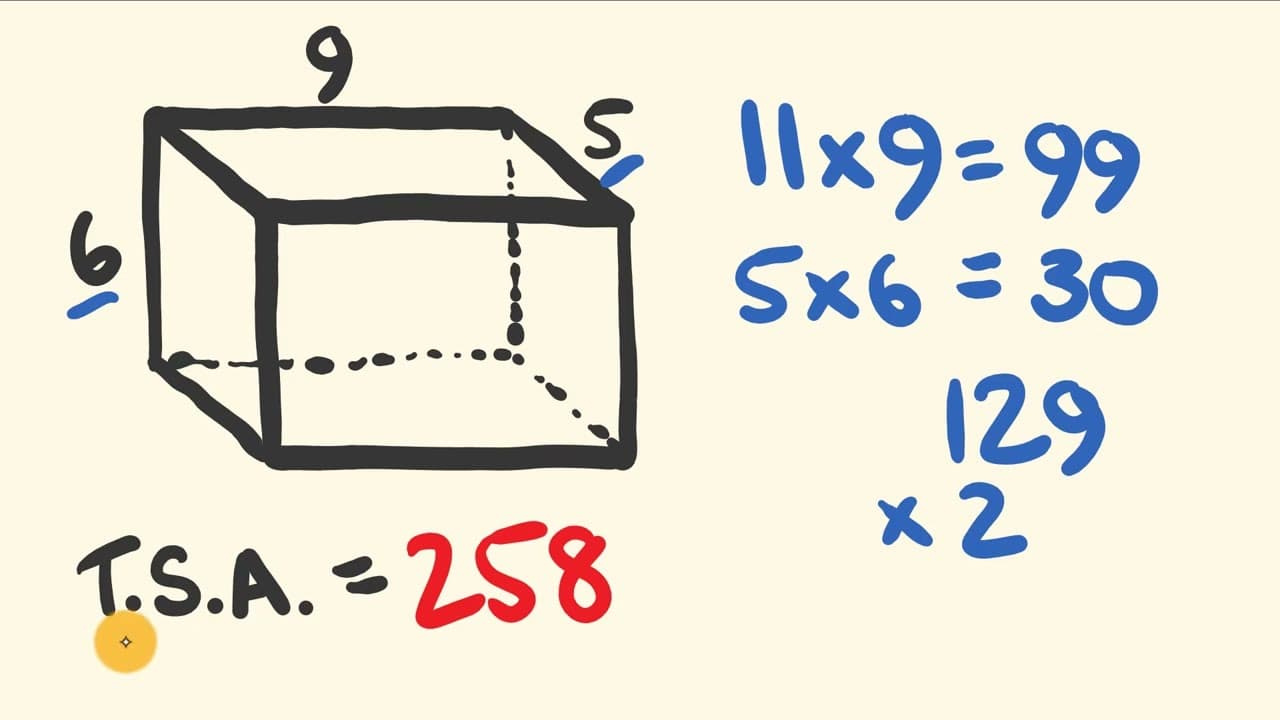
Add 6 and 5 to get 11, then multiply by 9 to get 99. Multiply 5 by 6 to get 30, add 99 and 30 to get 129, and double it to obtain 258 square units.
Q: Which two side lengths should you add first in the shortcut?
You can choose any two side lengths. In the 6-by-9-by-5 example, 6 and 5 are chosen because their sum is 11, making the next multiplication, 11 times 9, straightforward.
Q: What rectangles make up the faces of a 4-by-7-by-3 rectangular prism?
The three different rectangles measure 3 by 4, 7 by 3, and 7 by 4 units. Each rectangle occurs twice: on the sides, top and bottom, or front and back.
Q: How is this shortcut different from calculating every face separately?
The usual approach calculates the areas of the three different rectangles, adds them, and multiplies by 2. The shortcut combines two rectangle-area calculations by adding two side lengths before multiplying by the third, then calculates only the remaining rectangle separately.
Summary & Key Takeaways
-
Demonstrates a shortcut method to calculate the total surface area of rectangular prisms in seconds.
-
Explains how to add two side lengths and multiply by the third, simplifying the process.
-
Provides examples with step-by-step calculations for understanding and application.
Read in Other Languages (beta)
Share This Summary 📚
Summarize YouTube Videos and Get Video Transcripts with 1-Click
Try YouTube Summary with ChatGPT & Claude or YouTube Transcript Generator
Explore More Summaries from tecmath 📚



Summarize YouTube Videos and Get Video Transcripts with 1-Click
Try YouTube Summary with ChatGPT & Claude or YouTube Transcript Generator