How Does Vectorization Improve Code Performance?
TL;DR
Vectorization improves code performance by replacing explicit for loops with built-in functions, significantly speeding up computations. For example, using Numpy's matrix multiplication or element-wise operations can enhance efficiency without the overhead of loop iterations. This technique is essential for optimizing tasks in neural networks and other programming scenarios.
Transcript
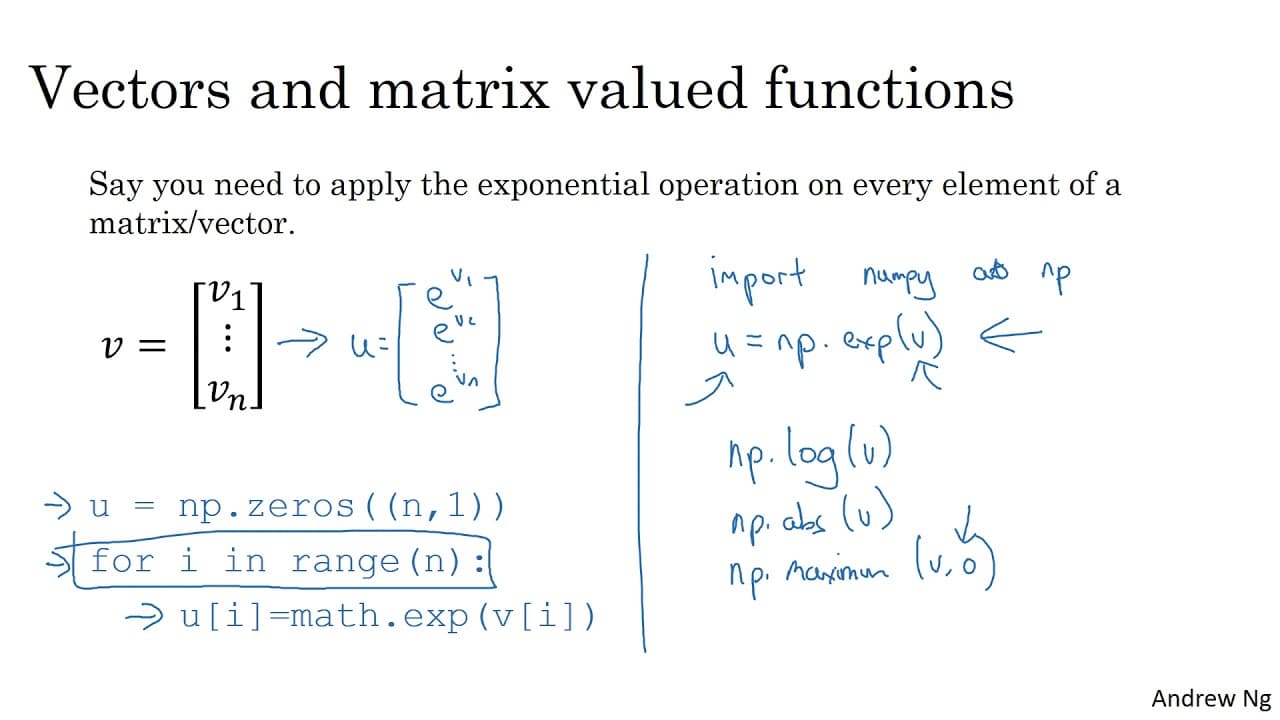
in the previous video you saw a few examples of how vectorization by using built-in functions and by avoiding explicit for loops allows you to speed up your code significantly let's take a look at few more examples the rule of thumb to keep in mind is when you programming your neural network so when you're programming logistic regression whenever p... Read More
Key Insights
- 👨💻 Vectorization in coding replaces explicit for loops with built-in functions, enhancing speed and efficiency.
- 🔃 Examples such as matrix multiplication and element-wise operations showcase the benefits of vectorization.
- 👨💻 Numpy's built-in functions enable optimized code without the need for explicit for loops.
- 👨💻 By leveraging vectorization techniques, code performance can be significantly improved.
- 🥺 Vectorized operations in coding lead to faster computations and streamlined processes.
- 👨💻 Avoiding explicit for loops is crucial for optimizing code performance.
- 👨💻 Vectorization can simplify complex computations in coding through efficient built-in functions.
Install to Summarize YouTube Videos and Get Transcripts
Explore YouTube Video Summarizer or Get YouTube Transcript Extractor
Questions & Answers
Q: How does vectorization improve code performance?
Vectorization enhances code performance by replacing explicit for loops with built-in functions, reducing the need for iterative computations and speeding up processes significantly.
Q: What are some examples of vectorized operations in coding?
Vectorized operations include matrix multiplication, element-wise computations like exponentiation, logs, and absolute values, all of which can be efficiently implemented using numpy's built-in functions.
Q: Why is it essential to avoid explicit for loops in coding?
Avoiding explicit for loops in coding is crucial for optimizing performance because built-in functions and vectorized operations offer faster and more efficient ways of computation, eliminating the need for iterative processing.
Q: How can vectorization be implemented in logistic regression coding?
In logistic regression coding, vectorization can be applied by utilizing numpy's built-in functions for operations like derivative computations, thereby improving code efficiency by minimizing the need for explicit for loops.
Summary & Key Takeaways
-
Vectorization in coding improves efficiency by replacing explicit for loops with built-in functions.
-
Examples include speeding up computations for matrix multiplication and element-wise operations.
-
By leveraging numpy's built-in functions, code can be optimized without the need for explicit for loops.
Read in Other Languages (beta)
Share This Summary 📚
Summarize YouTube Videos and Get Video Transcripts with 1-Click
Try YouTube Summary with ChatGPT & Claude or YouTube Transcript Generator
Explore More Summaries from DeepLearningAI 📚





Summarize YouTube Videos and Get Video Transcripts with 1-Click
Try YouTube Summary with ChatGPT & Claude or YouTube Transcript Generator