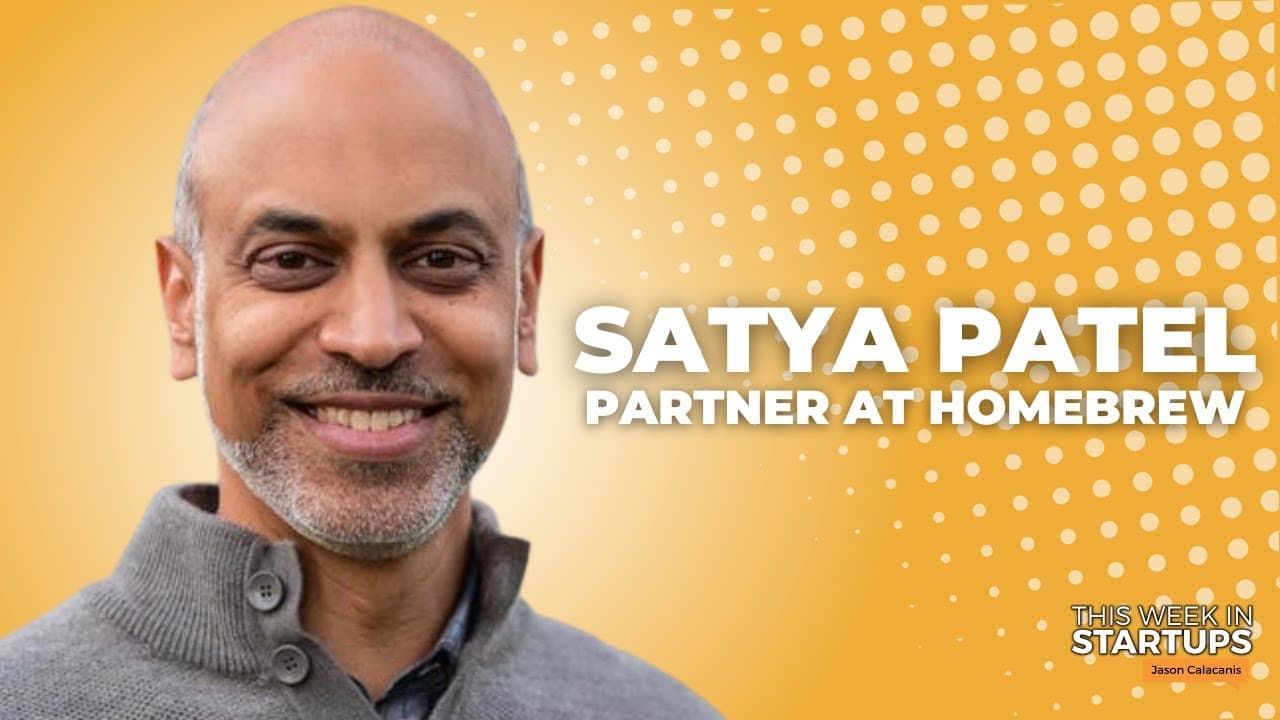
Satya Patel on the state of VC, flexible investing frameworks & converting to evergreen | E1715
TL;DR
Homebrew's shift to an evergreen fund allows for more flexible investment decisions and risk-taking, as it uses its own capital instead of relying on outside LPs. This structure reduces the pressure of fundraising and enables a focus on long-term value creation. Key lessons drawn from Google's early days emphasize the importance of culture, values, and trust in successful company building.
Transcript
today on this week in startups Satya Patel from Homebrew joins Jason for a really deep discussion on the state of VC generative ai's impact why Homebrew converted to an evergreen fund with their own Capital what rules he and Jason have for investing in Founders and why they might break them and so much more it's a great episode stick with us this w... Read More
Key Insights
- 🛀 The shift to an evergreen fund has provided Homebrew with flexibility in investment decisions and risk-taking.
- 🥳 Culture, values, and trust play a crucial role in building startups successfully, drawing lessons from Google's early days.
- ❓ Founders with firsthand experience of the problem they are solving and clear leadership are essential for successful investments.
Install to Summarize YouTube Videos and Get Transcripts
Explore YouTube Video Summarizer or Get YouTube Transcript Extractor
Questions & Answers
Q: What lessons did Satya Patel learn from his time at Google and how does it apply to his venture capital work?
Satya emphasizes the importance of culture, intentional values, and hiring the right people in building successful startups, drawing lessons from Google's early days.
Q: How has Homebrew's shift to an evergreen fund impacted their investment decisions and risk appetite?
Satya discusses the rationale behind transitioning to an evergreen fund, allowing them to be more flexible in investment decisions and take on different types of risks.
Q: How does Satya Patel approach investing in founders and what rules does he typically follow?
Satya highlights the value of investing in founders who have firsthand experience of the problem they are solving and the importance of having a lead investor in a funding round.
Q: What key insights can be gathered about the current market cycle and the challenges of building successful startups?
Satya shares insights on the bear cycle in the market, challenges with cap table management, and the significance of market size exploration in startup success.
Summary
In this video, Satya Patel from Homebrew joins Jason to discuss the state of VC, generative AI's impact, Homebrew's conversion to an evergreen fund, and their rules for investing in founders. They also discuss the challenges at Google, the future of AI chat interfaces, and the current market for capital allocators.
Questions & Answers
Q: What did Satya learn most at Google that he carries forward in his investments today?
Satya mentioned that the early days of Google were exciting because people joined for the opportunity to work with incredibly smart individuals and believed in the mission of making the world's information universally accessible and useful. He emphasized the importance of culture and values in building a company, as well as the significance of hiring people who align with those values. Additionally, he emphasized the value of having a culture of trust, where people assume the best in each other's decisions and actions.
Q: Why did Homebrew decide to use its own capital instead of raising from outside LPs for their fourth fund?
Satya explained that Homebrew made the decision to use their own capital for their fourth fund as a strategic move to be more competitive in the market. While it may not have been the best economic decision in the short term, they believed that being 100% LP would provide them with the best economics in the long term. He also mentioned that not having a fund allowed them to take different kinds of risks and be more flexible in their investments.
Q: Did the decision to use their own capital make Satya and his team more risk-seeking?
Satya acknowledged that not having a fund allowed them to be more risk-seeking in their investments, as they no longer had to worry about fund-related constraints like check sizes and ownership. They could focus on individual investment opportunities and the potential returns they could earn from them. However, he also mentioned that managing other people's money created a different kind of stress and pressure, as the responsibility to deliver returns for LPs was significant.
Q: How did the first few funds at Homebrew perform and did that impact their decision to use their own capital?
Satya mentioned that they started Homebrew during the beginning of a bull market, which led to strong returns for their initial funds. However, he clarified that the decision to use their own capital for their fourth fund was not driven by the performance of their previous funds. Instead, it was a strategic choice based on their belief in being good pickers and their confidence in their ability to generate returns. The financial success of their earlier funds merely provided them with the financial wherewithal to pursue this approach.
Q: What are some of the challenges at Google today and how does their money-making machine potentially hinder pursuing new opportunities like AI chat interfaces?
Satya mentioned two challenges at Google. First, he noted that as the company grew, it developed a culture of saying no, which made it more challenging to experiment and make small changes or releases. Second, he highlighted that Google's existing business, which heavily relies on search volume, can make it difficult to invest in technologies like AI chat interfaces that may potentially cannibalize the core business. However, he also acknowledged that there are areas where chat interfaces can complement or enhance traditional search, especially in industries like travel.
Q: Do you see chat-based AI interfaces as a replacement or complement to traditional search, and have you personally started using chat interfaces more than traditional searches?
Satya believes that chat-based AI interfaces will have different roles in relation to traditional search. There will be types of searches that chat interfaces will be better suited for, leading to new types of searches being performed. Additionally, chat interfaces can replace existing searches, providing better results and user experiences. Lastly, they can complement traditional search by offering additional information or personalized insights. While Satya personally hasn't transitioned to using chat interfaces extensively, he can envision scenarios where they could be more beneficial, particularly in areas like travel.
Q: What are the challenges and opportunities in combining proprietary data with foundation models like chat GPT, and have you seen any investment opportunities in this area?
Satya believes that combining foundation models with proprietary data is a significant opportunity for innovation and investment. Having access to proprietary data can enhance the personalized experiences delivered by AI models. Companies like Salesforce are already incorporating open AI and chat GPT to build their own proprietary models. Satya mentioned an investment in Pinecone, a vector database that allows for the aggregation of different information to bridge the gap between public models and proprietary data. Overall, he sees this area as valuable for further exploration and investment.
Q: Does it feel like the pace of AI innovation is moving faster than previous technology revolutions?
Satya agrees that the pace of innovation in AI, particularly with the launch of chat GPT-3, feels unlike anything we've seen before. He acknowledges that there is an AI bubble, but also recognizes the tremendous value that can be created by AI. He believes that the challenge for investors is identifying where that value will accrue. While there is a level of uncertainty, he sees AI as a transformative force moving at an unprecedented pace.
Q: What is the market like for capital allocators in 2023, and how does it compare to previous cycles?
Satya believes that the market for capital allocators is currently in a bear cycle, with little activity outside of seed-stage investing. Series A and later-stage investments are primarily inside or down rounds. He predicts that this bear cycle will continue well into 2024, and the IPO market may not fully open until next year. He also expects challenges in terms of liquidity for private companies, as many are still below their previous private market valuations from 2021 and early 2022. This may lead to companies going public at lower valuations and causing conflicts and challenges on boards. He anticipates cap table battles and potential divergence in perspectives among different investors.
Q: What could happen if private companies go public when their private valuations are not supported by the market?
Satya expects that some companies may go public below their previous private market valuations due to the lack of liquidity and the market's current conditions. In these situations, the late-stage investors may convert their investments and hope for future growth in the public markets. He also mentioned that there could be cap table battles and conflicts arising from the different economic incentives of various investors. Founders will have to make decisions based on their specific situations, potentially leading to hurt feelings and tension among stakeholders.
Q: How does fear of career stagnation and financial pressure contribute to bad behavior among investors?
Satya acknowledged that fear and financial pressure can lead to bad behavior among both new and experienced investors. This fear may stem from concerns about building track records, partnering at firms, maintaining relationships with LPs, or protecting their share of the management company. He emphasized that bad behavior is not exclusive to new investors and that experienced investors can also exhibit such behavior when faced with uncertainty and challenges.
Q: Are there any investment opportunities in the AI space, or are these ideas more likely to be integrated into existing companies like OpenAI and Google?
Satya believes that there are investment opportunities in the AI space, particularly in areas like infrastructure that bridging the gap between foundation models and proprietary data. He mentioned an investment in Pinecone, and he expects more companies to explore the incorporation of proprietary data into AI models. While existing companies like OpenAI and Google have an advantage, he sees room for innovation and differentiation in this field.
Q: Are you trying to build the next Uber or Robinhood with your investments?
Satya expressed his hope to invest in companies that can become significant players and have a positive impact on their respective industries. While building the next Uber or Robinhood may not be the primary goal, he aims to support founders with transformative ideas and enable them to build successful businesses. He recognizes the potential for companies to disrupt and reshape industries, and that is something he strives to contribute to as an investor.
Takeaways
In summary, Satya Patel and Jason discuss various topics including the importance of culture and values, the decision to use Homebrew's own capital, the challenges and opportunities at Google, the future of AI chat interfaces, and the current market for capital allocators. They touch on the impact of fear and financial pressure on investor behavior and the potential challenges for companies going public when their private valuations are not supported by the market. Overall, they provide insights into the current state of the VC industry and the fast-paced nature of AI innovation.
Summary & Key Takeaways
-
Satya Patel from Homebrew shares insights on the state of VC, generative AI impact, and Homebrew's shift to an evergreen fund.
-
Discussion on deep-dives into the early days of Google, importance of culture and trust in company building, and the significance of leadership in investing.
-
Insights on market cycles, deciding on fund structure, and key investment principles for success.
Read in Other Languages (beta)
Share This Summary 📚
Summarize YouTube Videos and Get Video Transcripts with 1-Click
Try YouTube Summary with ChatGPT & Claude or YouTube Transcript Generator
Explore More Summaries from This Week in Startups 📚





Summarize YouTube Videos and Get Video Transcripts with 1-Click
Try YouTube Summary with ChatGPT & Claude or YouTube Transcript Generator