How Could Nvidia’s AI Stack Threaten AMD and Other Competitors?
TL;DR
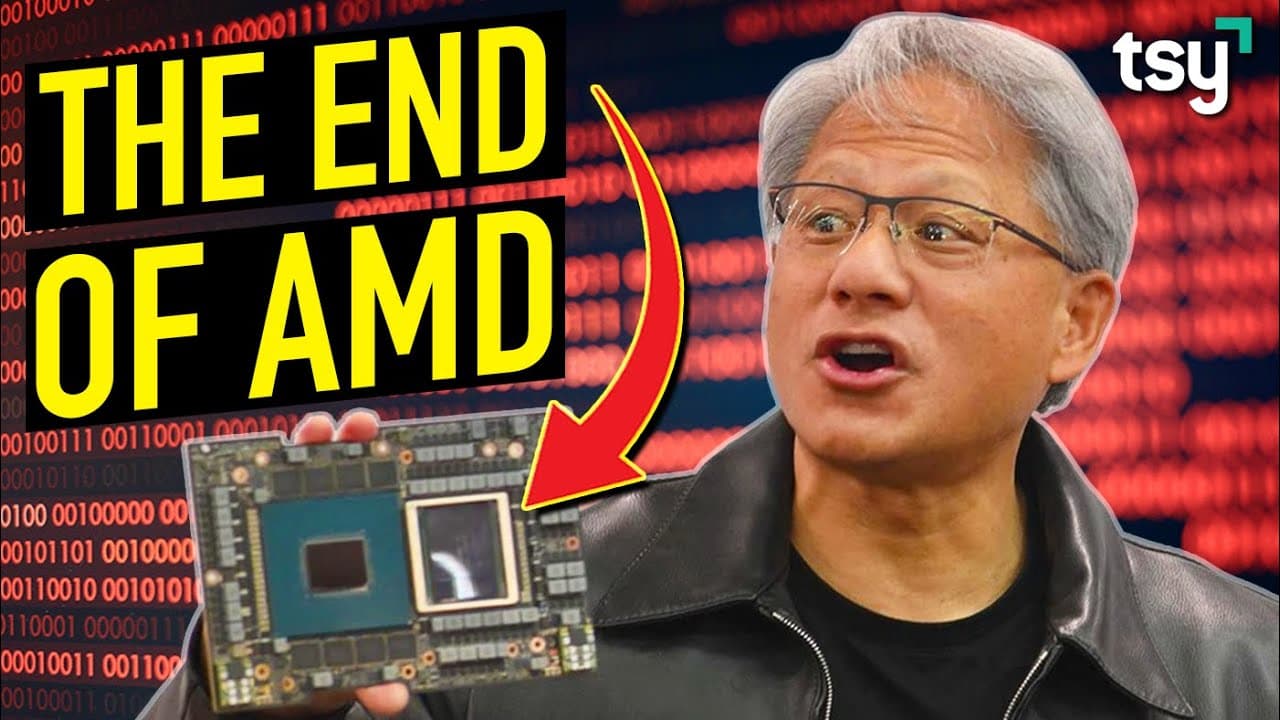
Nvidia could outpace AMD and other competitors by controlling AI hardware, networking, and software as one integrated stack. At Computex, Jensen Huang said DGX H100 systems could deliver around 150 times the work for the same power or run the same large language model at about 4% of the cost. Read on to see how Nvidia’s GPUs, Grace Hopper Superchip, networking technologies, and software reinforce that advantage.
Transcript
just a few weeks ago Nvidia made it clear that they're not just leading the charge when it comes to artificial intelligence they're trying to own the entire AI Market altogether the hardware the software and everything in between and they just might pull it off and add another trillion dollars to their market cap don't believe me let me show you ju... Read More
Key Insights
- ✋ Nvidia's hardware and software solutions offer significantly higher performance and cost-effectiveness than competitors like AMD and Intel.
- 📚 The company's comprehensive ecosystem and vast library of AI and software libraries make it an attractive choice for developers.
- 🥺 Nvidia's dominance in the AI market could lead to a lack of competition, hindering innovation and choice for developers.
- 😀 Competitors like AMD and Intel face significant challenges in catching up with Nvidia's market share and innovative capabilities.
- 💨 Facebook, Google, Microsoft, and Amazon need to develop products that can chip away at Nvidia's market share, fostering healthy competition in the AI market.
- 💨 Nvidia's modular server platform and networking technologies further solidify its position as the market leader and make it difficult for data centers to switch away from its ecosystem.
- 💗 The potential for Nvidia's market cap to increase by another trillion dollars is not out of the question given the growing size of the AI and accelerator markets.
Install to Summarize YouTube Videos and Get Transcripts
Explore YouTube Video Summarizer or Get YouTube Transcript Extractor
Questions & Answers
Q: How could Nvidia’s AI strategy threaten AMD and other competitors?
Nvidia is pursuing the entire AI stack, including GPUs, the Grace Hopper Superchip, networking technologies, and software for AI applications. The transcript argues that this integrated offering puts AMD and Intel under pressure because Nvidia can compete across both accelerated computing and more CPU-heavy data-center workloads.
Q: What performance and power advantages did Nvidia claim for GPU-based data centers?
Jensen Huang said data centers switching from AMD and Intel CPUs to Nvidia GPUs could perform 44 times more work while using less than one-third of the power. The example described 48 GPU servers costing $10 million and consuming 3.2 gigawatt-hours.
Q: What benefits did Nvidia claim for its DGX H100 GPU systems?
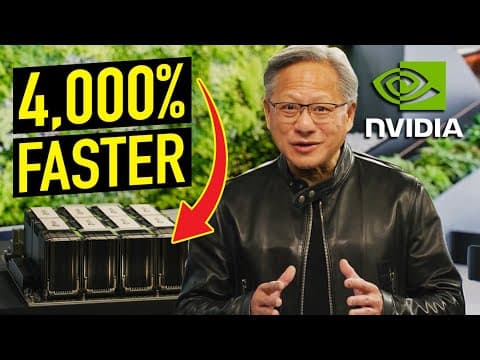
The transcript says a data center using Nvidia’s DGX H100 systems could perform around 150 times the work with the same amount of power. Alternatively, it could power the same large language model for around 4% of the cost.
Q: Why does Nvidia describe the data center as the computer?
Nvidia’s argument is that organizations should optimize the cost and performance of the whole data center rather than a single server. This framing supports tightly integrating GPU systems, networking, and software into one large computing platform.
Q: What is the Nvidia Grace Hopper Superchip designed to do?
The Grace Hopper Superchip lets Nvidia compete directly with AMD and Intel for data-center workloads that rely more heavily on CPUs. It expands Nvidia’s position beyond its traditional GPU focus.
Q: How do NVLink and InfiniBand strengthen Nvidia’s AI platform?
The transcript says NVLink and InfiniBand can connect hundreds of Nvidia Superchips. This allows them to operate effectively as one supercomputer-sized GPU.
Q: What did AMD demonstrate with the MI300X and Falcon model?
AMD demonstrated the MI300X running Falcon, a 40-billion-parameter model, on a single AMD Instinct GPU accelerator. The narrator says this was more impressive than the poem demonstration appeared, but notes that the same model could also run on an equivalent Nvidia GPU.
Q: What applications can Nvidia’s AI hardware and software support?
Nvidia showed its stack powering large language models and AI avatars for multiple uses. The applications mentioned include retail, customer service, manufacturing, robotics, video games, and movies.
Summary & Key Takeaways
-
Nvidia is leading the charge in the AI market, aiming to own the entire industry with its hardware and software solutions.
-
Recent AI announcements and innovations from companies like Google, Microsoft, and AMD pale in comparison to Nvidia's keynote at Computex.
-
Nvidia showcased products, services, and software that are set to dominate the AI stack, offering significantly higher performance and cost-effectiveness.
Read in Other Languages (beta)
Share This Summary 📚
Summarize YouTube Videos and Get Video Transcripts with 1-Click
Try YouTube Summary with ChatGPT & Claude or YouTube Transcript Generator
Explore More Summaries from Ticker Symbol: YOU 📚




Summarize YouTube Videos and Get Video Transcripts with 1-Click
Try YouTube Summary with ChatGPT & Claude or YouTube Transcript Generator