How to Calculate Gas Density Using the Ideal Gas Law
TL;DR
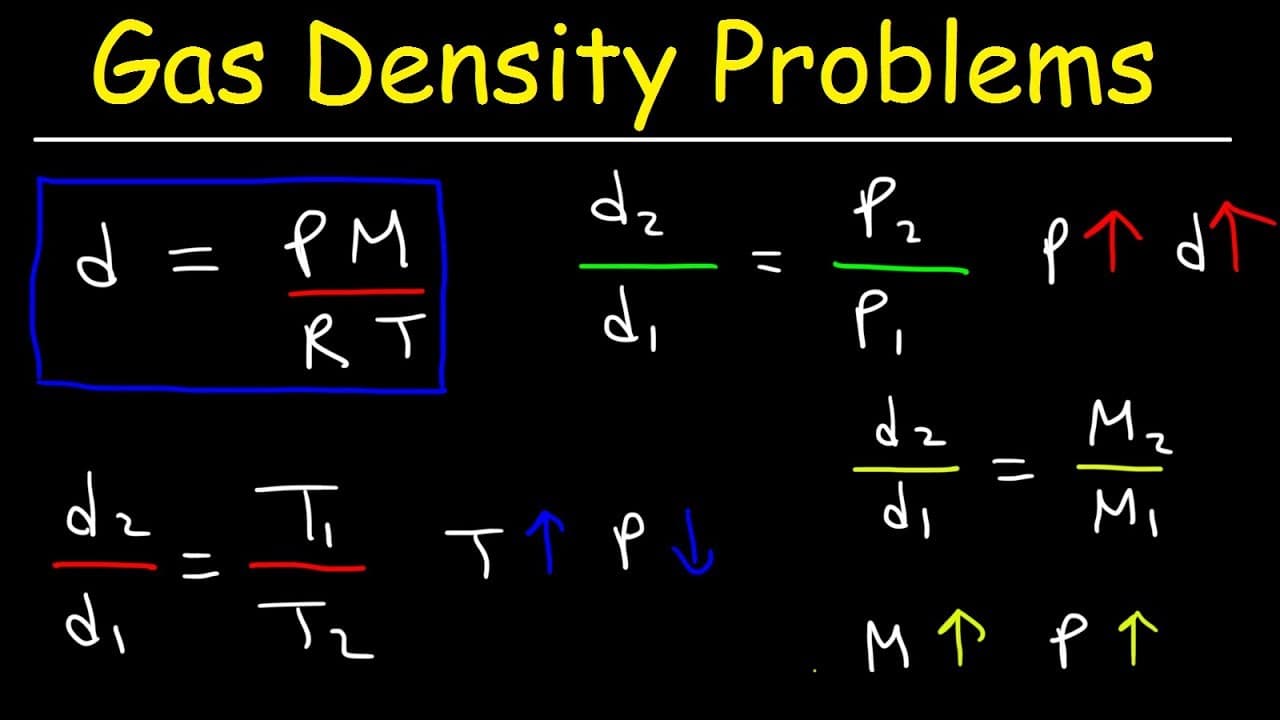
To calculate gas density using the ideal gas law, use the formula density = (pressure × molar mass) / (R × temperature). Ensure pressure is in atm, temperature in Kelvin, and molar mass in grams per mole. Density increases with pressure and molar mass but decreases with temperature.
Transcript
let's work on this problem calculate the density of carbon dioxide gas at 42 degrees Celsius at a pressure of 1.7 atm so what equation can we use to calculate the density well let's start with this equation the ideal gas law equation PV is equal to NRT now what we need to do is we need to replace n with something n is the number of moles and that's... Read More
Key Insights
- 🫢 The ideal gas law equation PV = nRT can be used to calculate gas density.
- 💆 Density is determined by pressure, temperature, and molar mass.
- 🫢 Increasing pressure increases gas density, while increasing temperature decreases it.
- 🫢 Gas density is directly related to molar mass and pressure, and inversely related to temperature.
Install to Summarize YouTube Videos and Get Transcripts
Explore YouTube Video Summarizer or Get YouTube Transcript Extractor
Questions & Answers
Q: How can you calculate the density of a gas using the ideal gas law equation?
To calculate gas density, use the equation density = pressure * molar mass / (R * temperature), where pressure is in atm, molar mass is in grams per mole, R is the ideal gas constant, and temperature is in Kelvin.
Q: What is the density of nitrogen gas at STP?
The molar mass of nitrogen gas (N2) is 28.02 grams per mole. At STP (0 degrees Celsius and 1 atm), the density of nitrogen gas is 1.25 grams per liter.
Q: How do changes in temperature and pressure affect the density of a gas?
Increasing pressure increases the density of a gas, while increasing temperature decreases it. Density is directly related to pressure and inversely related to temperature.
Q: How do you calculate the new density of a gas when the pressure is increased?
If the pressure of a gas is increased by a certain factor, the density will also increase by the same factor. Multiply the original density by the factor to calculate the new density.
Summary & Key Takeaways
-
The ideal gas law equation PV = nRT is used to calculate gas density.
-
The equation is modified by replacing n (number of moles) with mass divided by molar mass.
-
Density is equal to pressure times molar mass divided by R times temperature.
-
Calculating the density requires the molar mass of the gas, temperature in Kelvin, and pressure in atm.
Read in Other Languages (beta)
Share This Summary 📚
Summarize YouTube Videos and Get Video Transcripts with 1-Click
Try YouTube Summary with ChatGPT & Claude or YouTube Transcript Generator
Explore More Summaries from The Organic Chemistry Tutor 📚

Summarize YouTube Videos and Get Video Transcripts with 1-Click
Try YouTube Summary with ChatGPT & Claude or YouTube Transcript Generator