How to Conduct Hypothesis Tests for Proportions
TL;DR
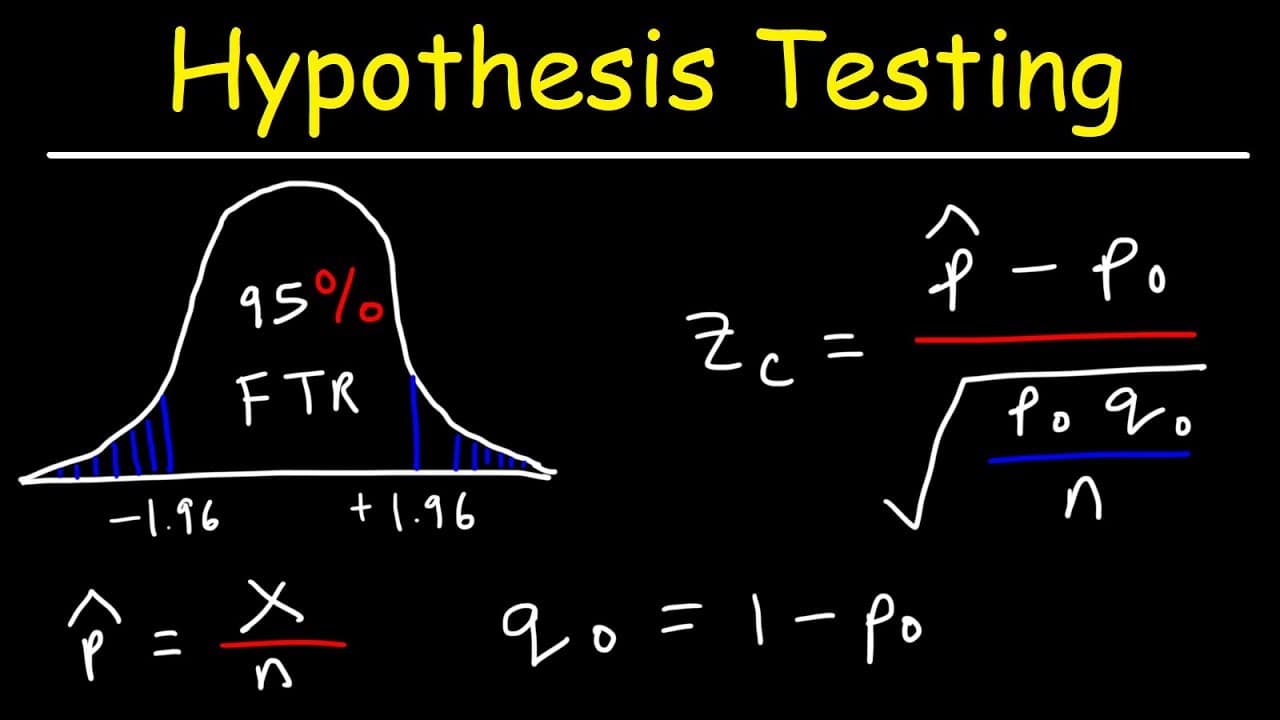
To conduct hypothesis tests for proportions, you first establish the null hypothesis, which states a specific proportion, and the alternative hypothesis, which suggests a different one. By calculating the sample proportion and comparing the calculated z-value to the critical z-value at your chosen confidence level, you can determine whether to reject or fail to reject the null hypothesis.
Transcript
in this video we're going to work on some hypothesis tests and problems associated with proportions so let's start with this one number one a tech company believes that the percentage of residents in town xyz that own a cell phone is 70 percent a marketing manager believes his value to be different he conducts a survey of 200 individuals and found ... Read More
Key Insights
- 🎁 The null hypothesis represents the status quo or the belief being challenged, while the alternative hypothesis presents the opposing belief.
- 🤪 Calculated z values are compared to critical z values to determine whether to reject or accept the null hypothesis.
- 🤪 The confidence level determines the critical z value, which is used to assess the calculated z value in the rejection or fail to reject region.
- 🗂️ The sample proportion is calculated by dividing the number of successes by the sample size.
- 🍸 Hypothesis tests can be one-tailed or two-tailed, depending on the range of values specified in the alternative hypothesis.
- 🏆 The rejection region in a hypothesis test is shaded and represents the area where the null hypothesis is rejected.
- 🤪 A null hypothesis is rejected if the calculated z value falls within the rejection region.
Install to Summarize YouTube Videos and Get Transcripts
Explore YouTube Video Summarizer or Get YouTube Transcript Extractor
Questions & Answers
Q: What are the null and alternative hypotheses in the example provided?
The null hypothesis states that 70% of residents in XYZ town own a cell phone, while the alternative hypothesis asserts that the proportion is different from 70%.
Q: Is the test in this example one-tailed or two-tailed?
The test is two-tailed because the alternative hypothesis states that the proportion does not equal 70%, allowing for it to be greater or less than 70%.
Q: How are the critical z values determined in hypothesis testing?
The critical z values are determined based on the confidence level. The sum of the areas in the non-shaded region provides the cumulative area, which is used to find the corresponding z value in the positive z-score table.
Q: What is the conclusion of the hypothesis test in part b?
At a 95% confidence level, there is not enough evidence to reject the null hypothesis, suggesting that the proportion of cell phone owners in XYZ town is likely 70%.
Summary & Key Takeaways
-
The video discusses a tech company's belief that 70% of residents in XYZ town own a cell phone, while a marketing manager believes it to be different. A survey of 200 individuals was conducted, with 130 responding yes to owning a cell phone.
-
The null hypothesis states that the proportion is 70%, while the alternative hypothesis claims it is different. The sample proportion is calculated as 0.65, with the proportion associated with the null hypothesis being 0.30.
-
By comparing the calculated z value with the critical z value, it is determined that there is not enough evidence to reject the null hypothesis at a 95% confidence level.
Read in Other Languages (beta)
Share This Summary 📚
Summarize YouTube Videos and Get Video Transcripts with 1-Click
Try YouTube Summary with ChatGPT & Claude or YouTube Transcript Generator
Explore More Summaries from The Organic Chemistry Tutor 📚





Summarize YouTube Videos and Get Video Transcripts with 1-Click
Try YouTube Summary with ChatGPT & Claude or YouTube Transcript Generator