Alkyne Synthesis Reaction: What Is the Major Product of Propyne, Sodium Amide, and Ethyl Bromide?
TL;DR
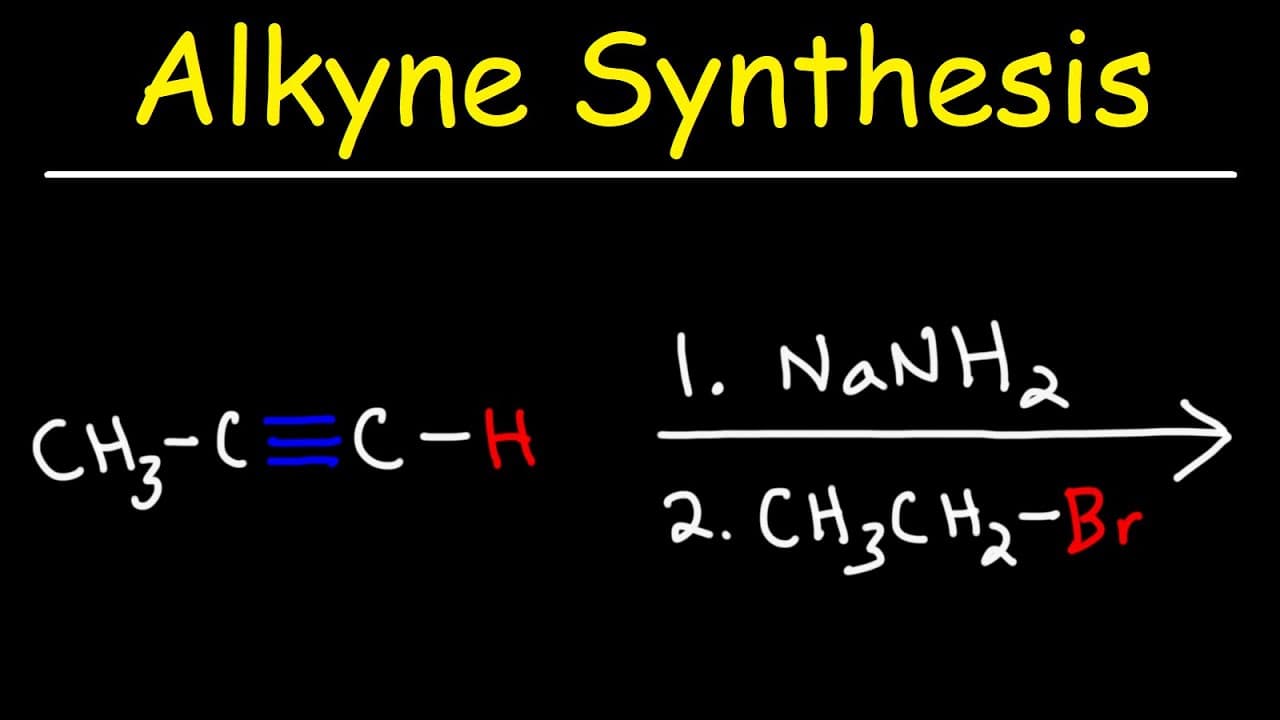
The alkyne propyne reacts with sodium amide followed by ethyl bromide to form 2-pentyne as the major product. Sodium amide removes the alkyne CH hydrogen, whose pKa is around 25, creating a negatively charged carbon that attacks ethyl bromide through an SN2 reaction. Read on to see how this forms a carbon-carbon bond and determines the product name.
Transcript
number nine which of the following is the major product that is formed in the reaction of propine with sodium amide followed by ethyl bromide so let's draw it propine is basically a three carbon alkyne we're going to react it with sodium amide nanh2 followed by ethyl bromide ch3ch2 br sodium has a positive charge so the amide ion is going to have a... Read More
Key Insights
- 💁 Propine reacts with sodium amide and ethyl bromide to form 2-pentyne through a deprotonation and SN2 reaction.
- 💁 Sodium amide acts as a strong base, while the alkaline ion formed acts as a nucleophile.
- 👶 The formation of 2-pentyne involves the creation of a new carbon-carbon bond.
- 🧘 The naming of the compound is based on the position of the triple bond, resulting in the name 2-pentyne.
- 🈸 The reaction demonstrates the application of organic chemistry principles in understanding reaction mechanisms.
- ❓ The significance of correct answer selection in organic chemistry problems.
- 🎮 Additional resources and exams reviews are available through the YouTube membership program and video playlists.
Install to Summarize YouTube Videos and Get Transcripts
Explore YouTube Video Summarizer or Get YouTube Transcript Extractor
Questions & Answers
Q: How does this alkyne reaction produce 2-pentyne?
Sodium amide first deprotonates the alkyne CH group of propyne, producing a negatively charged carbon within the triple-bond system. That nucleophile attacks the primary carbon of ethyl bromide in an SN2 reaction, forming a carbon-carbon bond and a five-carbon product.
Q: What does NaNH2 do to an alkyne?
NaNH2 acts as a strong base and removes the alkyne CH hydrogen. The transcript states that this hydrogen has a pKa of around 25 and that deprotonation creates a carbon with a negative charge in the triple-bond system.
Q: Why can sodium amide deprotonate propyne?
The amide ion has a negative charge and two lone pairs, so it acts as a strong base. It is strong enough to remove the alkyne CH hydrogen from propyne.
Q: What happens after the alkyne ion forms?
The negatively charged carbon behaves as a good nucleophile. It attacks the primary carbon of ethyl bromide and displaces the leaving group through an SN2 reaction.
Q: What is the major product of propyne treated with sodium amide and then ethyl bromide?
The major product is 2-pentyne, identified as answer choice B. The sequence adds the ethyl group to the deprotonated propyne and creates a five-carbon system.
Q: Why does the reaction with ethyl bromide proceed by an SN2 mechanism?
The negatively charged alkyne intermediate acts as the nucleophile and attacks the primary carbon of ethyl bromide. During that attack, the leaving group is expelled and a new carbon-carbon bond forms.
Q: Why is the product named 2-pentyne?
The product contains five carbons, so its name uses the pent prefix. Its triple bond lies between carbons two and three, and numbering with the lower position gives the name 2-pentyne.
Q: What new bond forms in this alkyne synthesis reaction?
A new carbon-carbon bond forms between the negatively charged carbon of the alkyne intermediate and the primary carbon of ethyl bromide. This bond formation expands the original three-carbon propyne structure into a five-carbon system.
Summary & Key Takeaways
-
Propine, a three-carbon alkyne, reacts with sodium amide nanh2 followed by ethyl bromide ch3ch2 br.
-
Sodium amide acts as a strong base, deprotonates the alkyne CH hydrogen, and forms an alkaline ion.
-
The resulting alkaline ion behaves as a nucleophile and undergoes an SN2 reaction with the primary carbon of ethyl bromide, leading to the formation of 2-pentyne.
Read in Other Languages (beta)
Share This Summary 📚
Summarize YouTube Videos and Get Video Transcripts with 1-Click
Try YouTube Summary with ChatGPT & Claude or YouTube Transcript Generator
Explore More Summaries from The Organic Chemistry Tutor 📚


Summarize YouTube Videos and Get Video Transcripts with 1-Click
Try YouTube Summary with ChatGPT & Claude or YouTube Transcript Generator