What Is Chemical Shift in NMR Spectroscopy?
TL;DR
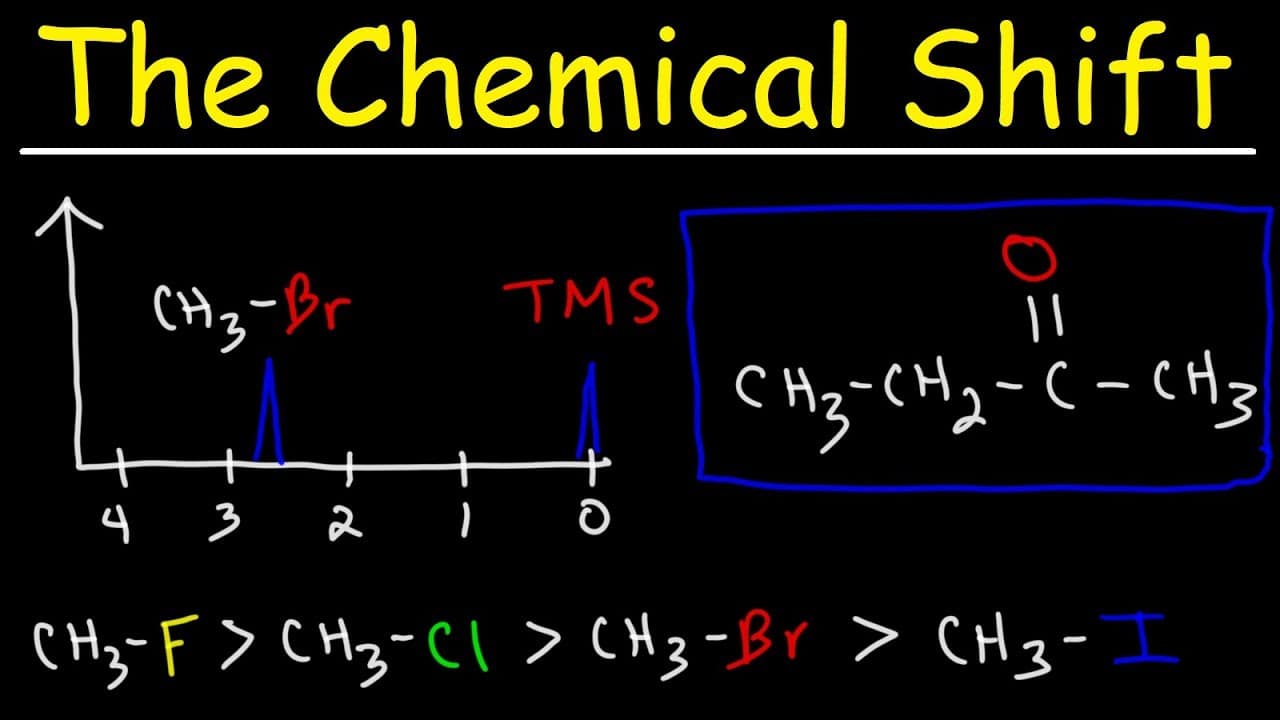
Chemical shift is the position of an NMR signal, defined as the observed shift (in hertz) divided by the spectrophotometer's operating frequency (in megahertz), multiplied by 10 to the 6 to give a value in ppm. It is represented by the symbol delta. Electron-withdrawing groups and electronegative atoms deshield nearby protons and raise the shift: methyl fluoride reads about 4.3 ppm versus 1.0 ppm for methane. Read on for the values and patterns behind each signal.
Transcript
in this video we're going to talk about chemical shift chemical shift represented by the symbol delta is basically the ratio of the observed chemical shift which is typically given in hertz divided by the operating frequency of the spectrophotometer which is typically given in megahertz now to get a number between 0 and 12 you're going to have to m... Read More
Key Insights
- 🥳 Chemical shift in NMR spectroscopy is determined by the ratio of observed chemical shift to the operating frequency of the spectrophotometer.
- ✋ Electronegative atoms and electron-withdrawing groups result in higher chemical shifts.
- 🍧 Presence of halogens increases chemical shift, with fluoride having the highest shift and iodine having the lowest shift among methyl compounds.
- 💨 Protons closer to electron-withdrawing groups have higher chemical shifts, while those further away have lower shifts.
Install to Summarize YouTube Videos and Get Transcripts
Explore YouTube Video Summarizer or Get YouTube Transcript Extractor
Questions & Answers
Q: What is the symbol for chemical shift in NMR?
Chemical shift is represented by the Greek symbol delta. It is measured in ppm (parts per million), shown on the x-axis of an NMR spectrum.
Q: What is chemical shift in NMR spectroscopy?
Chemical shift is the ratio of the observed chemical shift, typically given in hertz, divided by the operating frequency of the spectrophotometer, typically given in megahertz. Multiplying that ratio by 10 to the 6 gives a number between 0 and 12 expressed in ppm.
Q: How does the presence of a halogen affect the chemical shift?
A halogen greatly increases the chemical shift through the inductive effect, and more electronegative atoms produce higher shifts. The order is methyl fluoride highest (about 4.3 ppm), then methyl chloride (3.1 ppm), methyl bromide (2.7 ppm), and methyl iodide (2.2 ppm); methane is much lower at about 1.0 ppm.
Q: Why does methyl bromide have a higher chemical shift than methyl chloride is not correct?
Because chlorine is more electronegative than bromine, methyl chloride actually has the higher chemical shift of the two. Methyl bromide sits at about 2.7 ppm while methyl chloride is about 3.1 ppm, reflecting that stronger electronegativity deshields the protons more.
Q: How does the number of electron-withdrawing groups change the chemical shift?
Adding more electron-withdrawing groups on a carbon increases the chemical shift because they pull electrons away and deshield the proton. Chloroform, with three chlorine atoms, shows about 7.3 ppm, dichloromethane about 5.3 ppm, methyl chloride 3.1 ppm, and methane about 1.0 ppm.
Q: How does a proton's distance from an electron-withdrawing group affect its shift?
Protons closest to an electron-withdrawing group have the highest chemical shift and appear downfield (left side), while those farthest away have the lowest shift and appear upfield (right side). In 1-nitropropane the CH2 next to the nitro group is about 4.4 ppm, the middle CH2 about 2.1 ppm, and the terminal CH3 about 1.0 ppm.
Q: What does downfield and upfield mean on an NMR spectrum?
Downfield is the left side of the spectrum, where deshielded protons near electron-withdrawing groups appear with higher chemical shifts. Upfield is the right side, where shielded protons away from such groups appear with lower chemical shifts.
Q: What is TMS used for in NMR?
TMS (tetramethylsilane) is a silicon atom with four methyl groups used as the reference signal, and it has the lowest chemical shift. Compounds with electronegative atoms or electron-withdrawing groups, such as methyl bromide, show higher shifts than TMS.
Summary & Key Takeaways
-
Chemical shift in NMR spectroscopy is represented by the symbol delta, which is the ratio of observed chemical shift to the spectrophotometer's operating frequency.
-
The reference signal, Tetramethylsilane (TMS), has the lowest chemical shift value, while other compounds with electronegative atoms or electron-withdrawing groups have higher chemical shift values.
-
Presence of halogens increases the chemical shift, with methylfluoride having the highest shift and methyl iodide having the lowest shift.
Read in Other Languages (beta)
Share This Summary 📚
Summarize YouTube Videos and Get Video Transcripts with 1-Click
Try YouTube Summary with ChatGPT & Claude or YouTube Transcript Generator
Explore More Summaries from The Organic Chemistry Tutor 📚






Summarize YouTube Videos and Get Video Transcripts with 1-Click
Try YouTube Summary with ChatGPT & Claude or YouTube Transcript Generator