What Is the Stork Enamine Reaction Mechanism?
TL;DR
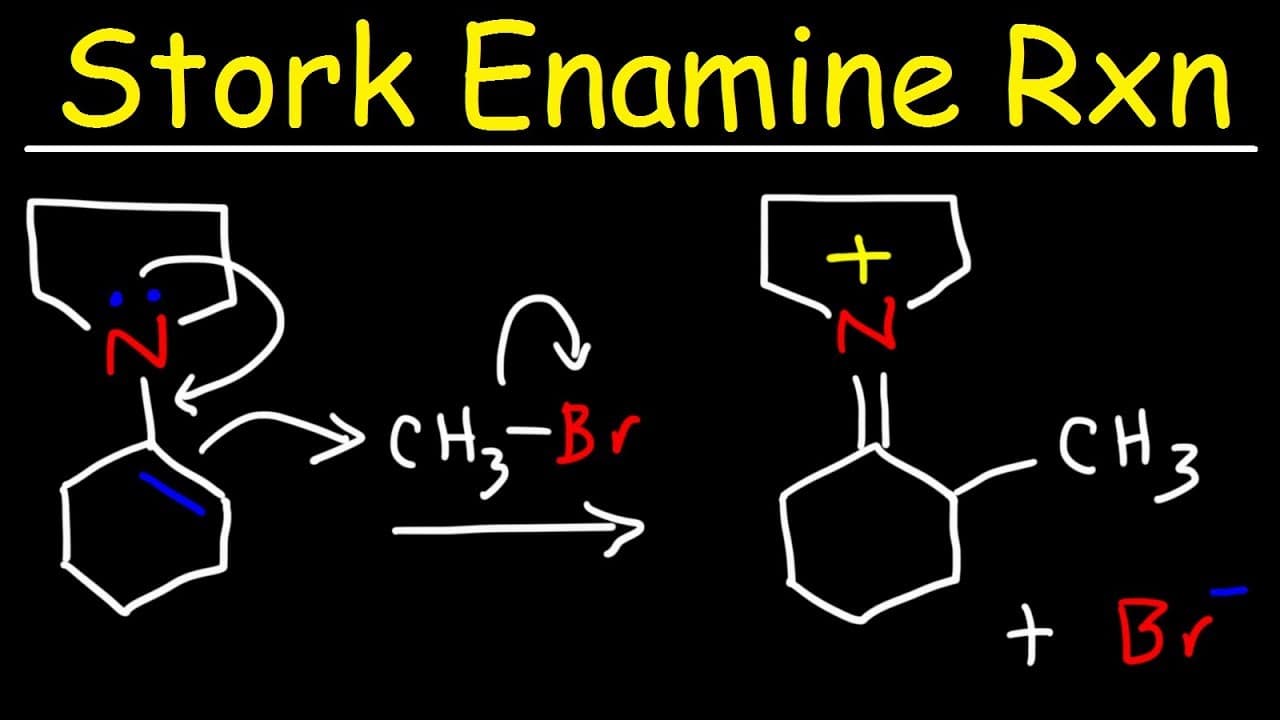
The Stork enamine reaction mechanism begins with a ketone reacting with a secondary amine to form an enamine intermediate. This enamine can be used for alkylation, reaction with an acid chloride, or participate in a Michael reaction, ultimately leading to a range of ketone products through hydrolysis and electrophilic attack.
Transcript
in this video we're going to briefly review the stork and amine reaction so let's say we have this particular molecule cyclohexanol and we're going to react it with a secondary amine whenever you react to ketone with a secondary amine you're going to get an enamine and so our product will look like this we're going to have a single bond between the... Read More
Key Insights
- 💁 The Stork and Amine reaction involves the formation of an enamine intermediate, which can be used for various reactions.
- ❓ Alkylation, reaction with acid chloride, and participation in a Michael reaction are some of the reactions that can be carried out using the enamine intermediate.
- 👊 The mechanism of the Stork and Amine reaction involves protonation, nucleophilic attack, and transfer of hydrogen atoms.
- 😥 The pH of the reaction system plays a crucial role in the formation of the enamine intermediate.
- 👊 The enamine intermediate acts as a nucleophile and attacks electrophilic carbon atoms.
- 💦 The enamine intermediate can be generated using a weak base such as water or another secondary amine.
- ❓ The enamine intermediate undergoes hydrolysis to regenerate the original ketone product.
Install to Summarize YouTube Videos and Get Transcripts
Explore YouTube Video Summarizer or Get YouTube Transcript Extractor
Questions & Answers
Q: What is the role of a secondary amine in the Stork and Amine reaction?
The secondary amine acts as a nucleophile and attacks the carbonyl carbon of the ketone, forming an enamine intermediate.
Q: How is the enamine intermediate converted into an iminium ion?
The enamine intermediate can be alkylated with an alkyl halide, causing the nitrogen atom to form a pi bond and resulting in the formation of an iminium ion.
Q: What happens when the enamine intermediate reacts with an acid chloride?
The acid chloride is attacked by the nitrogen atom of the enamine intermediate, forming an iminium ion. The iminium ion then expels a chloride ion, resulting in the formation of a ketone product.
Q: How does the enamine intermediate participate in a Michael reaction?
The enamine intermediate acts as a Michael donor and reacts with an alpha beta unsaturated aldehyde or ketone, resulting in the formation of a 1,5-dicarbonyl product.
Summary & Key Takeaways
-
The Stork and Amine reaction starts with the reaction between a ketone and a secondary amine to form an enamine intermediate.
-
The enamine intermediate can be alkylated using an alkyl halide, resulting in the formation of an iminium ion.
-
The iminium ion can be hydrolyzed with H3O+ to regenerate the original ketone.
-
The enamine intermediate can also react with an acid chloride to form an iminium ion, which can be further hydrolyzed to give a ketone product.
-
Additionally, the enamine intermediate can participate in a Michael reaction with an alpha beta unsaturated aldehyde or ketone, resulting in the formation of a 1,5-dicarbonyl product.
Read in Other Languages (beta)
Share This Summary 📚
Summarize YouTube Videos and Get Video Transcripts with 1-Click
Try YouTube Summary with ChatGPT & Claude or YouTube Transcript Generator
Explore More Summaries from The Organic Chemistry Tutor 📚



Summarize YouTube Videos and Get Video Transcripts with 1-Click
Try YouTube Summary with ChatGPT & Claude or YouTube Transcript Generator