How to Synthesize Phenylhydrazine From Aniline
TL;DR
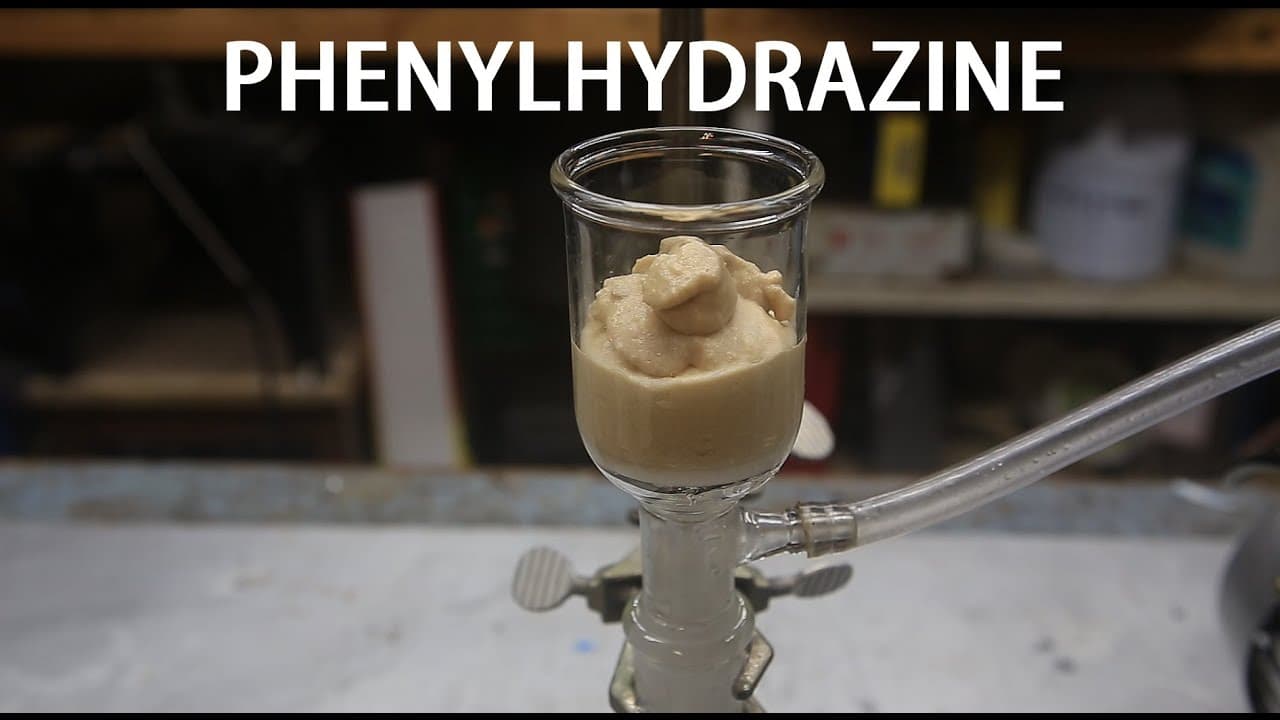
To synthesize phenylhydrazine, mix aniline with hydrochloric acid to form a salt and then add sodium nitrite to generate a diazonium salt, maintaining a low temperature. Finally, reduce the diazonium salt with stannous chloride to obtain phenylhydrazine, achieving a yield of about 10g, which can be recrystallized for purification.
Transcript
in chemistry the major use of phenyl hydrazine is to make molecules which are known as indoles the most widely used method to produce indoles from hydrogen's is known as the Fischer in dual synthesis this reaction is a pretty easy way to make indels and it's actually quite an old reaction it was first reported in 1875 by Fischer which makes the rea... Read More
Key Insights
- ❓ The Fischer indole synthesis, using phenyl hydrazine, is a well-established method for producing indoles industrially.
- 💯 Indoles are important in the fields of dyes and pharmaceuticals due to their core structure and functionality.
- ❓ The experiment described in the content provides a detailed procedure for the synthesis of indoles using specific reagents.
- 🎮 Precise temperature control is crucial throughout the synthesis process to ensure successful reactions.
- 🥺 Stannous chloride is used to reduce the diazonium salt of aniline, leading to the formation of indoles.
- 💦 The yield of the experiment was higher than theoretical, potentially due to remaining water content in the product.
- 🎭 Recrystallization can be performed to purify the synthesized phenyl hydrazine hydrochloride.
Install to Summarize YouTube Videos and Get Transcripts
Explore YouTube Video Summarizer or Get YouTube Transcript Extractor
Questions & Answers
Q: What is the significance of phenyl hydrazine in the Fischer indole synthesis?
Phenyl hydrazine plays a crucial role as a reagent in the Fischer indole synthesis, enabling the production of indoles, which are fundamental structures in various dyes and pharmaceuticals.
Q: How old is the Fischer indole synthesis?
The Fischer indole synthesis was first reported by Fischer in 1875, making it over a hundred years old. Despite its age, it remains a major method for the industrial production of indoles.
Q: Why are indoles important in the field of chemistry?
Indoles are significant in chemistry because they serve as the core structure for many dyes and pharmaceuticals, making them essential in these industries.
Q: What is the purpose of using phenyl hydrazine to make indoles?
The author intends to use phenyl hydrazine to produce indoles because they are known to have an unpleasant odor. This experiment aims to explore the synthesis process and the resulting smell of these compounds.
Summary & Key Takeaways
-
Phenyl hydrazine is a key reagent in the Fischer indole synthesis, which has been used for over a hundred years to produce indoles.
-
Indoles are vital components in dyes and pharmaceuticals due to their core structure.
-
The experiment described in the content details the synthesis process using specific quantities of sodium nitrite, hydrochloric acid, aniline, and stannous chloride.
Read in Other Languages (beta)
Share This Summary 📚
Summarize YouTube Videos and Get Video Transcripts with 1-Click
Try YouTube Summary with ChatGPT & Claude or YouTube Transcript Generator
Explore More Summaries from NileRed 📚
Summarize YouTube Videos and Get Video Transcripts with 1-Click
Try YouTube Summary with ChatGPT & Claude or YouTube Transcript Generator