How Does Temperature Affect Elimination vs Substitution Reactions?
TL;DR
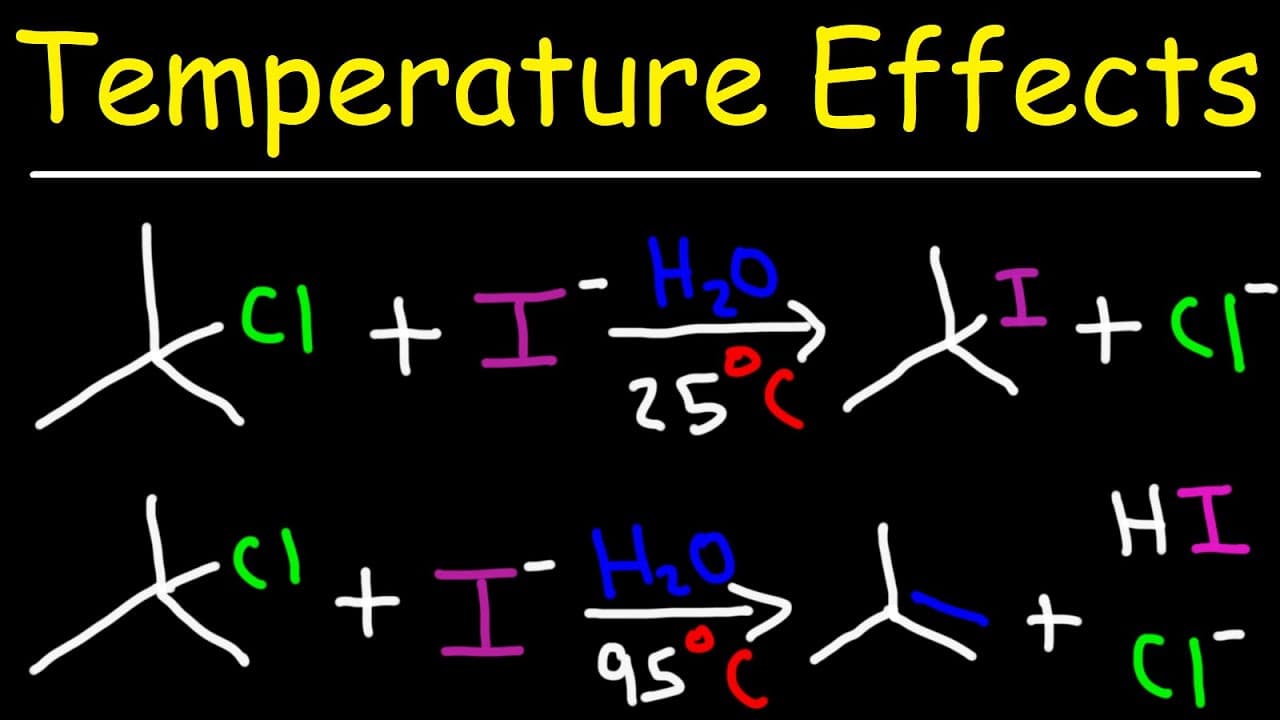
Increasing temperature favors elimination reactions over substitution reactions due to enhanced entropy, which makes the E1 reaction more spontaneous. At low temperatures, the reaction proceeds via the SN1 mechanism, while at higher temperatures, the E1 mechanism prevails, requiring more energy to break two bonds compared to one in SN1.
Transcript
consider the reaction that we have with tert-butyl chloride reacting with iodide dissolved in water but at different temperatures in the top example we're reacting it at a low temperature of 25 degrees Celsius and in the bottom example at a higher temperature at 95 degrees Celsius what's going to be the major product for this reaction and what mech... Read More
Key Insights
- 💦 Increasing the temperature favors the E1 reaction over the sn1 reaction in the reaction between tert-butyl chloride and iodide in water.
- 🥺 Low temperatures favor the sn1 reaction, leading to substitution, while high temperatures favor the E1 reaction, leading to elimination.
- 💄 The increase in temperature enhances the entropy effect, making the E1 reaction more energetically favorable.
- ✋ The E1 reaction has a higher activation energy due to the need to break two bonds compared to the sn1 reaction.
- ❓ Temperature impacts both the thermodynamics and kinetics of the reaction.
- ✋ The E1 reaction becomes more spontaneous at higher temperatures due to the entropy effect.
- 😘 Low temperatures favor the sn1 reaction because it has a lower activation energy.
Install to Summarize YouTube Videos and Get Transcripts
Explore YouTube Video Summarizer or Get YouTube Transcript Extractor
Questions & Answers
Q: Why do low temperatures favor the sn1 reaction?
Low temperatures limit the energy available to break bonds, making the sn1 reaction energetically favorable due to the lower activation energy required to break only one bond.
Q: How does an increase in temperature affect the yield of the E1 reaction?
As the temperature increases, the yield of the E1 reaction also increases due to the enhanced entropy effect, making the reaction more energetically favorable.
Q: What is the impact of temperature on the position of the equilibrium between sn1 and E1 reactions?
Increasing the temperature shifts the equilibrium towards the E1 reaction, as it becomes more energetically favorable, resulting in a decrease in the yield of the sn1 reaction.
Q: Why do elimination reactions have a higher activation energy than substitution reactions?
Elimination reactions require breaking two bonds (carbon-chlorine and carbon-hydrogen), which necessitates a greater input of energy compared to breaking only the carbon-chlorine bond in substitution reactions, resulting in a higher activation energy for the E1 reaction.
Summary & Key Takeaways
-
Reacting tert-butyl chloride with iodide in water at different temperatures (25°C and 95°C) results in different major products and reaction mechanisms.
-
At low temperatures, the reaction proceeds by the sn1 mechanism, leading to substitution with iodide as the major product.
-
At high temperatures, the reaction favors the E1 mechanism, leading to elimination with the formation of a double bond and the abstraction of a proton by water.
Read in Other Languages (beta)
Share This Summary 📚
Summarize YouTube Videos and Get Video Transcripts with 1-Click
Try YouTube Summary with ChatGPT & Claude or YouTube Transcript Generator
Explore More Summaries from The Organic Chemistry Tutor 📚




Summarize YouTube Videos and Get Video Transcripts with 1-Click
Try YouTube Summary with ChatGPT & Claude or YouTube Transcript Generator