What Is the Dipole Moment and How Does It Affect Polarity?
TL;DR
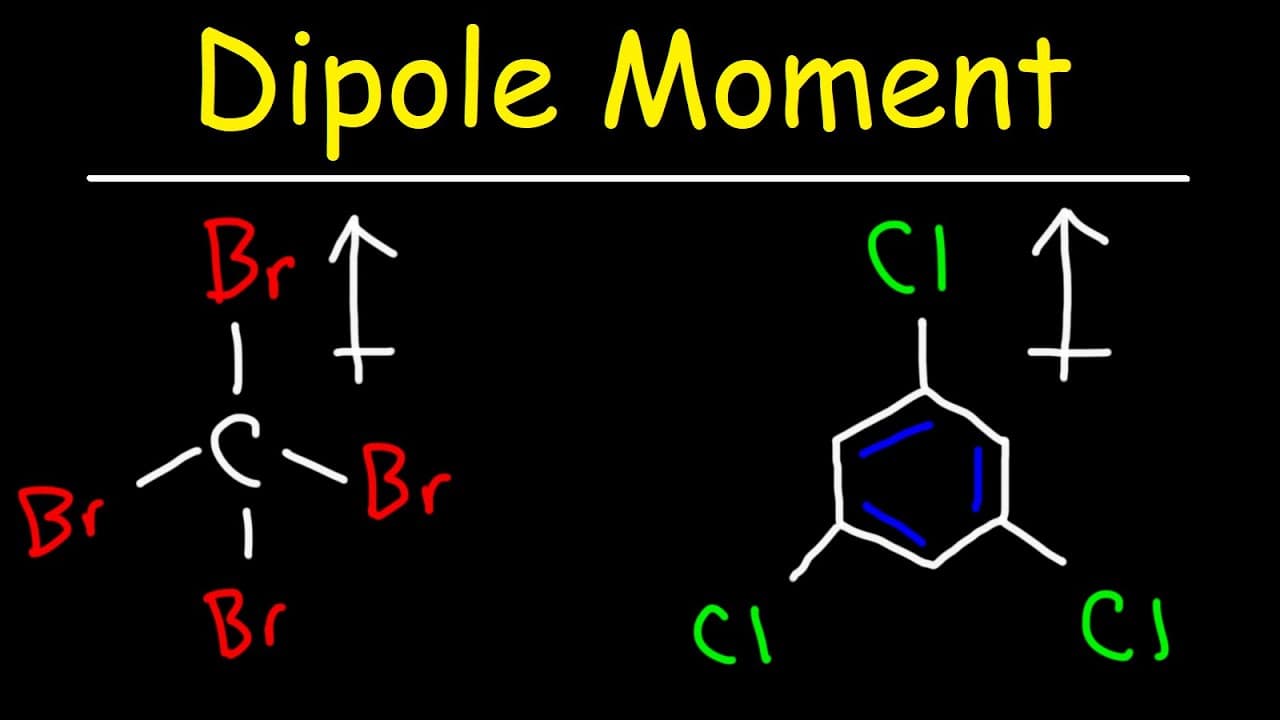
The molecule with carbon-fluorine bonds has the largest dipole moment, because its highly polar C-F bonds (electronegativity difference 1.5) do not cancel out. By contrast, carbon tetrabromide (CBr4), carbon dioxide (CO2), and 1,3,5-trichlorobenzene are all nonpolar because their bond dipoles cancel by symmetry. A bond only counts as polar when the electronegativity difference is 0.5 or greater. Read on to see how drawing vector arrows shows which dipoles cancel and which survive.
Transcript
number 10. which molecule has the largest dipole moment is it A B C or D well let's start with answer Choice a carbon Tetra bromide cbr4 carbon has an electronegativity value of 2.5 whereas bromine has an eon value of 2.8 the electronegativity difference is 0.3 in order for a bond to be polar the Electoral negativity difference has to be equal to o... Read More
Key Insights
- 🫀 The electronegativity difference between the atoms in a molecule determines the polarity of the bonds and, consequently, the dipole moment.
- ❓ In nonpolar molecules, the dipole moments from the bonds cancel out due to the symmetry of the molecule.
- 🐻❄️ Polar molecules have a net dipole moment because the dipole moments do not cancel out.
- 😥 The dipole moment can be determined by drawing arrows pointing toward the more electronegative atom in each bond.
- ❓ Carbon tetrabromide and 1,3,5-trichlorobenzene have nonpolar dipole moments due to the cancellation of dipole moments from the bonds.
- 🐻❄️ Carbon dioxide has polar bonds, but the dipole moments cancel out, resulting in a nonpolar dipole moment.
- 🐻❄️ Carbon fluoride has the largest dipole moment among the given molecules because the polar carbon-fluorine bonds do not cancel out.
Install to Summarize YouTube Videos and Get Transcripts
Explore YouTube Video Summarizer or Get YouTube Transcript Extractor
Summary & Key Takeaways
-
Carbon tetrabromide (CBR4) has a nonpolar dipole moment because the electronegativity difference between carbon and bromine is relatively small, canceling out the dipole moments.
-
Carbon dioxide (CO2) has polar bonds, but the dipole moments cancel out due to the opposite direction of the two carbon-oxygen bonds.
-
1,3,5-trichlorobenzene has a nonpolar dipole moment because the dipole moments from the carbon-chlorine bonds cancel each other out.
-
Carbon fluoride (CF4) has the largest dipole moment among the given molecules due to the polar carbon-fluorine bonds, which do not cancel out.
Read in Other Languages (beta)
Share This Summary 📚
Summarize YouTube Videos and Get Video Transcripts with 1-Click
Try YouTube Summary with ChatGPT & Claude or YouTube Transcript Generator
Explore More Summaries from The Organic Chemistry Tutor 📚



Summarize YouTube Videos and Get Video Transcripts with 1-Click
Try YouTube Summary with ChatGPT & Claude or YouTube Transcript Generator