What Is Substantial Performance in Contract Law?
TL;DR
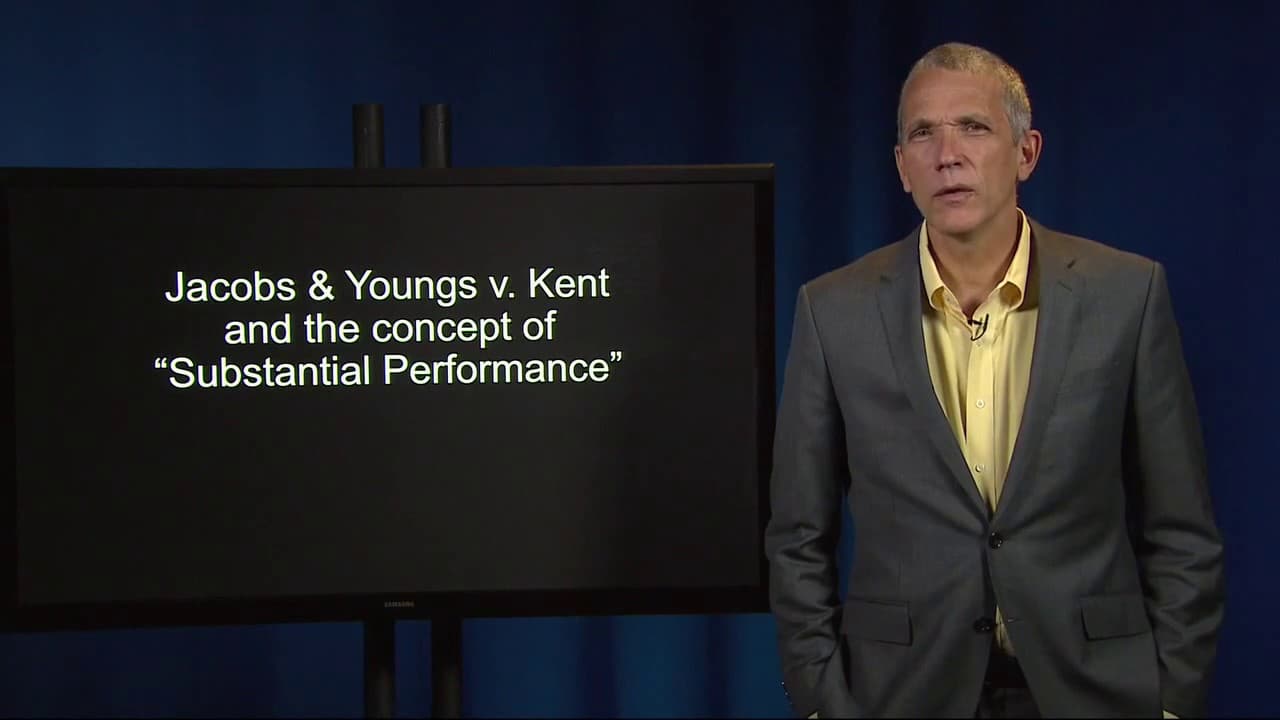
Substantial performance refers to a legal standard where a party fulfills enough of their contractual obligations to avoid material breach, even if minor deviations occur. In the Jacob and Youngs v. Kent case, the court established that if the quality of work is satisfactory and only a trivial breach exists, the buyer cannot withhold payment. Damages for such breaches are based on the diminished value rather than the cost to remedy the defect.
Transcript
today we're going to introduce the concepts of material breach and substantial performance by exploring Jacob and Youngs versus Kent the opinion was written by Benjamin cordoza while he was a judge on the New York state court of appeals as some of you may know Cardozo went on to become a Supreme Court Justice and like justices Scalia and Marshall C... Read More
Key Insights
- 👮 The case explores the concepts of material breach and substantial performance in contract law.
- 📏 The court rejects the perfect tender rule that would allow buyers to withhold payment for any breach and the independent promises rule that would require unconditional payment regardless of performance.
- 📏 The substantial performance rule is established, stating that a breach is only material if it is willful or if there is less than substantial performance.
- ❓ The measure of damages for a breach is determined to be diminution in value, considering the quality and value of the actual performance compared to what was promised.
- 🥳 Future parties have the ability to contract around the substantial performance rule by explicitly stating their preferences in the contract.
- 💼 The role of the architect and the certificate of completion in the case are briefly mentioned, with the court not extensively considering their effects.
- 💯 Outside the UCC, a buyer's duty to pay is conditioned on the seller's substantial performance, while a seller's duty to sell is usually conditioned on perfect tender of full payment.
Install to Summarize YouTube Videos and Get Transcripts
Explore YouTube Video Summarizer or Get YouTube Transcript Extractor
Questions & Answers
Q: Is the installation of Reading pipe a constructive condition for the duty to pay in the Jacob and Youngs vs. Kent case?
No, the court rejects the perfect tender rule, stating that a trivial and innocent breach does not constitute a condition to withhold payment. Instead, the court establishes the substantial performance rule.
Q: What is the measure of damages for the breach in this case?
The court determines that the measure of damages for the breach is diminution in value. Since the pipe installed was similar in quality and value to the promised Reading pipe, the defendant is only entitled to diminution in value damages.
Q: Can future parties contract around the substantial performance rule?
Yes, future parties can contract around the substantial performance rule. By explicitly stating their preferences in the contract, future buyers can request perfect tender and create a contractual duty for the Builder to fulfill specific requirements.
Q: What is the role of the architect and the certificate of completion in this case?
The architect's duty in issuing the certificate of completion is not extensively discussed in the case. However, it is mentioned that the architect's certification is typically considered a conditioned precedent to the duty of immediate payment, with limited exceptions.
Summary & Key Takeaways
-
The case involves a building company, Jacob and Youngs, contracted to build a summer home for the homeowner, George Kent. The company installed some pipe made by other manufacturers instead of the specified Reading manufacturer.
-
Kent discovered the error and demanded the plumbing to be redone. Jacob and Youngs refused, so Kent withheld payment of $3,483. The court examines whether the installation of Reading pipe is a constructive condition for the duty to pay and the measure of damages for the breach.
-
The court rejects the perfect tender rule and the independent promises rule. Instead, it establishes the substantial performance rule, where a breach is only considered material if it is willful or there is less than substantial performance.
Read in Other Languages (beta)
Share This Summary 📚
Summarize YouTube Videos and Get Video Transcripts with 1-Click
Try YouTube Summary with ChatGPT & Claude or YouTube Transcript Generator
Explore More Summaries from YaleCourses 📚

Summarize YouTube Videos and Get Video Transcripts with 1-Click
Try YouTube Summary with ChatGPT & Claude or YouTube Transcript Generator