Amide formation from acyl chloride | Carboxylic acids and derivatives | Khan Academy
TL;DR
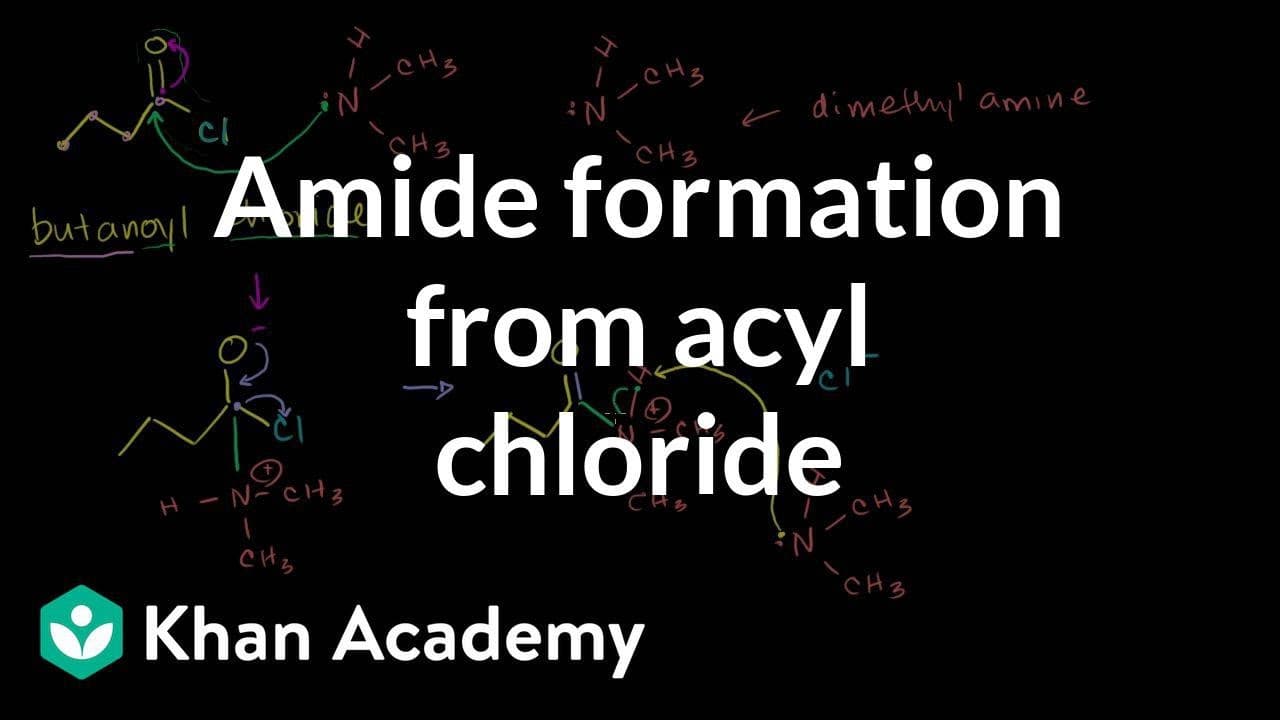
Butanoyl chloride can be converted to the more stable N,N-dimethylbutanamide through a reaction with dimethylamine.
Transcript
Let's think about what might happen if we had a molecule of butanoyl chloride. So one, two, three, four carbons. That's where the but- comes in, and then it's a butanoyl chloride. So it's an acyl halide or it's an acyl chloride. Let me write this down just to give us some practice with namings. This is butanoyl chloride. We saw a couple of videos a... Read More
Key Insights
- 🙅 Butanoyl chloride is an acyl chloride, while N,N-dimethylbutanamide is an amide.
- 👊 The reaction between butanoyl chloride and dimethylamine involves nucleophilic attack and bond rearrangements.
- 🙅 The formation of N,N-dimethylbutanamide is favored because it leads to a more stable carboxylic acid derivative.
Install to Summarize YouTube Videos and Get Transcripts
Explore YouTube Video Summarizer or Get YouTube Transcript Extractor
Questions & Answers
Q: What is the difference between butanoyl chloride and N,N-dimethylbutanamide?
Butanoyl chloride is an acyl chloride, while N,N-dimethylbutanamide is an amide. The former is less stable than the latter due to the presence of the more electronegative chlorine atom.
Q: How does dimethylamine react with butanoyl chloride?
Dimethylamine acts as a nucleophile and attacks the carbonyl carbon of butanoyl chloride. This leads to the formation of an intermediate with a chloride anion.
Q: Why is the reaction between butanoyl chloride and dimethylamine favorable?
The reaction is favorable because it results in the formation of a more stable carboxylic acid derivative (amide) from a less stable one (acyl chloride).
Q: How is N,N-dimethylbutanamide formed from the reaction?
N,N-dimethylbutanamide is formed through a series of bond rearrangements. The amine donates an electron to the carbonyl carbon, allowing the chloride anion to be formed. This chlorine ion subsequently reacts with another molecule of dimethylamine to form the final product.
Summary & Key Takeaways
-
Butanoyl chloride is a carboxylic acid derivative that is less stable than an amide.
-
Dimethylamine, a nucleophilic amine, can react with butanoyl chloride to form N,N-dimethylbutanamide.
-
The reaction involves the amine attacking the carbonyl carbon, followed by the rearrangement of bonds and formation of a chloride anion.
-
The resulting product is N,N-dimethylbutanamide, a more stable carboxylic acid derivative.
Read in Other Languages (beta)
Share This Summary 📚
Summarize YouTube Videos and Get Video Transcripts with 1-Click
Try YouTube Summary with ChatGPT & Claude or YouTube Transcript Generator
Explore More Summaries from Khan Academy 📚



Summarize YouTube Videos and Get Video Transcripts with 1-Click
Try YouTube Summary with ChatGPT & Claude or YouTube Transcript Generator