What Is Confirmation Bias and How Does It Affect Solving Puzzles?
TL;DR
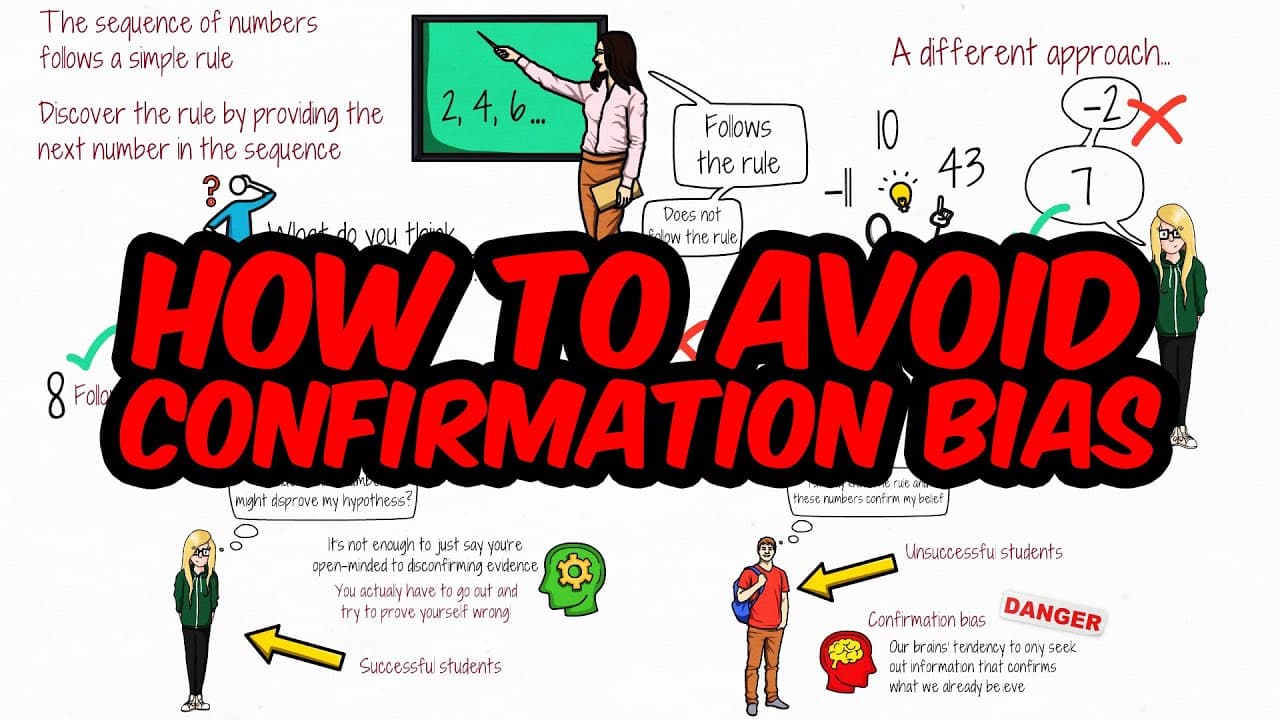
Confirmation bias is the tendency to believe we are right and only look for evidence that supports our existing beliefs, often leading to incorrect conclusions. In a math puzzle, successful students avoid this trap by actively seeking to disprove their hypotheses, demonstrating that an open-minded approach is crucial for accurate problem-solving.
Transcript
A professor walks into a room and gives her students the following three numbers: 2, 4, 6. The professor then tells her students that the sequence of numbers follows a simple rule and that it’s the students’ job to discover the rule by providing the number next in the sequence. Each time the students guess the next number in the sequence, ... Read More
Key Insights
- 🥺 Confirmation bias leads to the acceptance of incorrect beliefs based on seeking only confirming evidence.
- 🍂 Success in problem-solving often requires actively seeking out disconfirming evidence to avoid falling into cognitive traps.
- 🤗 Open-mindedness and a willingness to challenge one's beliefs lead to more accurate problem-solving and decision-making.
- 👍 The importance of testing hypotheses and being willing to be proven wrong in order to reach the truth.
- 🤔 The value of critical thinking and humility in approaching challenges, whether in math puzzles or real-life situations.
- 💀 The danger of prematurely settling on beliefs without actively seeking to disprove them.
- ❓ The significance of actively seeking out contrasting evidence to avoid cognitive biases and improve problem-solving skills.
Install to Summarize YouTube Videos and Get Transcripts
Explore YouTube Video Summarizer or Get YouTube Transcript Extractor
Questions & Answers
Q: What challenge did the professor present to the students regarding number sequences?
The professor asked the students to identify the rule in a sequence by guessing the next number, highlighting the common trap of confirmation bias.
Q: What distinguished the unsuccessful students from the successful ones in deciphering the rule?
Unsuccessful students stuck to confirming their belief about the rule by suggesting numbers that matched their hypothesis, while successful students sought to prove themselves wrong by looking for disconfirming evidence.
Q: Why did the professor shake her head when most students guessed that adding 2 to the last number was the rule?
The professor shook her head because the rule was actually that the next number in the sequence must be higher than the previous one, emphasizing the danger of confirmation bias.
Q: How did one student successfully identify the rule in the number sequence?
The successful student tested various numbers, aiming to find a flaw in her hypothesis rather than confirming it, eventually deducing that the next number had to be higher than the previous one.
Summary & Key Takeaways
-
A professor challenges students to identify a rule in a number sequence by guessing the next number.
-
Most students fall into the trap of confirmation bias, believing they have the rule and only suggesting numbers to confirm it.
-
Successful students adopt a different approach by trying to disprove their hypotheses, showcasing the importance of open-mindedness.
Read in Other Languages (beta)
Share This Summary 📚
Summarize YouTube Videos and Get Video Transcripts with 1-Click
Try YouTube Summary with ChatGPT & Claude or YouTube Transcript Generator
Explore More Summaries from The Art of Improvement 📚


Summarize YouTube Videos and Get Video Transcripts with 1-Click
Try YouTube Summary with ChatGPT & Claude or YouTube Transcript Generator