How to Identify Business Opportunities Using AI
TL;DR
Opportunity identification is the skill of noticing unmet wants, missing products, or underserved markets, then acting on those gaps. The proposed strategy is to let humans supply intuition, feelings, and original direction while AI handles analytical tasks such as generating ideas, creating designs, editing graphics, and optimizing product listings.
Transcript
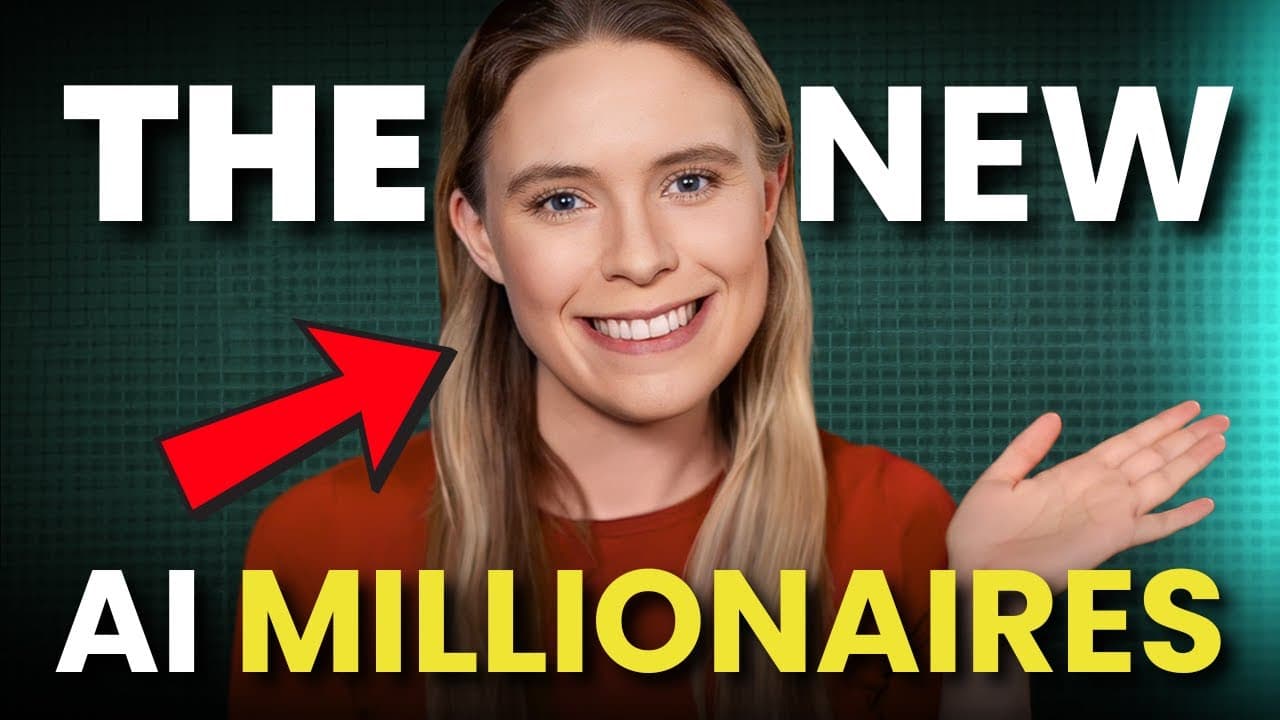
Look, we have entered the new AI era and now the pathway to getting rich and becoming a millionaire has completely changed. And if we're being honest here, this new world that we're living in is creating new financial winners. But it's also creating new financial losses. And in this video, I'm going to share the number one skill that is separating ... Read More
Key Insights
- Opportunity identification is the ability to spot missing products, services, or content and act on those gaps. The creator presents it as the most important human skill for building wealth while AI increasingly performs analytical work that previously supported many well-paid knowledge-worker careers.
- The traditional millionaire formula is to obtain a secure, well-paid job, live below your means, invest at least 20% of your income in stock market index funds, and wait 10 to 20 years. The creator argues that current economic and technological pressures make this path harder.
- Analytical intelligence is the ability to solve problems by recalling and remixing existing knowledge. Doctors, lawyers, accountants, financial advisers, coders, and developers are presented as examples of knowledge workers whose tasks can overlap with AI's strength in processing and recombining information.
- AI works best when a task depends on preexisting information that can be searched, recalled, or remixed. The creator argues that AI can support research, slogan generation, artwork, graphic editing, and listing optimization after a person has identified the underlying opportunity and chosen the direction.
- Human intuition is central to recognizing what feels absent from a market. In the creator's example, browsing Etsy produced a personal realization that clever clothing designs for specific dog breeds were scarce, which suggested that other shoppers might share the same unmet preference.
- A one-person AI-assisted business can combine human opportunity recognition with automated execution. The creator used ChatGPT, Midjourney, Canva, Etsy, Printify or Printful, and Claude across ideation, design, listing optimization, order processing, production, packaging, and shipping.
- School primarily rewards analytical intelligence through activities such as recalling mathematical formulas and literary themes. The creator argues that opportunity identification receives little formal encouragement, so many people find it difficult to generate business or content ideas despite being capable of developing the skill.
- Opportunity identification is a learnable skill rather than an innate or magical ability. The suggested practice is to study books, videos, and entrepreneurial case studies that show how people noticed market gaps and created products, services, or content to address them.
Install to Summarize YouTube Videos and Get Transcripts
Explore YouTube Video Summarizer or Get YouTube Transcript Extractor
Questions & Answers
Q: What is opportunity identification in the AI era?
Opportunity identification is the skill of recognizing products, services, or content that people want but cannot adequately find, then developing an offer to fill that gap. The creator distinguishes it from analytical intelligence, which recalls and remixes existing knowledge. Opportunity identification instead focuses on what is missing and often draws on personal feelings, intuition, and unmet preferences.
Q: Why does the creator consider opportunity identification valuable?
The creator considers opportunity identification valuable because AI is highly capable of searching, recalling, and remixing preexisting information, which overlaps with many analytical tasks performed by knowledge workers. Humans can still contribute by sensing unmet wants and imagining new offers. They can then use AI to research, create, edit, optimize, and automate parts of the resulting business.
Q: How can humans and AI work together to create a business?
Humans can begin by noticing an unmet preference, underserved audience, or missing product and deciding what should be created. AI can then provide analytical and production support, such as proposing slogans, generating pictures, assisting with graphic design, or optimizing marketplace listings. Automated print-on-demand applications can also process orders, print items, package them, and ship them to customers.
Q: How did the creator identify a print-on-demand opportunity?
The creator browsed Etsy for clothing related to particular dog breeds, including huskies, and noticed that few clever designs matched what she personally wanted to buy. She inferred that other shoppers might feel similarly. That personal observation became a market-gap hypothesis and supplied the direction for an AI-assisted print-on-demand clothing business.
Q: Which tools were used in the Etsy print-on-demand example?
The creator used ChatGPT to develop clever slogan ideas, Midjourney to generate pictures, and Canva to assemble the designs. She uploaded the finished work to print-on-demand services such as Printify and Printful, listed the products on Etsy at a markup, and used ChatGPT and Claude to help optimize listings for Etsy's recommendation algorithms.
Q: How does the print-on-demand store operate after a sale?
When a customer purchases clothing, the connected print-on-demand application detects the order and handles the physical fulfillment process. It prints the selected design on the item, packages the product, and ships it to the customer. The creator keeps the difference between the marked-up selling price and the relevant costs as profit, allowing much of the workflow to run automatically.
Q: Why do many people struggle to find business ideas?
The creator argues that schools and society train people mainly in analytical intelligence. Mathematics often rewards recalling formulas, while literature assignments reward recalling and discussing themes from books. Opportunity identification has little formal place in that system, so the ability to notice useful exchanges, unmet wants, or market gaps may remain underdeveloped even in capable students and workers.
Q: How can someone improve opportunity identification skills?
The creator recommends studying books, videos, and case studies in which entrepreneurs explain how they noticed gaps and created products, services, or content to fill them. Repeated exposure can provide creative inspiration and reveal patterns in how opportunities are found. The central message is that opportunity identification is a skill that can improve through sufficient time, observation, and practice.
Summary & Key Takeaways
-
The traditional path to wealth described in The Millionaire Next Door involves securing a well-paid job, living below your means, investing at least 20% of income in stock market index funds, and waiting 10 to 20 years. The creator argues that wage pressure, rising living costs, automation, and offshoring are weakening that model.
-
Opportunity identification means noticing something people want that existing products, services, or content do not adequately provide. The creator considers it more defensible than analytical intelligence because AI excels at recalling and remixing existing information, while humans can use feelings and intuition to recognize what is absent and imagine a potentially valuable alternative.
-
A print-on-demand Etsy store illustrates the proposed workflow. The creator noticed a shortage of clever clothing designs for particular dog breeds, then used ChatGPT for slogans, Midjourney for pictures, Canva for designs, and chatbots for listing optimization. Print-on-demand applications handle production, packaging, and shipping after customers place orders.
Read in Other Languages (beta)
Share This Summary 📚
Summarize YouTube Videos and Get Video Transcripts with 1-Click
Try YouTube Summary with ChatGPT & Claude or YouTube Transcript Generator
Explore More Summaries from Wholesale Ted 📚
Summarize YouTube Videos and Get Video Transcripts with 1-Click
Try YouTube Summary with ChatGPT & Claude or YouTube Transcript Generator