How to Decode Deep Learning Research Papers
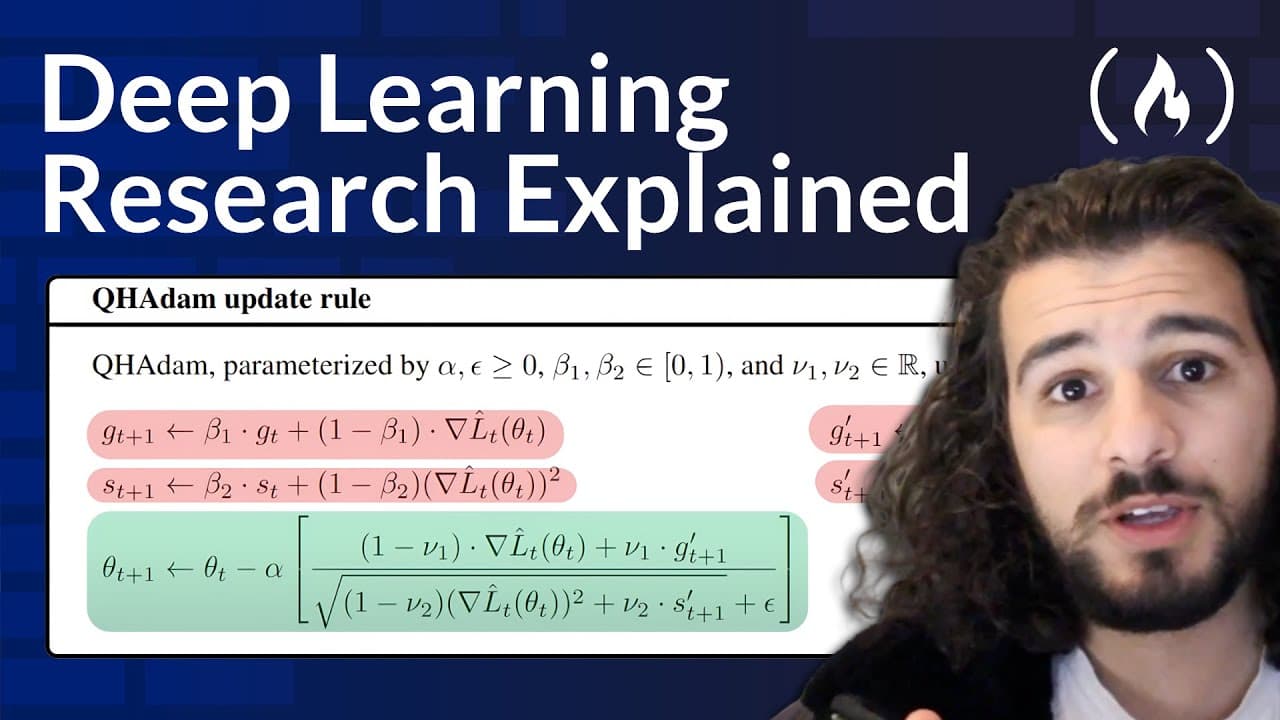
TL;DR
Master deep learning research papers by honing three critical skills: reading technical articles, grasping mathematical notation, and understanding codebases. This tutorial provides a structured approach, including tips for effectively navigating dense content and applying learnings from recent models like the Segment Anything Model (SAM) to enhance your understanding.
Transcript
if you've ever felt intimidated by Deep learning research papers with their dense mathematical notation and complex code bases this comprehensive tutorial will show you how to effectively understand and Implement Cutting Edge AI research through practical examples using recent papers you'll learn the three essential skills needed to... Read More
Key Insights
- Deep learning research papers are dense with mathematical notation and complex code, but understanding them is achievable with the right approach.
- Three essential skills for mastering deep learning research include reading technical papers, understanding mathematical notation, and navigating research codebases.
- The tutorial breaks down the process into steps like getting external context, casual reading, filling knowledge gaps, and conducting a code deep dive.
- Understanding mathematical notation involves identifying formulas, translating symbols into meaning, and summarizing the concepts into intuitive understanding.
- Efficient math learning relies on selecting the right subfield, finding exercise-rich resources, and using a structured approach to tackle exercises.
- Reading deep learning codebases requires mapping the code structure, elucidating components, and taking notes of unclear elements.
- The Segment Anything Model (SAM) demonstrates how zero-shot capabilities can be achieved through a combination of architecture and training strategies.
- SAM's architecture includes an image encoder, prompt encoder, and mask decoder, each playing a crucial role in its functionality.
Install to Summarize YouTube Videos and Get Transcripts
Explore YouTube Video Summarizer or Get YouTube Transcript Extractor
Questions & Answers
Q: What are the three essential skills needed to master deep learning research?
The three essential skills needed to master deep learning research are reading technical papers, understanding mathematical notation, and navigating research codebases. These skills enable one to effectively comprehend and implement cutting-edge AI research through practical examples and recent papers.
Q: How can one approach reading a deep learning research paper?
Reading a deep learning research paper involves several steps: getting external context by finding summaries and videos, conducting a casual read to note unknowns, filling knowledge gaps by researching these unknowns, and understanding the methodology and results through a detailed analysis of the paper's content.
Q: What is the significance of understanding mathematical notation in deep learning research?
Understanding mathematical notation is crucial in deep learning research because it provides a well-grounded intuition about why certain methods work. It involves identifying formulas, translating symbols into meaning, and summarizing the concepts into an intuitive understanding, which is essential for grasping the theoretical underpinnings of deep learning models.
Q: What is the 'green, yellow, and red' method in learning math?
The 'green, yellow, and red' method is a structured approach to learning math that involves categorizing exercises based on understanding. Green indicates full understanding, yellow indicates partial understanding requiring review, and red indicates a lack of understanding needing further study. This method helps focus efforts on areas needing improvement.
Q: How does one navigate a deep learning codebase effectively?
Navigating a deep learning codebase involves mapping the code structure to understand its architecture, elucidating all components by examining dependencies, and taking notes of unclear elements for further study. This process helps in comprehending the implementation details and the rationale behind the code's design.
Q: What are the main components of the Segment Anything Model (SAM)?
The main components of the Segment Anything Model (SAM) include the image encoder, prompt encoder, and mask decoder. The image encoder processes the input image, the prompt encoder handles different types of prompts, and the mask decoder generates the segmentation masks. These components work together to achieve SAM's zero-shot capabilities.
Q: What is the purpose of the Segment Anything Model (SAM)?
The purpose of the Segment Anything Model (SAM) is to provide a flexible and robust solution for segmentation tasks with zero-shot capabilities. It is designed to handle various prompts and output segmentation masks, enabling it to generalize across different tasks without requiring additional training, making it useful for applications like virtual reality.
Q: How does SAM achieve zero-shot performance?
SAM achieves zero-shot performance through its architecture, which includes an image encoder, prompt encoder, and mask decoder, and its training strategy, which mimics interactive segmentation with a large dataset. This setup allows SAM to generalize well to new tasks without additional training, similar to how large language models like GPT are pre-trained.
Summary & Key Takeaways
-
This tutorial provides a comprehensive guide on how to understand and implement deep learning research papers, focusing on essential skills like reading technical papers, understanding mathematical notation, and navigating research codebases.
-
The tutorial outlines a step-by-step approach to reading research papers, including getting external context, conducting a casual read, filling knowledge gaps, and understanding the methodology and results.
-
A deep dive into the Segment Anything Model (SAM) showcases how it achieves zero-shot capabilities through its architecture and training strategies, emphasizing the importance of understanding both theory and code.
Read in Other Languages (beta)
Share This Summary 📚
Summarize YouTube Videos and Get Video Transcripts with 1-Click
Try YouTube Summary with ChatGPT & Claude or YouTube Transcript Generator
Explore More Summaries from freeCodeCamp.org 📚

![The Most Important Skills Going Forward with CTO + Homebrew Maintainer Mike McQuaid [Podcast #204] thumbnail](/_next/image?url=https%3A%2F%2Fi.ytimg.com%2Fvi%2F58Tn2xB8kIE%2Fhqdefault.jpg&w=750&q=75)
Summarize YouTube Videos and Get Video Transcripts with 1-Click
Try YouTube Summary with ChatGPT & Claude or YouTube Transcript Generator