Why AI Models Need Real-World Evaluations
TL;DR
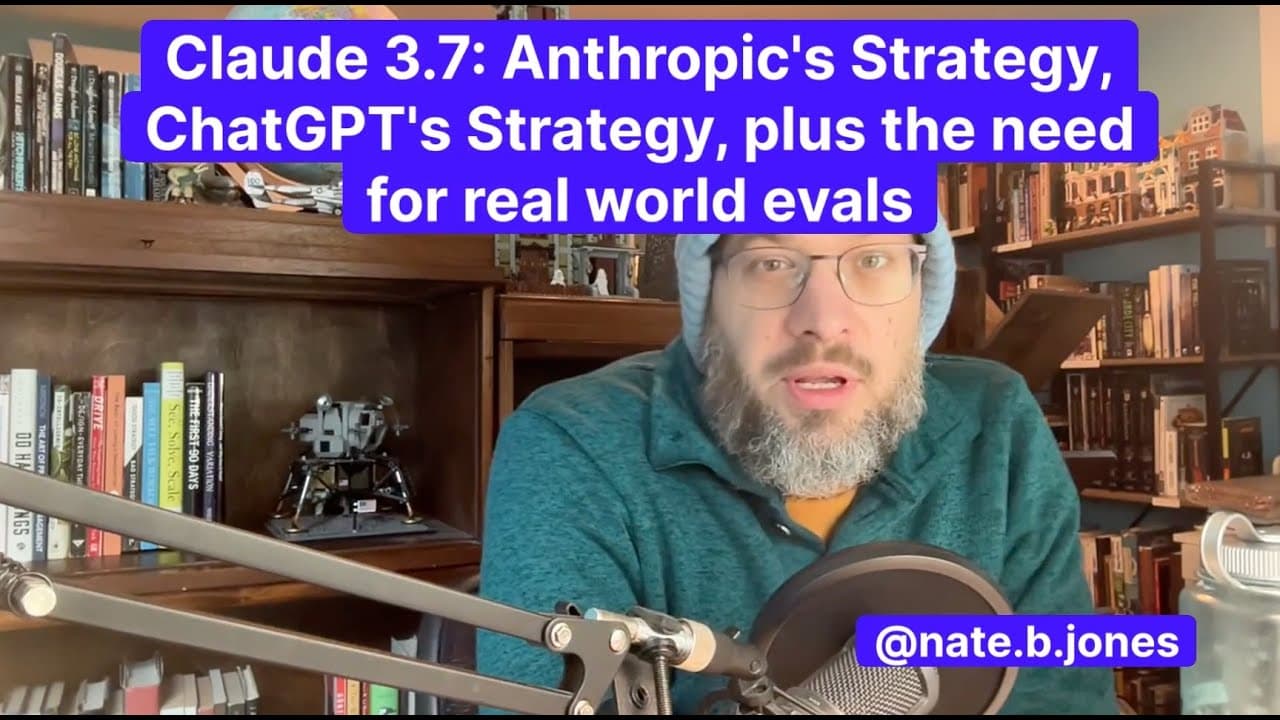
AI models need independent evaluations that measure economically useful work, because strong scores on widely published academic benchmarks may reflect training targeted at those tests. Claude 3.7 illustrates Anthropic’s focused challenger strategy around coding and building, while ChatGPT faces the broader challenge of presenting multiple capabilities as one coherent product for a general audience.
Transcript
the launch of Claude 3.7 is really underlining for me that we need better evals or better evaluations for AI models right now I think models are very overfitted to the evaluations that are widely published like the Aime and so all of these models score incredibly well on these widely known evaluations but it's because they are trained from the get-... Read More
Key Insights
- Widely published evaluations are vulnerable to overfitting because AI models can be trained from the beginning to excel on known tests such as AIME. High scores may therefore confirm preparation for benchmarks without demonstrating that a model can perform meaningful work in practical settings.
- Economically useful work is not adequately captured by most academic benchmarks. The central evaluation question is whether a model can complete tasks that create real productivity and value, rather than whether it can maximize performance on a familiar collection of standardized questions.
- Lancer is designed to measure whether an AI model can independently complete freelance work. It is described as the closest available benchmark for real work, and Claude 3.5 reportedly earned its highest score so far, showing that practical performance may differ from academic rankings.
- Model differences remain visible through hands-on use even when benchmark scores look similar. These differences are often described as a model’s vibes, an informal impression that experienced users develop but struggle to communicate reliably across occupations, workflows, and task requirements.
- Anthropic’s Claude 3.7 strategy is a challenger-brand approach focused on specialization. The model emphasizes Claude’s established strengths in coding and building, with prioritized access through developer-oriented environments such as terminals, Cursor, GitHub integration, and the ChatGPT app.
- ChatGPT’s strategy requires broader generalization because it serves a general audience and offers roughly half a dozen models. Its investment in GPT-5 is framed as an effort to combine those options into one coherent model whose purpose is easier for ordinary users to understand.
- Claude 3.7 is expected to remain a popular coding model because Claude 3.5 stayed favored for coding for nine or ten months after release despite competing launches. Hands-on comparisons suggest that Claude 3.7 feels meaningfully better than Claude 3.5, especially when building from identical prompts.
- Independent real-world benchmarks face a funding and incentive problem. Companies that can afford them may treat economically valuable AI workflows as proprietary advantages, while model developers have incentives to support evaluations they expect their own future systems to perform well on.
Install to Summarize YouTube Videos and Get Transcripts
Explore YouTube Video Summarizer or Get YouTube Transcript Extractor
Questions & Answers
Q: Why do AI models need real-world evaluations?
AI models need real-world evaluations because excellent results on widely published academic tests do not necessarily prove that they can complete meaningful work. Models may be trained from the outset to perform well on familiar benchmarks such as AIME, making the evaluation process circular. Tests based on realistic, economically useful tasks would better reveal practical differences among models.
Q: How can AI models become overfitted to benchmarks?
AI models can become overfitted when widely known evaluations influence how they are trained and optimized. If developers know the types of problems included in a benchmark, they can prepare models to score highly on those problems from the beginning. The resulting scores may measure alignment with the test more than independent usefulness across unfamiliar real-world tasks.
Q: What does economically useful work mean for AI models?
Economically useful work refers to tasks that generate meaningful productivity or value rather than merely producing strong academic benchmark results. The transcript connects this idea to models independently completing practical assignments, such as freelance work. Evaluating that capability requires realistic tasks that reflect actual workflows, deliverables, and outcomes instead of only standardized questions with known scoring methods.
Q: What is the Lancer benchmark designed to measure?
Lancer is designed to measure an AI model’s ability to independently complete freelance work, making it an attempt to evaluate practical performance. It is described as the closest current benchmark for measuring real work. Claude 3.5 reportedly achieved the highest score so far, although the benchmark is maintained by OpenAI rather than an independent evaluation organization.
Q: Why should independent organizations maintain AI benchmarks?
Independent organizations should maintain AI benchmarks because model makers are inherently interested parties, even when they try to evaluate systems fairly. A developer may fund and promote a benchmark because it expects a future model to perform strongly on it. Independent maintenance could reduce that conflict and make comparisons of economically useful work more credible across competing systems.
Q: How is Anthropic positioning Claude 3.7?
Anthropic is positioning Claude 3.7 as a specialized challenger focused on coding and building, areas where Claude has historically performed well. Its prioritized availability in terminals, Cursor, GitHub integration, and the ChatGPT app supports that strategy. The approach concentrates on a recognizable strength instead of attempting to present Claude as a single solution for every audience and task.
Q: How does ChatGPT’s strategy differ from Claude’s strategy?
ChatGPT must appeal to a broader audience, so its strategy requires generalization and a coherent explanation of what the product is for. The transcript describes ChatGPT as managing roughly half a dozen models and investing in GPT-5 to bring them into one understandable model. Claude instead follows a challenger strategy by specializing in coding and building workflows.
Q: Why are independent real-world AI benchmarks difficult to fund?
Independent real-world benchmarks require substantial money and continuing work to create and maintain. Companies with enough resources may have little incentive to share how they use AI for economically useful work because those workflows can be proprietary advantages. Model makers can fund evaluations, but their interests may bias benchmark selection, leaving no obvious independent sponsor with both resources and motivation.
Summary & Key Takeaways
-
Widely published academic evaluations may no longer reveal meaningful differences among AI models because developers train models to perform well on known tests. Similar benchmark scores can therefore conceal substantial differences in practical usefulness. The industry needs evaluations that measure whether models can independently complete valuable work under realistic conditions for actual users.
-
Lancer is presented as the closest current attempt to measure economically useful performance by testing independent completion of freelance work. Claude 3.5 reportedly achieved the highest score so far, despite predating Claude 3.7. However, OpenAI maintains the benchmark, creating a strong argument for evaluations operated by independent organizations instead of model developers.
-
Anthropic is positioning Claude 3.7 as a specialized challenger centered on coding and building, with availability through terminals, Cursor, GitHub integration, and the ChatGPT app. ChatGPT has a broader strategic problem: it must generalize its offering and make several models understandable as one coherent product, which motivates its investment in GPT-5.
Read in Other Languages (beta)
Share This Summary 📚
Summarize YouTube Videos and Get Video Transcripts with 1-Click
Try YouTube Summary with ChatGPT & Claude or YouTube Transcript Generator
Explore More Summaries from AI News & Strategy Daily | Nate B Jones 📚






Summarize YouTube Videos and Get Video Transcripts with 1-Click
Try YouTube Summary with ChatGPT & Claude or YouTube Transcript Generator