How to fix a brand that makes no money in 14 minutes
TL;DR
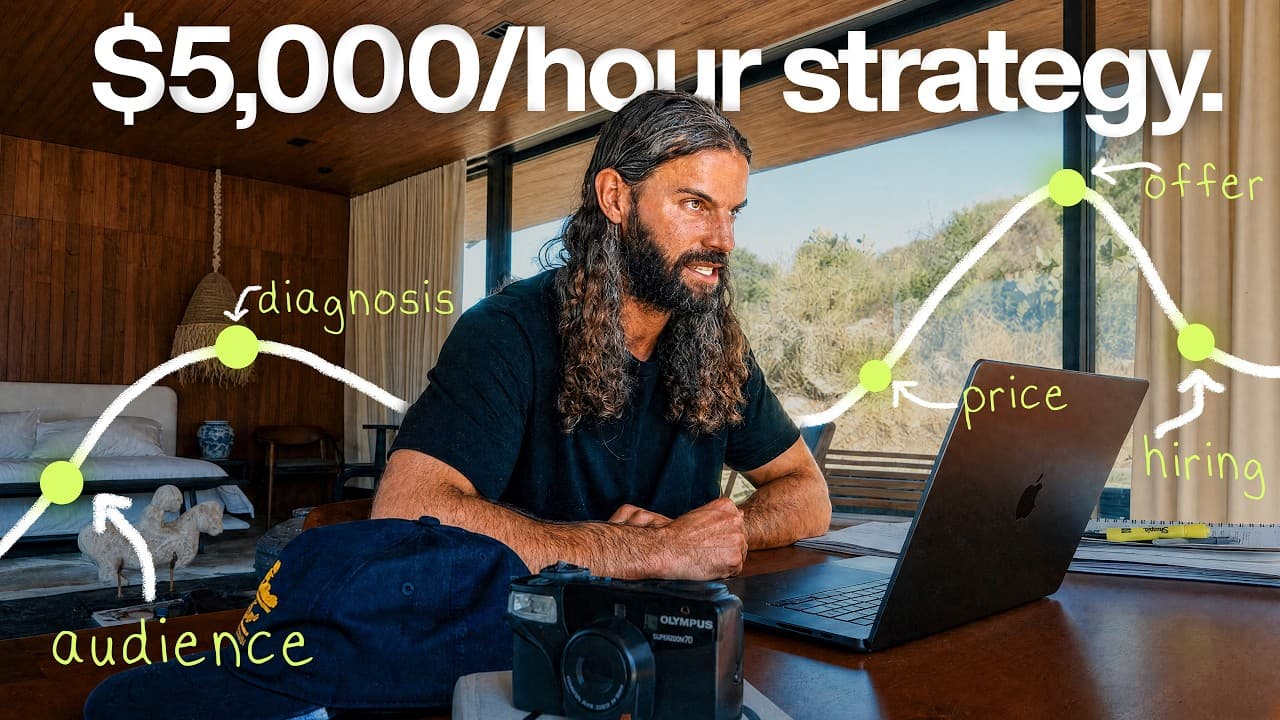
The core fix is to stop letting the business run through you. Build an engine with a chief of staff and a social media manager to multiply your output, delegate decisions, and remove yourself from routine bottlenecks. Price your time, audit where hours go, and hire to create founder leverage not founder chaos.
Transcript
Give me 14 minutes and I'll fix the reason your brand makes no money. You know, I once had a video do over 14 million views and nobody bought anything from it. I could hear it in the way people recognize me in public from that video. These videos are really cool, man. That was the whole sentence every time. That gap is structural. Every dollar your... Read More
Key Insights
- The core problem is that every dollar earned passes through the founder, creating a single point of failure.
- A founder must remove routine decisions from themselves to unlock growth and revenue scalability.
- An engine or system, not more content, drives profits by converting attention into money.
- Delegation must be supported by documented processes so tasks can be done 80% as well as by the founder.
- Introduce a right-sized media team including a chief of staff and a social media manager to multiply output.
- Ask one question when problems arise to push decisions to the people closest to the work.
- Hire weapons instead of traditional employees to aggressively scale core areas of the business.
- Set a high hourly rate to filter tasks and prevent small tasks from consuming critical time.
- More videos from this channel:
- More from this channel: Matt Gray
Install to Summarize YouTube Videos and Get Transcripts
Explore YouTube Video Summarizer or Get YouTube Transcript Extractor
Questions & Answers
Q: How do you stop revenue from being limited by the founder’s time?
Revenue becomes scalable when the founder creates an engine that can operate without constant personal involvement. This means removing almost all day-to-day decisions from the founder, documenting workflows, and replacing direct control with delegation to trusted team members. The result is a system where attention converts to money with less founder fatigue.
Q: What is the engine trap described in the video?
The engine trap is when the founder is the bottleneck for every important action in the company. Content, proposals, and client decisions all require the founder's approval, preventing the business from scaling. Recognizing this trap leads to reorganizing responsibilities so decisions flow without the founder as the choke point.
Q: Why is hiring a 'weapon' more effective than hiring traditional staff?
A weapon is someone who not only executes a task well but also expands the capability of the team by hiring more weapons and pushing performance beyond the brief. This multiplier effect accelerates growth and helps build a self-sustaining system where each role elevates the others rather than just filling a checkbox.
Q: What role does a chief of staff play in the profitable brand playbook?
The chief of staff reduces the founder’s workload by handling coordination, scheduling, and critical communications. This frees the founder to focus on high-leverage activities that drive revenue, while the staffer ensures that processes keep running smoothly and that delegated tasks meet required standards.
Q: How should a founder price their time, and why?
Price your time at a premium to distinguish between truly strategic tasks and routine work. The speaker suggests an hourly rate that filters tasks, ensuring only high-value activities stay on the founder’s plate. This cleaves off tasks that can be delegated and creates clearer boundaries for where effort should be invested.
Q: What is the one question to ask when a problem arises?
Respond by asking, What do you recommend? This shifts the burden back to the team member with firsthand knowledge and avoids the founder solving every problem. It preserves ownership, builds founder leverage, and accelerates the process of moving decisions away from the founder.
Q: How does documenting SOPs help offload work?
Documenting standard operating procedures creates reliable handoffs that can be executed by others at a high standard. Recording tasks, procedures, and decisions reduces the risk of backsliding into founder dependency and ensures that delegated work maintains consistent quality as responsibilities shift.
Q: What is the ultimate outcome of implementing these changes?
The ultimate outcome is a founder who is an architect rather than the engine, able to name the one decision the business is waiting on and move it forward this week. The business becomes scalable, profitable, and capable of running with reduced founder involvement, even as revenue grows.
Summary & Key Takeaways
-
The video argues that revenue is limited by the founder acting as the bottleneck. It shows how simply increasing content or hiring people without changing decision flow can widen the gap between attention and money. The key is restructuring to remove founder dependency and create scalable systems.
-
A practical framework is presented as the profitable brand playbook. It includes diagnosing the bottlenecks, removing low-value tasks, and building a structured team that can run without constant founder input. The approach emphasizes documented handoffs and clear roles.
-
The speaker offers actionable steps like setting an hourly rate, delegating tasks, and asking one critical question to shift ownership. The message is to architect the business so that revenue moves without the founder sinking more time into day-to-day decisions.
Read in Other Languages (beta)
Share This Summary 📚
Summarize YouTube Videos and Get Video Transcripts with 1-Click
Try YouTube Summary with ChatGPT & Claude or YouTube Transcript Generator
Explore More Summaries from Matt Gray 📚
Summarize YouTube Videos and Get Video Transcripts with 1-Click
Try YouTube Summary with ChatGPT & Claude or YouTube Transcript Generator