How to Use OpenAI's GPT 3.5 Embedding Model
TL;DR
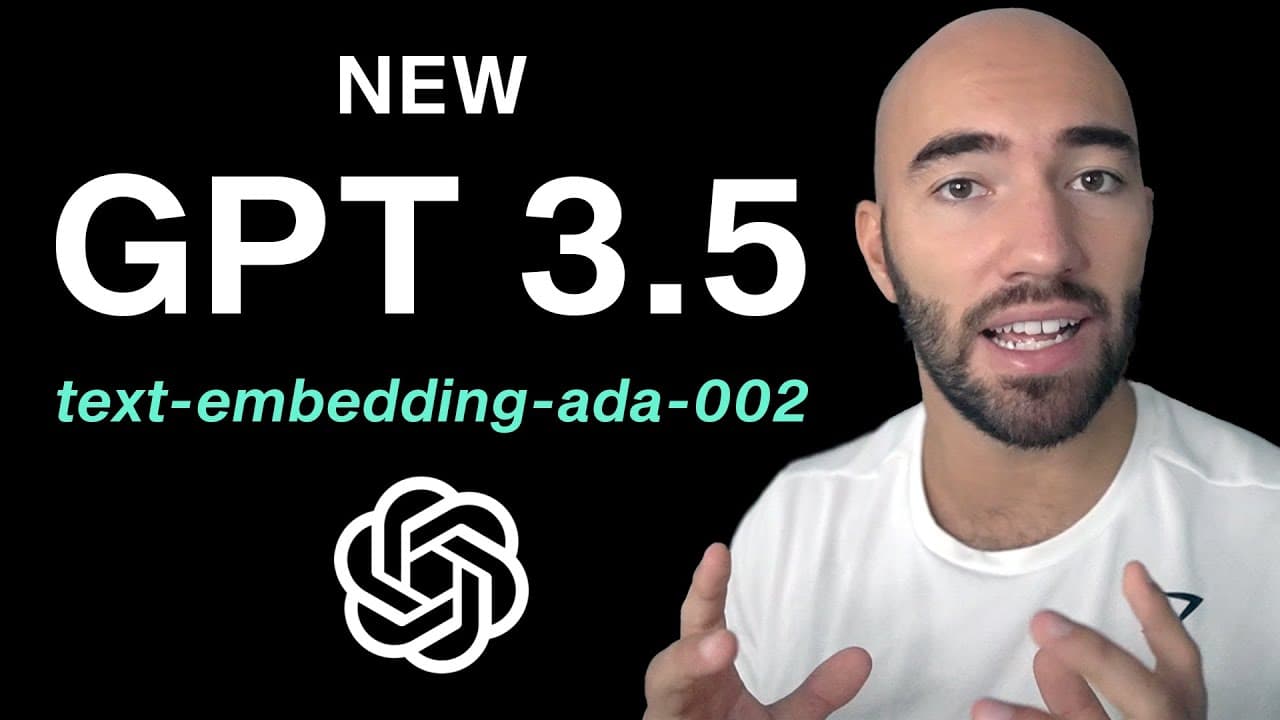
OpenAI's GPT 3.5 embedding model streamlines document searching by converting text into compact, meaningful embeddings. This enables quick and accurate retrieval of relevant information, leveraging Pinecone for efficient indexing and querying, making semantic searches straightforward and effective.
Transcript
today we're going to have a look at how we can use openai's new text embedding model creatively named text embedding order 002 to essentially search through loads of documents and do it in a super easy way so we really don't need to know that much about what is going on behind the scenes here we can just kind of get going with it and get really imp... Read More
Key Insights
- 👨🔬 OpenAI's text embedding model simplifies the process of searching through large documents by converting them into embeddings.
- 🏪 Pinecone, a vector database, is used to store and retrieve the embeddings, enabling efficient document retrieval.
- 👻 The model's ability to generate meaningful embeddings allows for highly accurate and relevant search results.
- 👤 The simplicity and effectiveness of the approach make it easy for users to implement and benefit from the text embedding model.
- 👨🔬 Lexical search limitations are overcome by the text embedding model's ability to identify context and semantic similarities.
- 👨🔬 The collaboration between OpenAI and Pinecone provides a powerful and user-friendly solution for document search tasks.
- ✋ The performance of the text embedding model is highly praised, offering both high accuracy and efficiency.
Install to Summarize YouTube Videos and Get Transcripts
Explore YouTube Video Summarizer or Get YouTube Transcript Extractor
Questions & Answers
Q: How does the text embedding model convert sentences into embeddings?
The text embedding model converts sentences into embeddings within a vector space, where sentences with similar meanings are located closely together in the space.
Q: How is the indexing process carried out using Pinecone?
During indexing, the embeddings generated by the text embedding model are stored in Pinecone, a vector database, allowing for efficient storage and retrieval of document data.
Q: What happens during the querying process?
When a query is received, it is embedded using the text embedding model, and the top K most relevant vectors, representing similar documents, are returned from the indexed data stored in Pinecone.
Q: How are the results of the query presented to the user?
Instead of returning the embedded vectors, the text associated with the most relevant vectors is returned to the user, providing meaningful and interpretable search results.
Key Insights:
- OpenAI's text embedding model simplifies the process of searching through large documents by converting them into embeddings.
- Pinecone, a vector database, is used to store and retrieve the embeddings, enabling efficient document retrieval.
- The model's ability to generate meaningful embeddings allows for highly accurate and relevant search results.
- The simplicity and effectiveness of the approach make it easy for users to implement and benefit from the text embedding model.
- Lexical search limitations are overcome by the text embedding model's ability to identify context and semantic similarities.
- The collaboration between OpenAI and Pinecone provides a powerful and user-friendly solution for document search tasks.
- The performance of the text embedding model is highly praised, offering both high accuracy and efficiency.
- The integration of open-source tools and libraries makes it accessible for developers to implement and experiment with the model.
Summary & Key Takeaways
-
OpenAI's text embedding model, Text Embedding Order 002, enables easy and efficient searching through vast amounts of documents.
-
The model converts sentences into meaningful embeddings within a vector space, allowing for proximity-based similarity calculations.
-
Indexed data, created using the model, is stored in Pinecone, a vector database, enabling fast querying and retrieval of relevant documents.
Read in Other Languages (beta)
Share This Summary 📚
Summarize YouTube Videos and Get Video Transcripts with 1-Click
Try YouTube Summary with ChatGPT & Claude or YouTube Transcript Generator
Explore More Summaries from James Briggs 📚


Summarize YouTube Videos and Get Video Transcripts with 1-Click
Try YouTube Summary with ChatGPT & Claude or YouTube Transcript Generator