How to Solve Common Array Coding Problems
TL;DR
Solve array problems by translating each requirement into a controlled traversal, checking indexes before access, and updating only the intended elements. For alternate swapping, process indexes in steps of two, swap each element with its next neighbor when that neighbor exists, and leave the final element unchanged when the array length is odd.
Transcript
Hello everyone. How are you all? This is love Babbar. And Welcome to the channel CodeHelp In last video, we have learned about Arrays How to access? How to create? How to initialize arrays? We have learned how to pass Array in function And when we pass in function and update What it impacts and we have learned as discussed One or two question, We h... Read More
Key Insights
- Alternate swapping is the operation of exchanging every adjacent pair in an array. The first element swaps with the second, the third swaps with the fourth, and the process continues until no complete pair remains.
- An odd-length array is handled by leaving its final unmatched element unchanged. In the example 1, 2, 7, 8, 5, the result is 2, 1, 8, 7, 5 because 5 has no neighboring element available for a swap.
- An even-length array allows every element to participate in exactly one adjacent swap. The example 1, 2, 3, 4, 5, 6 becomes 2, 1, 4, 3, 6, 5 after all three pairs exchange positions.
- The boundary check is whether i plus 1 is less than the array size. This condition confirms that the next indexed element belongs to the array before the algorithm attempts to access and swap it.
- The traversal step is i plus equals 2 because each iteration finishes one complete pair. Advancing by only one position would revisit an element that was already swapped and incorrectly exchange it again with the following element.
- A reusable swapAlternate function is designed to receive an array and its size. It traverses paired positions, checks that the next position is valid, and then swaps the values stored at indexes i and i plus 1.
- Manual swapping requires temporary storage because directly assigning one array position to the other overwrites a value. One value must be held temporarily, the other value moved into its position, and the saved value placed into the remaining position.
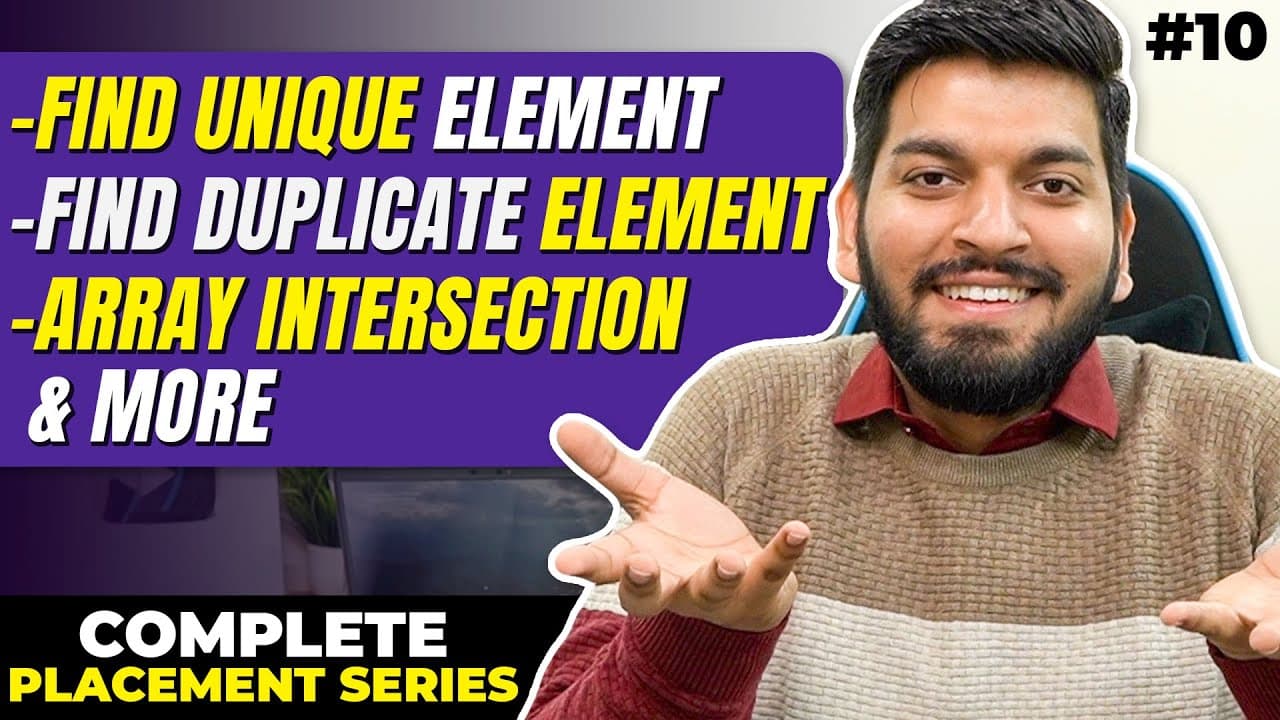
- The problem set is broader than alternate swapping and includes unique elements, duplicates, array intersection, pair sum, triplet sum, and sorting 0, 1, and 2. Homework adds unique occurrence counting and finding every duplicate in an array.
Install to Summarize YouTube Videos and Get Transcripts
Explore YouTube Video Summarizer or Get YouTube Transcript Extractor
Questions & Answers
Q: How do you swap alternate elements in an array?
Start at index 0 and treat each current element and its next element as one pair. Check whether i plus 1 is less than the array size, then swap the values at indexes i and i plus 1. Increase i by 2 after each iteration so that every pair is processed once and previously swapped elements are not revisited.
Q: How does alternate swapping handle an odd-length array?
An odd-length array leaves its final element unchanged because that value has no partner to swap with. The algorithm checks whether the next index is smaller than the array size before performing each exchange. For 1, 2, 7, 8, 5, it swaps 1 with 2 and 7 with 8, while 5 remains where it is.
Q: Why does the loop advance by two during alternate swapping?
The loop advances by two because one iteration processes two adjacent elements as a complete pair. After swapping indexes 0 and 1, the next required pair begins at index 2. Advancing by one would move to index 1, causing an already processed value to be swapped again with index 2 and producing the wrong arrangement.
Q: How do you prevent an out-of-range access when swapping array pairs?
Before accessing the neighboring element, test whether i plus 1 is less than the array size. A true result means the next index is inside the array and the pair can be swapped safely. A false result means the current value is the unmatched final element, so the swap is skipped and that value remains unchanged.
Q: How can two array values be swapped without a built-in function?
Use a temporary variable to preserve one value before either array position is overwritten. Store the value from one index in the temporary variable, copy the neighboring value into the first position, and then place the saved value into the second position. Direct assignment without temporary storage causes one original value to be lost before the exchange is complete.
Q: What mistake occurred while testing the alternate swap code?
The demonstrated even array contained 8 elements, but an incorrect size of 10 was initially supplied during testing. That mismatch caused extra numbers to appear in the output because the operation treated positions beyond the intended elements as part of the array. Correcting the supplied size to 8 produced the expected sequence 2, 5, 4, 9, 6, 7, 0, 1.
Q: Which array coding problems are included in the lesson?
The listed array exercises include finding a unique element, identifying duplicates in an array, computing an array intersection, finding a pair sum, finding a triplet sum, and sorting values containing 0, 1, and 2. Alternate swapping is introduced as a small warm-up before moving to questions associated with LeetCode, CodeStudio, and other platforms.
Q: What array problems are assigned for additional practice?
The description assigns further practice on counting unique occurrences and finding all duplicates in an array. It also links additional questions for triplet sum and sorting 0, 1, and 2. These exercises extend the lesson beyond the alternate-swapping demonstration and give learners variations to solve independently after studying the presented array traversal approach.
Summary & Key Takeaways
-
The lesson begins with alternate swapping as a warm-up array problem. Adjacent elements are exchanged in pairs, producing 2, 1, 8, 7, 5 from 1, 2, 7, 8, 5. When an odd-length array has one unmatched final element, that element remains in its original position after all complete pairs are processed.
-
The implementation traverses the array from index 0 and advances by two after each attempted pair. Before accessing the next position, it checks whether i plus 1 is smaller than the array size. This boundary condition supports even and odd lengths while preventing access beyond the array's valid indexed positions during execution.
-
The broader lesson covers array questions from LeetCode and CodeStudio, including finding a unique element, detecting duplicates, computing array intersections, finding pair and triplet sums, and sorting values containing 0, 1, and 2. Additional homework includes unique occurrence counts and finding all duplicates in an array for further independent practice.
Read in Other Languages (beta)
Share This Summary 📚
Summarize YouTube Videos and Get Video Transcripts with 1-Click
Try YouTube Summary with ChatGPT & Claude or YouTube Transcript Generator
Explore More Summaries from CodeHelp - by Babbar 📚



Summarize YouTube Videos and Get Video Transcripts with 1-Click
Try YouTube Summary with ChatGPT & Claude or YouTube Transcript Generator