Why Smart People Make Stupid Decisions (And How to Avoid This)
TL;DR
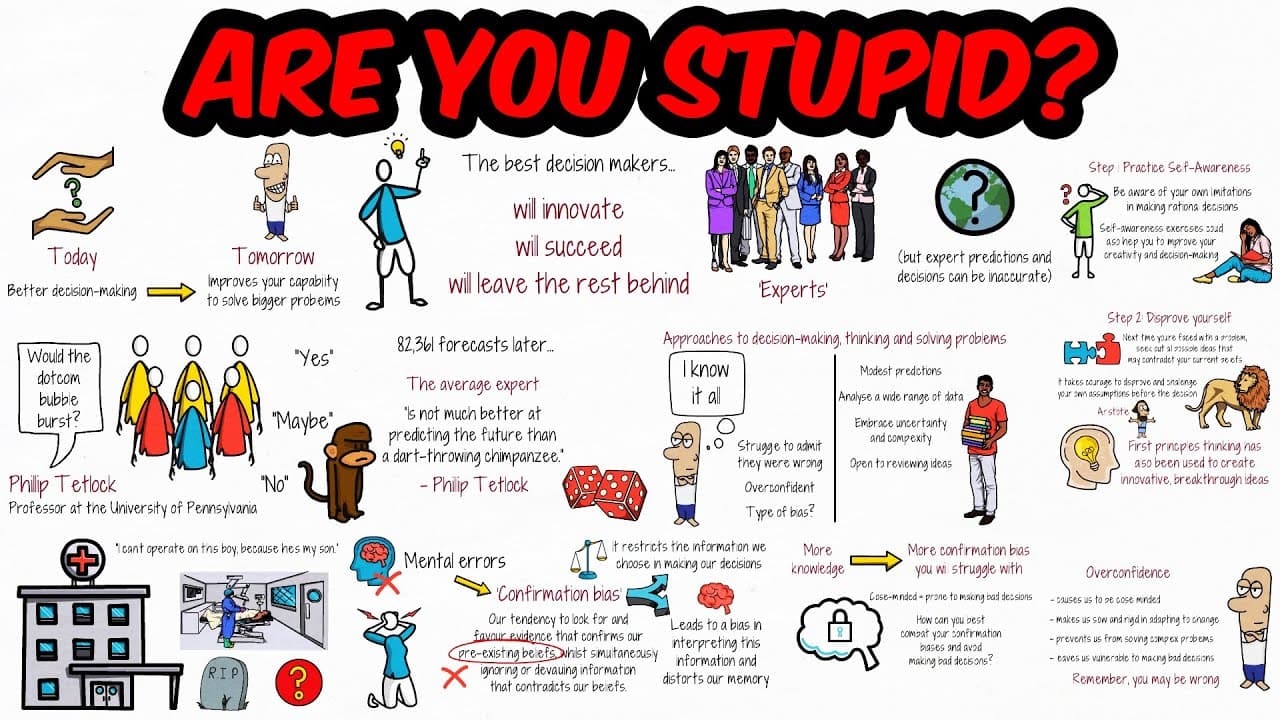
Smart people make bad decisions when confirmation bias and overconfidence cause them to favor existing beliefs and reject contradictory evidence. Philip Tetlock’s 20-year study examined 82,361 expert forecasts and found that the average expert was not much better at predicting the future than chance. Practicing self-awareness and actively trying to disprove your assumptions can improve decisions. Read on for the study’s lessons and two practical steps.
Transcript
The quality of your decisions today will determine the quality of your life tomorrow. Our decisions influence how well we make use of our talents, efforts and resources. Better decision-making improves our capability to solve bigger, more complex problems — quickly and reliably. In this increasingly complex, disruptive and uncertain period of human... Read More
Key Insights
- 🎭 Expert predictions are often unreliable, with many experts performing no better than chance.
- 🤗 Smart decision-makers are open to uncertainty and challenge their beliefs when solving problems.
- 🥺 Confirmation bias leads to bad decisions by favoring existing beliefs and ignoring contradictory evidence.
- 🤳 Combatting confirmation bias requires self-awareness and a willingness to challenge one's assumptions.
- 😚 Overconfidence can lead to close-mindedness, hindering the ability to adapt to change and solve complex problems effectively.
- 🤔 Innovation and breakthrough ideas can stem from challenging existing assumptions and practicing first principles thinking.
- 🤗 Listening and remaining open-minded to new information is crucial for making better decisions in a complex world.
Install to Summarize YouTube Videos and Get Transcripts
Explore YouTube Video Summarizer or Get YouTube Transcript Extractor
Questions & Answers
Q: Why do smart people make stupid decisions?
Smart people can become overconfident and cling to their beliefs even when valid evidence contradicts them. Confirmation bias then restricts the information they consider, biases how they interpret it, and distorts their memory.
Q: What did Philip Tetlock’s study reveal about expert predictions?
Philip Tetlock spent 20 years collecting and studying 82,361 forecasts from experts. He concluded that the average expert was not much better at predicting the future than a dart-throwing chimpanzee and suggested that most would have done better by guessing randomly.
Q: How did the most reliable experts make decisions?
The better forecasters made modest predictions only after analyzing a wide range of external data and information. They were comfortable with uncertainty and complexity and willing to review ideas that challenged their beliefs and assumptions.
Q: Why were the most knowledgeable experts less reliable?
In Tetlock’s study, the experts with the most knowledge were, on average, the least reliable. They were overconfident, struggled to admit mistakes, and maintained their beliefs despite valid contradictory evidence.
Q: What is confirmation bias?
Confirmation bias is the tendency to seek and favor evidence that supports pre-existing beliefs while ignoring or devaluing contradictory information. It arises partly because conflicting ideas create discomfort, prompting people to reconfirm what they already believe.
Q: How does confirmation bias affect decision-making?
Confirmation bias narrows the information people use to make decisions. It also biases their interpretation of that information and distorts memory, increasing the likelihood of irrational mistakes.
Q: What are the two steps for avoiding bad decisions?
Step 1 is to practice self-awareness by recognizing your limitations, slowing down, relaxing, and deliberately focusing on what matters. Step 2 is to try to disprove yourself by seeking ideas and evidence that contradict your current assumptions before deciding.
Q: How does the surgeon riddle demonstrate confirmation bias?
The surgeon can say the injured boy is her son because she is his mother. Someone who unconsciously assumes that a surgeon must be male may overlook this simple answer and search for explanations that preserve that assumption.
Summary & Key Takeaways
-
Expert predictions are often inaccurate, with many experts performing no better than chance.
-
Smart decision-makers are open to uncertainty, challenge their beliefs, and value diverse information.
-
Confirmation bias leads to bad decisions by favoring existing beliefs and ignoring contradictory evidence.
Read in Other Languages (beta)
Share This Summary 📚
Summarize YouTube Videos and Get Video Transcripts with 1-Click
Try YouTube Summary with ChatGPT & Claude or YouTube Transcript Generator
Explore More Summaries from The Art of Improvement 📚
Summarize YouTube Videos and Get Video Transcripts with 1-Click
Try YouTube Summary with ChatGPT & Claude or YouTube Transcript Generator