How to Fine-Tune GPT-3.5 with GPT-4 Outputs
TL;DR
Fine-tuning GPT-3.5 using GPT-4 outputs can significantly enhance model performance. By leveraging GPT-4's advanced reasoning and output generation, developers can create synthetic datasets that improve the capabilities of GPT-3.5, offering a cost-effective and efficient solution for AI model enhancement.
Transcript
somebody you know friend of a friend reached out to me with a legal question I'm like I'm really not qualified to answer this but I am qualified to put it into chat if they were one company they could have avoided this whole mess and I spoke to Emil Michael this Chief business officer Uber and he was like yeah I tried to get us to acquire them to m... Read More
Key Insights
- GPT-3.5 can be fine-tuned using outputs from GPT-4 to improve performance.
- Synthetic data generation is a viable method for training AI models.
- Chain of thought prompts can enhance model reasoning capabilities.
- Fine-tuning GPT-3.5 is cost-effective compared to using GPT-4 directly.
- AI bundles could offer a solution to high churn rates in AI app subscriptions.
- Collaborations between AI companies may lead to more comprehensive service offerings.
- Training on synthetic data addresses data provenance and privacy concerns.
- AI's role in co-pilot versus full automation scenarios varies by industry.
Install to Summarize YouTube Videos and Get Transcripts
Explore YouTube Video Summarizer or Get YouTube Transcript Extractor
Questions & Answers
Q: How can GPT-4 outputs be used to fine-tune GPT-3.5?
GPT-4 outputs can be used to fine-tune GPT-3.5 by generating synthetic datasets that capture advanced reasoning and task completion capabilities. By training GPT-3.5 on these datasets, developers can enhance its performance, making it more efficient and cost-effective compared to direct use of GPT-4. This method leverages the strengths of GPT-4 to improve the capabilities of a less advanced model.
Q: What are the benefits of using synthetic data for AI training?
Using synthetic data for AI training offers several benefits, including improved data privacy and reduced risk of exposing sensitive information. Synthetic data can be generated to simulate real-world scenarios, providing a diverse and robust dataset for model training. This approach also allows for the creation of large datasets without the need for extensive data collection and cleaning processes.
Q: What is the potential impact of AI bundles on app retention?
AI bundles could significantly improve app retention by offering users access to multiple AI applications under a single subscription. This model reduces the friction of managing multiple subscriptions and encourages users to explore a variety of apps. For developers, it provides a steady revenue stream and increases the likelihood of user engagement across different applications, addressing the common challenge of high churn rates.
Q: How does chain of thought prompting improve AI model performance?
Chain of thought prompting improves AI model performance by guiding the model through a structured reasoning process. This method encourages the model to break down tasks into logical steps, enhancing its ability to understand and complete complex tasks. By incorporating chain of thought prompts in training, models can develop better problem-solving skills and produce more accurate outputs.
Q: What are the challenges in creating an AI bundle subscription?
Creating an AI bundle subscription faces several challenges, including coordinating between different AI companies, determining revenue-sharing models, and managing customer relationships. Companies may be reluctant to join a bundle if it means losing direct control over their customer base. Additionally, ensuring that the bundle offers sufficient value to users while maintaining competitive pricing is a complex task that requires careful planning and negotiation.
Q: Why is there a debate on accelerating AI applications versus new models?
The debate on accelerating AI applications versus new models centers around the balance between immediate user benefits and long-term advancements. Developing new models like GPT-5 can push the boundaries of AI capabilities, but improving existing applications can provide more immediate and tangible benefits to users. The decision involves considering resource allocation, potential risks, and the overall impact on the AI ecosystem.
Q: How does training on synthetic data address data privacy concerns?
Training on synthetic data addresses data privacy concerns by eliminating the need to use real client data, which may contain sensitive information. Synthetic data can be designed to mimic real-world scenarios without exposing personal or proprietary details, reducing the risk of data breaches. This approach allows companies to comply with privacy regulations while still benefiting from robust datasets for model training.
Q: What role do AI collaborations play in the industry's future?
AI collaborations play a crucial role in shaping the industry's future by fostering innovation and sharing resources. Collaborative efforts can lead to the development of comprehensive service offerings, streamline regulatory compliance, and reduce competitive tensions. By working together, AI companies can accelerate technological advancements, address common challenges, and create more value for users and developers alike.
Summary & Key Takeaways
-
Fine-tuning GPT-3.5 with GPT-4 outputs offers a practical way to enhance model performance. By generating synthetic datasets from GPT-4, developers can train GPT-3.5 to achieve similar results at a lower cost. This method also mitigates data privacy concerns by using synthetic data instead of real client data.
-
AI companies face challenges in customer retention due to high churn rates. An AI bundle subscription model could provide a solution by offering users access to a wide range of AI applications under a single subscription. This approach could benefit both users and developers by reducing friction and increasing app usage.
-
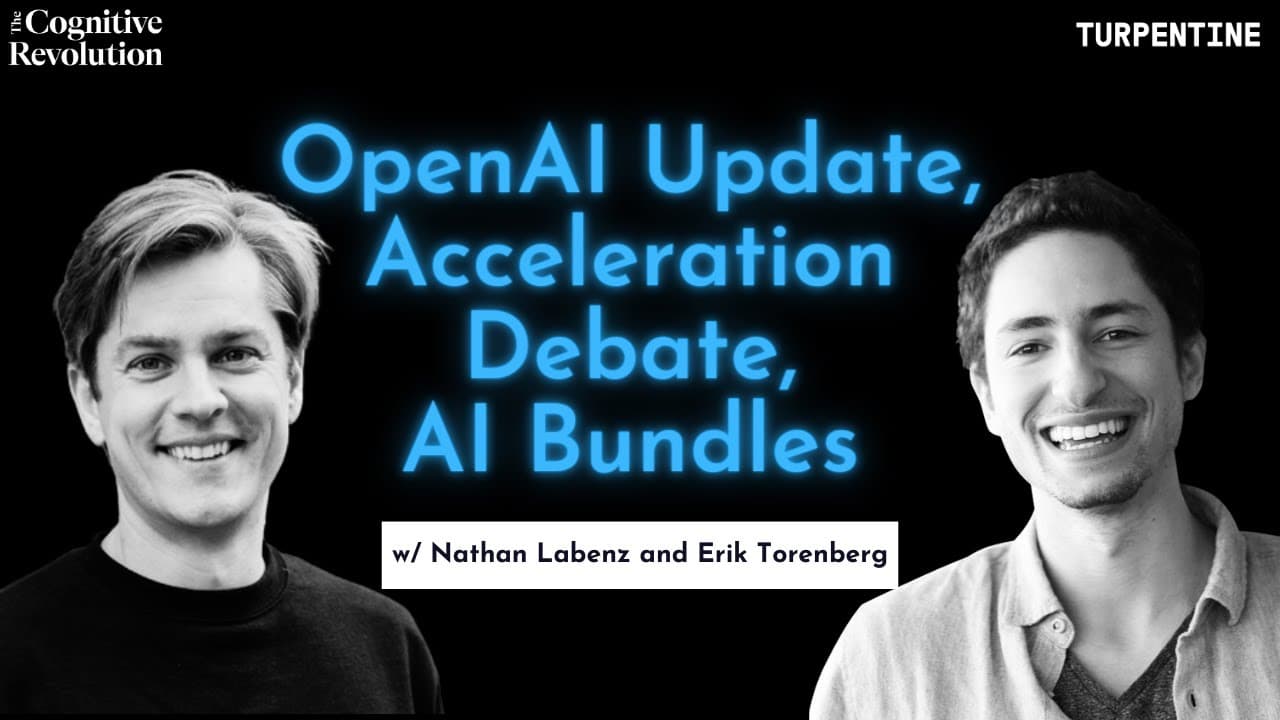
The debate on AI development focuses on whether to accelerate application development or the creation of new models. While new models like GPT-5 may offer advanced capabilities, improving existing models and applications can provide immediate benefits to users. Collaboration among AI companies could facilitate both goals.
Read in Other Languages (beta)
Share This Summary 📚
Summarize YouTube Videos and Get Video Transcripts with 1-Click
Try YouTube Summary with ChatGPT & Claude or YouTube Transcript Generator
Explore More Summaries from Cognitive Revolution "How AI Changes Everything" 📚






Summarize YouTube Videos and Get Video Transcripts with 1-Click
Try YouTube Summary with ChatGPT & Claude or YouTube Transcript Generator